Chinese Brush Pots: Function, Material and the Scholar’s Desk
中国笔筒:收纳、材质与文人书案
A Chinese brush pot, or bitong (笔筒), performs a modest task: it keeps brush handles upright and within reach. Yet the open cylinder also offers a continuous surface for carving, painting, inscription and the play of natural grain. On a scholar’s desk, practical storage and visual culture meet in one compact object.
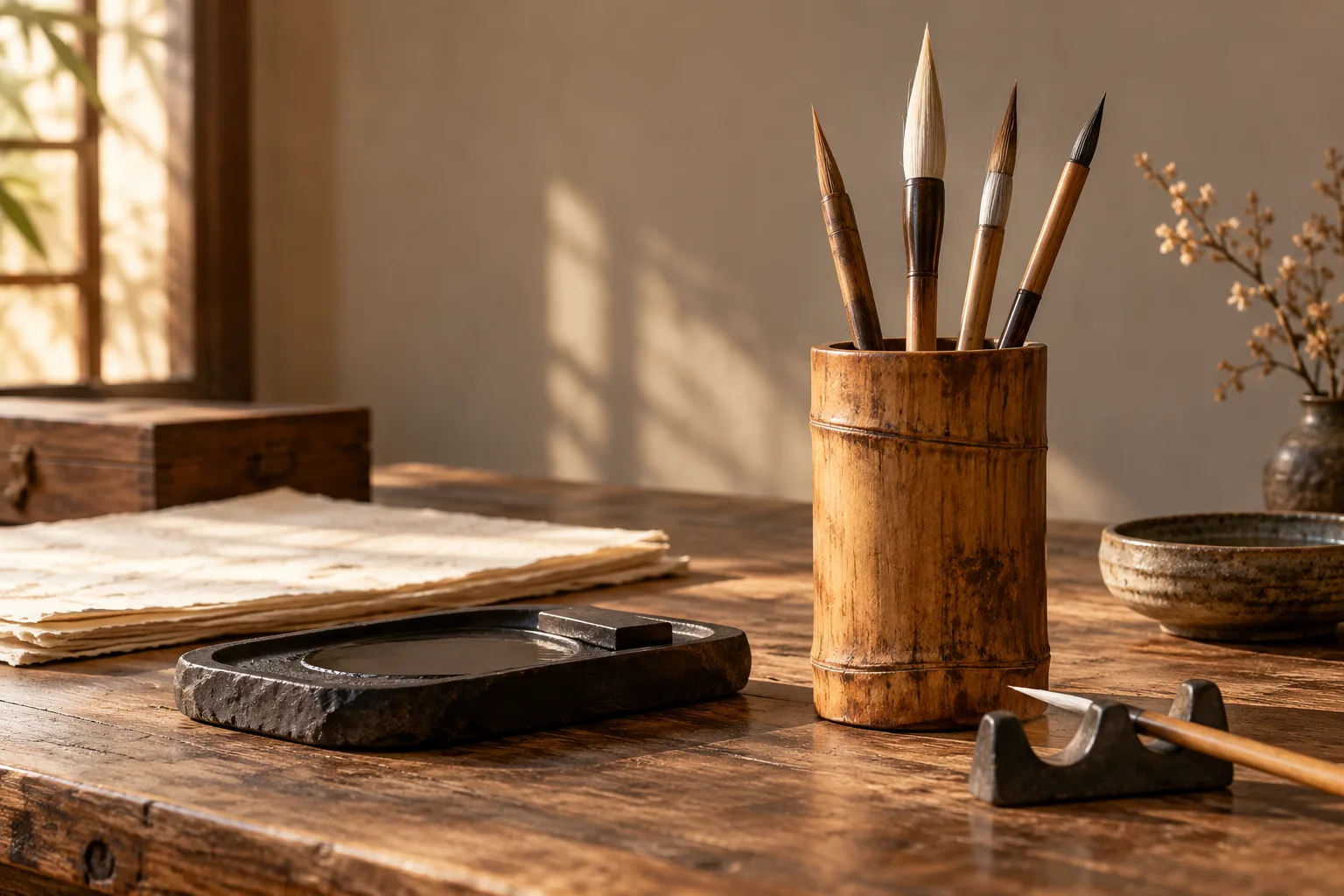
This guide begins with construction and use before turning to subject matter. It compares bamboo, wood, porcelain and stone through documented museum examples, and it keeps attribution separate from appearance. A landscape carved around a cylinder may invite learned viewing, but it does not by itself reveal the owner, maker, date or place of use.
A desk container, not a generic vessel
Its open form keeps brush handles upright
A brush pot is normally taller than it is wide, open at the top and stable enough to hold several brushes by their handles. It is storage rather than a surface on which a wet brush rests during writing. Before assigning a date or symbolism, look at the rim, interior depth, base and proportions: they explain how the object could stand, receive handles and resist tipping.
Brush pot, brush rest and water vessel do different work
The site’s guide to Chinese brush rests shows a low support that keeps a working brush from touching the table. A water dropper adds small amounts of water to the inkstone. The brush pot stores brushes upright before or after use. Museum labels sometimes vary, so identification should join the catalogue term to the object’s openings, scale and structure.
Shape comes before decoration
Many examples are round cylinders, but square, lobed and naturally irregular bodies also occur. A section of bamboo can suggest the basic form with little intervention; hardwood, porcelain or stone requires different methods of hollowing, turning, moulding or carving. Feet, a separate base, a lining or a later mount may change both stability and appearance. Record them before reading the imagery.
Materials change how the object is made and read
Bamboo and wood preserve grain as well as carving
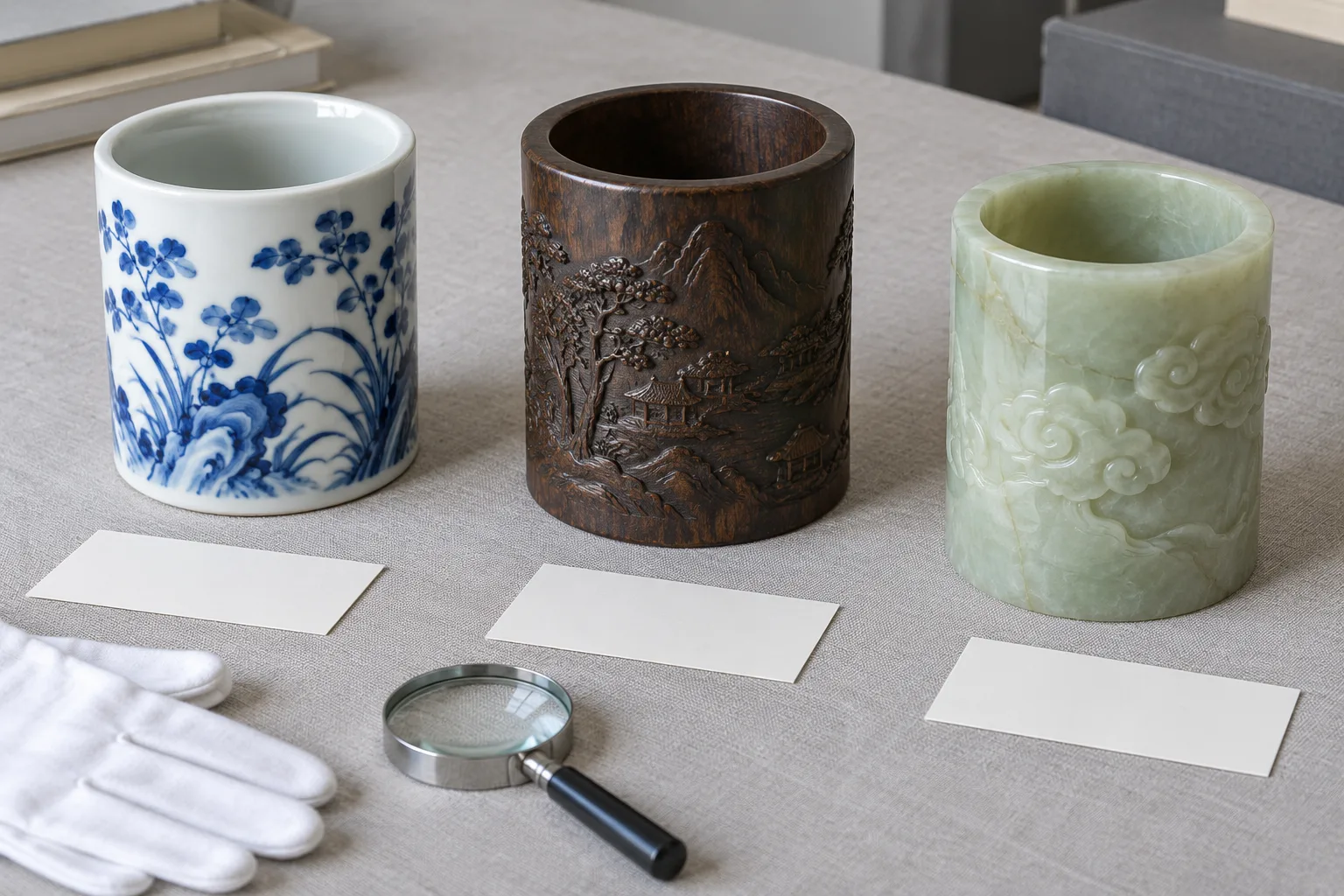
Bamboo invites a maker to work with nodes, curved walls and contrasting layers. The Palace Museum’s bamboo brush pot with pine and cranes identifies a liuqing technique in which selected areas of the glossy outer skin remain to form shallow relief. Hardwood permits deeper carving, smooth undecorated walls or the deliberate retention of a trunk-like contour. Grain, joinery and tool marks matter as much as the scene.
Porcelain joins vessel technology to painted surface
Porcelain brush pots may be moulded or thrown, glazed and painted, sometimes with a flat base and sometimes with a recessed or footed construction. The British Museum’s large blue-and-white porcelain brush pot documents figures in a landscape on a cylindrical body. A familiar palette does not by itself identify a kiln or reign; paste, glaze, foot, painting, marks and secure provenance must be studied together.
Stone changes weight, translucency and carving
Hardstone and jade examples translate the simple cylinder into a heavier, light-responsive object. The Met’s nephrite brush pot with a Daoist paradise is catalogued as Qing-dynasty China. That record supports the material, date range and museum identification of the subject. It does not make every pale green cylinder Daoist, nor does a Daoist image prove Wudang provenance or the religious identity of an owner.
The surface becomes a field for images and text
A cylinder makes viewing continuous
A scene wrapped around a pot cannot be seen all at once. Turning the object reveals successive trees, rocks, buildings or figures and can make empty space part of the composition. Carvers adjust depth to the curved wall: shallow lines may suggest distance, while deeper relief brings a foreground forward. A single catalogue photograph can therefore hide transitions and the back of the work.
Landscape and learned gatherings are subjects, not biographies
Pines, bamboo, plum, mountains, scholars and famous gatherings connect brush pots with a wider literati image world. The National Palace Museum’s boxwood brush pot with pine, bamboo and plum is catalogued through its material, carved scene and collection history. Such imagery may reward literary recognition, but it cannot demonstrate that a named scholar owned, commissioned or used the object without further evidence.
Inscriptions, signatures and marks require corroboration
A poem, cyclical date, studio name or artisan’s signature can be important evidence, yet it must be read accurately and compared with construction and provenance. Marks can be copied, added later or misunderstood. Never authenticate from a photograph of one inscription alone. Record where the text appears, how it was made, whether it crosses repairs and how the museum or specialist explains it.
Read a brush pot responsibly
Use six passes from object to context
- Identity: record catalogue title, stated date, place, material and dimensions.
- Form: examine rim, wall, interior, base, feet and any lining or mount.
- Making: distinguish carving, turning, moulding, painting, glazing and inlay.
- Surface: map grain, relief, inscription, image sequence, wear and repair.
- Function: ask how brushes could stand without assuming every cylinder was used.
- Provenance: separate documented ownership and excavation from visual resemblance.
Condition can reveal use and later collecting
Interior scratches, ink staining, worn rims or a polished base may be relevant, but each needs conservation assessment. Later feet, replacement bases, repairs and fitted boxes can belong to an object’s collecting history rather than its first manufacture. Do not fill, clean or test an antique. Practical experiments belong to modern replicas, while museum objects require trained handling.
Keep the Wudang connection evidential
Brush pots could carry Daoist landscapes, immortal figures or auspicious images, and writing desks existed in religious as well as secular settings. Still, subject matter is not provenance. An object should be called Wudang, temple-owned or connected to a named Daoist only when inscriptions, archives, excavation or continuous custody support that claim. The same discipline applies to seals and inkstones: begin with the particular object, then build the cultural interpretation.
Return to Chinese calligraphy for the wider relationship between scripts, materials and ways of looking. On the scholar’s desk, the brush pot is neither merely a container nor automatically a masterpiece; it becomes informative when function, material, image and provenance are allowed to answer different questions.