Chinese Inkstones: Stone, Carving and the Scholar’s Desk
中国砚台:石材、雕刻与文房生活
An inkstone is both a tool and an object with a biography. Its surface receives water and solid ink; its hollow may hold the liquid produced by grinding. Yet the same object can also carry geological patterns, carved images, inscriptions, collector’s seals, repairs and a fitted case. A careful reading therefore begins with what survives before turning to a celebrated stone name, an ownership story or a symbolic interpretation.
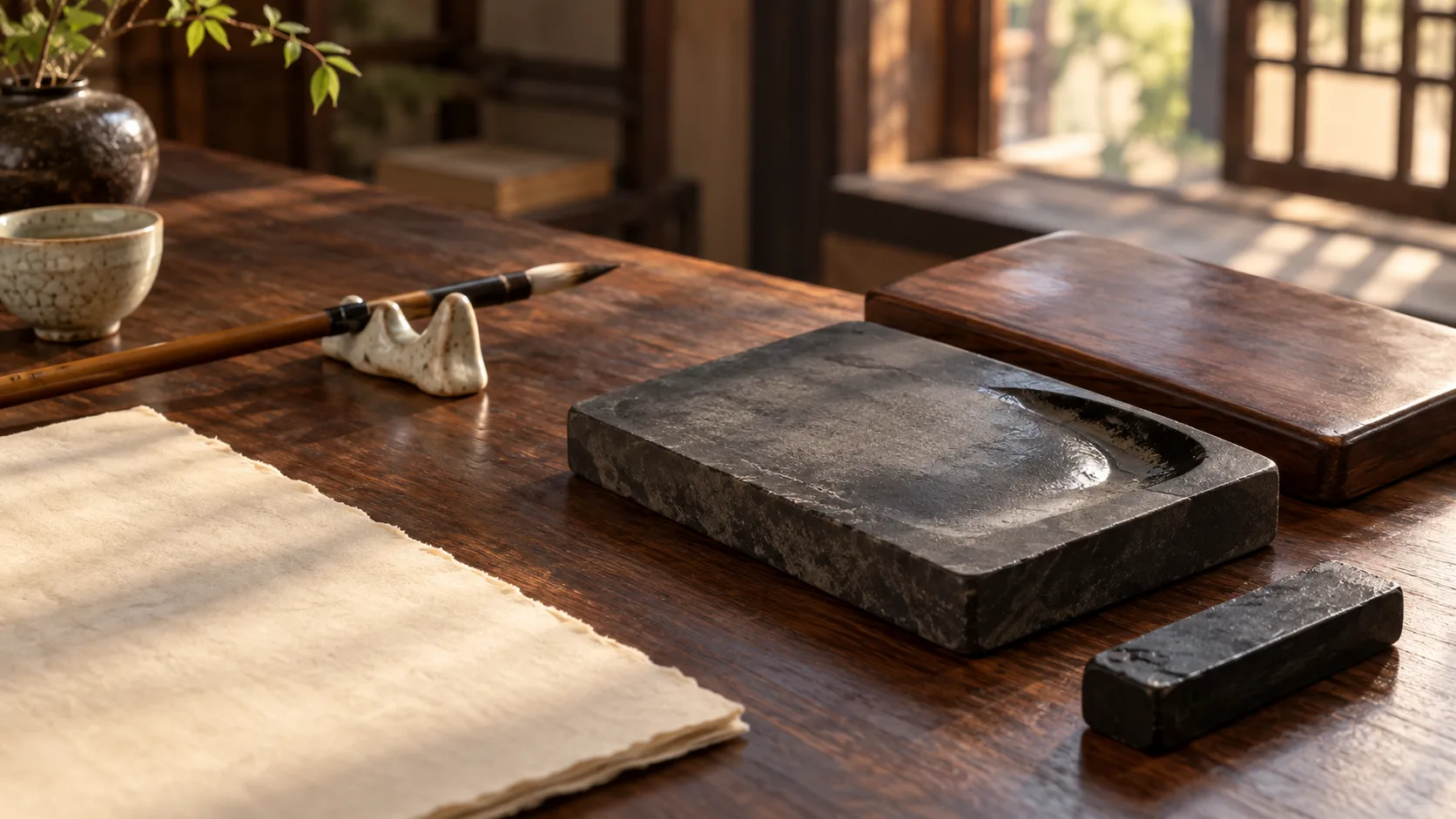
This guide complements the practical overview of writing tools by concentrating on inkstones as material objects. It does not authenticate antiques or teach conservation. To place the inkstone within the broader arts of writing, begin with Chinese Calligraphy.
Begin with a working object
Find the grinding plane and the liquid hollow
On many inkstones, a relatively flat, finely finished area provides a surface on which a solid inkstick can be worked with water. A shallower or deeper hollow may collect the resulting ink. The relation between these zones matters more than any one English label: catalogues may use “plain,” “well,” “pool” or simply describe the shape. Follow the institution’s terminology while recording what each part could physically do.
Stone is common, but not the only medium
Colour alone cannot identify a material. The Metropolitan Museum’s inkstone with Su Wu is catalogued as Duanxi slate, while its dragon-and-carp inkstone is chengni: refined clay that was filtered, kneaded, moulded, fired and then carved. “Inkstone” is therefore a functional category that can include both quarried stone and fired ceramic material.
Record dimensions, parts and case separately
Copy the museum’s measurements, object number and material before interpreting a photograph. Note whether dimensions include a cover or fitted box, and whether the base, lid and stone have separate records. The Metropolitan Museum’s bamboo-design inkstone is recorded with a wood case; treating case and stone as distinct components helps prevent a later container from being mistaken for the original carving.
Read material and carving together
Regional names require catalogue evidence
Duan and She are important names in the history of Chinese inkstones, but a dark or greenish stone is not automatically one or the other. Use the material or place wording supplied by a museum, and preserve uncertainty. The National Palace Museum’s Su Dongpo inkstone with carved lacquer box is identified as Duan stone; the Metropolitan Museum’s contemporary Moon and Cloud inkstone is slate from She prefecture. These are documented identifications, not visual shortcuts for unattributed objects.
Natural markings can guide intervention
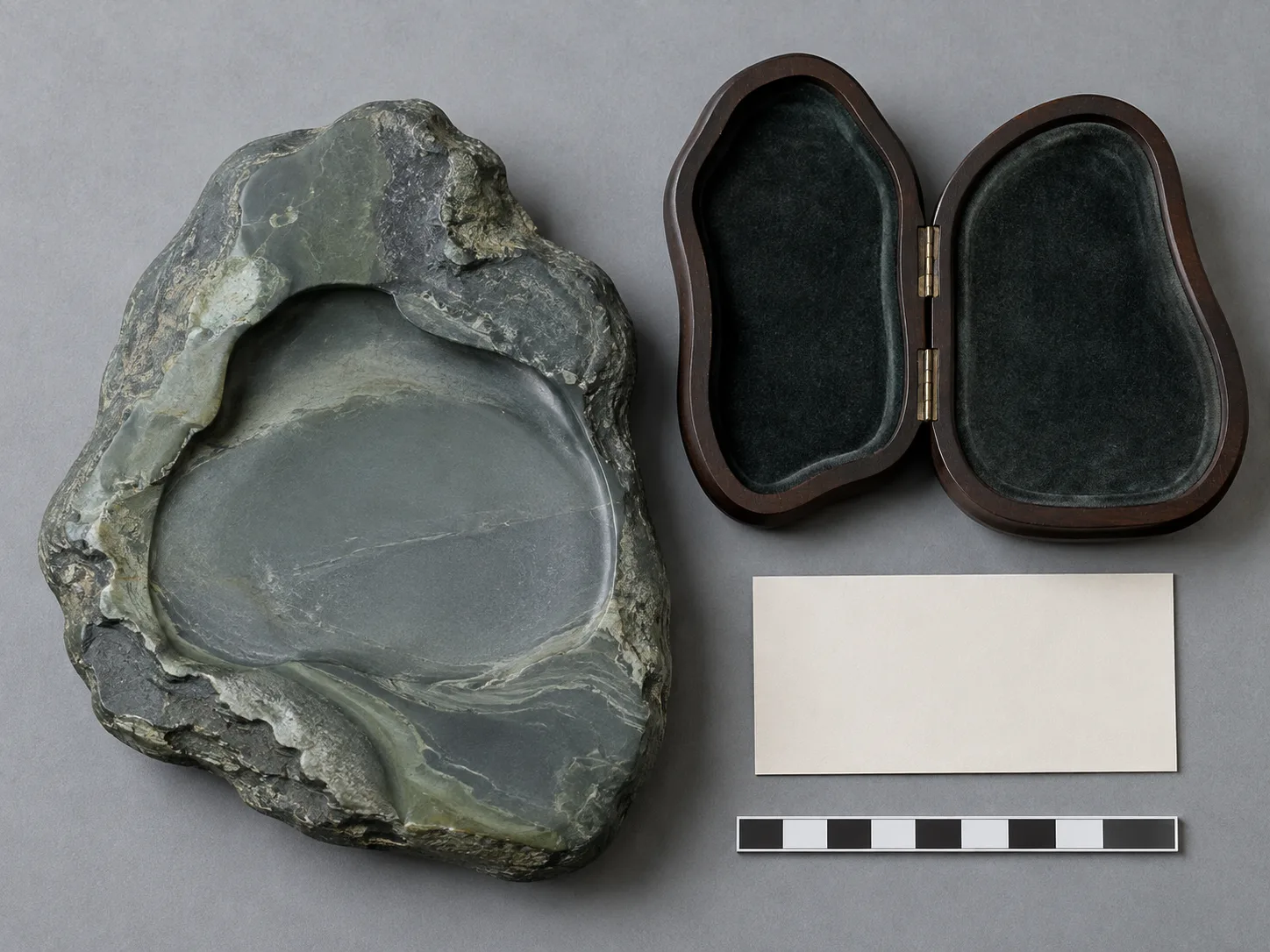
An inkstone need not conceal the character of its raw material. The National Palace Museum’s inkstone with natural form retains a smoothly rounded outer shape with only limited modification. In the Met’s Moon and Cloud, the maker used the stone’s banding to suggest clouds while leaving much of the slab visible. Compare this material-led approach with Chinese scholars’ rocks, where texture and natural form are also part of the act of looking.
Images may share space with the working surface
Carved stories and emblems can organise the margins, underside or hollow without erasing the tool’s practical zones. The Su Wu inkstone places a historical scene around fine-grained Duanxi slate; the chengni example uses a dragon and carp motif associated in its catalogue with examination success. Describe where imagery sits and what the record says before generalising its meaning. A motif documented for one work is not a universal explanation for every inkstone.
Follow inscriptions and the object’s afterlife
Read inscription, attribution and certainty together
Inscriptions may name a maker, owner, occasion, poem or later collector, but they need the same scrutiny as other evidence. The Met’s bamboo-design record says a signature has led the work to be possibly attributed to Wang Shizhen; that qualifier is essential. Consult a clear image, transcription and translation when available, and never upgrade “possibly,” “traditionally attributed” or “in the style of” into certainty. The guide to Chinese seals and seal carving explains why a mark is evidence to investigate rather than a certificate by itself.
Cases and boxes make later histories visible
A fitted case can protect an inkstone, frame it for handling and preserve a collector’s intervention. It may be contemporary with the stone or substantially later. The National Palace Museum’s Su Dongpo example combines a Duan inkstone, inscriptions and a carved lacquer box while tracing a collecting story through the Qing period. Record what the catalogue assigns to each component rather than treating the ensemble as one moment of manufacture.
Wear, residue and repair are clues, not dates
A polished depression, dark residue, chipped edge or repaired case may reflect use and care, but appearance alone cannot establish when a change occurred. Later owners may have used, cleaned or remounted an older piece. Photograph condition without scraping or washing the surface, and leave technical examination to conservators. For a related method of separating an original image from its mounting and later inscriptions, continue with how to read a Chinese hanging scroll.
Use a six-pass museum method
Start with the institution’s record
Record the museum, accession number, title, date wording, material, dimensions, provenance, bibliography and access date. Distinguish what the record identifies from what you infer from the image. The National Palace Museum’s essay on objects in the scholar’s studio shows how inkstones joined brushes, ink and paper within a changing culture of use and collecting; it is context, not proof of one object’s owner.
Move through six questions
- Function: Where are the grinding plane, liquid hollow, rim and working edge?
- Material: What does the catalogue identify—stone, slate, refined clay, wood or mixed media?
- Making: Which areas were cut, polished, carved, moulded, fired or left close to natural form?
- Images and words: Where are motifs, inscriptions, seals and signatures, and how securely are they interpreted?
- Provenance: Which owners, sales, gifts or collection transfers are documented, and where are the gaps?
- Afterlife: How have use, cases, repairs, cleaning and display shaped what is now visible?
Study antiques; use only a suitable modern stone
Do not grind ink on, add water to or clean a historic object. Liquids, abrasion and residue can damage surfaces and erase evidence. Practise with a stable modern inkstone intended for use, following the maker’s care instructions. Compare its working surface with modern teaware through clay, glaze and form, and use Chinese ink rubbings to explore a different relationship between ink, surface and recorded marks.