Chinese Brush Rests: Mountains, Materials and the Scholar’s Desk
中国笔架:山形、材质与文人书案
A brush rest is easy to overlook. It may be only a few centimetres long, yet it changes the working surface: a damp brush can pause above the table instead of rolling, staining paper or flattening its point. In Chinese it is commonly called bǐjià (笔架, “brush support”) or bǐgé (笔格). Surviving examples also show that this modest task became an occasion for ceramics, metalwork, hardstone carving and miniature landscape.
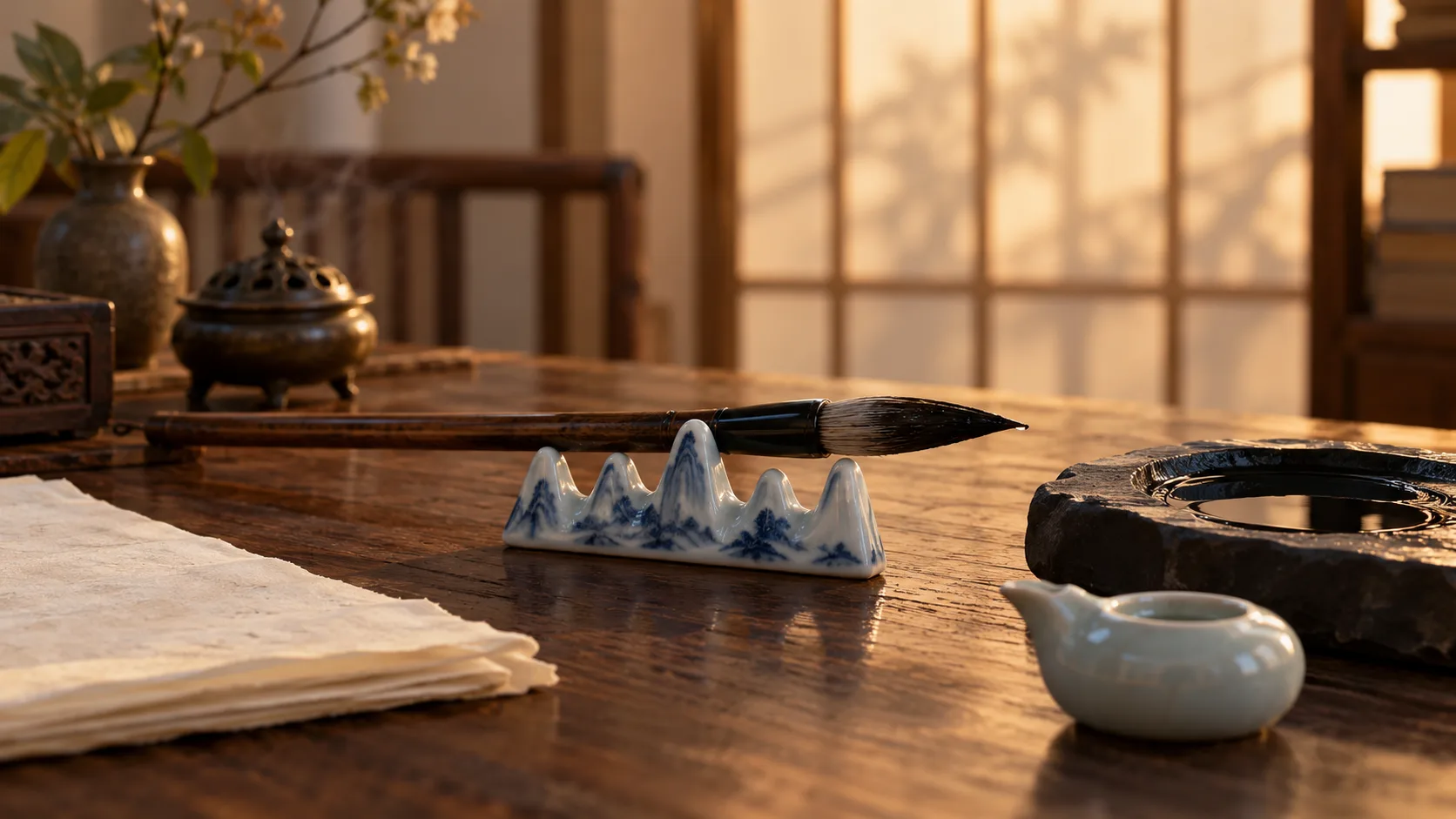
A small tool with two lives
What the rest does
The simplest rest provides one or more hollows between raised points. The shaft lies across a hollow while the wet tip projects clear of the object and desk. This is a temporary pause, not long-term storage: dry brushes may stand in a brush pot, while a brush rest belongs beside the active writing area. Its usefulness is easiest to understand alongside the brush, inkstone and paper on a working desk.
Beyond the Four Treasures
Brush, ink, paper and inkstone are conventionally grouped as the Four Treasures, but a studio contained many supporting objects. The Hong Kong Palace Museum lists brush pots, brush rests, water droppers, paperweights and seals among accessories that served practical and aesthetic purposes. The National Palace Museum likewise describes a scholar’s table where tools in varied materials joined use with display. A brush rest is therefore best read as part of an ensemble, not as an isolated ornament. Begin with the Four Treasures of the Study, then notice what the writing process required around them. Hong Kong Palace Museum: scholar’s objects; National Palace Museum: utensils of the scholar’s study.
Rest, pot, washer and water dropper
Modern English labels can blur different jobs. A brush pot stores several brushes upright; a brush washer is a vessel for rinsing; a water dropper meters water for ink; a rest supports a brush horizontally during work. Some historical objects combine functions, so form must be inspected rather than inferred from a translated title alone. The Palace Museum’s collection overview places brush rests among a much larger family of studio implements. Palace Museum: scholars’ implements.
Reading form, material and making
Why peaks work
A row of peaks naturally creates saddles for one or more shafts, which helps explain the frequency of mountain-shaped rests. Mountains also turn a practical support into a tiny landscape. The Palace Museum records three- and five-peak forms, twelve-peak forms, animal shapes and pieces of naturally expressive wood. A five-peaked porcelain example in the British Museum makes the functional rhythm especially clear: peaks separate brushes while the low base keeps the object stable. Palace Museum: bronze brush rest; British Museum: peaked porcelain brush rest.
Material changes the experience
Porcelain can make a crisp, washable ridge; metal permits casting, engraving and inlay; jade, crystal and other hardstones invite close looking at polish, translucency and natural colour; bamboo and wood bring grain and lightness. These are observations about possibilities, not a rule for dating. The Metropolitan Museum’s rock-crystal hill rest is specifically dated 1793, while its pewter-and-brass mountain rest is dated to the seventeenth century. Material alone does not supply a secure date. The Met: rock-crystal hill rest; The Met: pewter mountain rest.
Decoration is evidence, not a codebook
Peaks, beasts, flowers and auspicious motifs can carry associations, but meaning depends on period, workshop, patron and context. The Met’s seventeenth-century pewter example combines a five-peak form with mythical beasts and brass foil. A deep-purple Yixing-clay rest at the National Museum of Asian Art is interpreted by that museum through plum-blossom-like purity and resolve. Such readings should stay attached to the documented object; they should not be automatically transferred to every rest with a similar colour or contour. National Museum of Asian Art: Yixing brush rest.
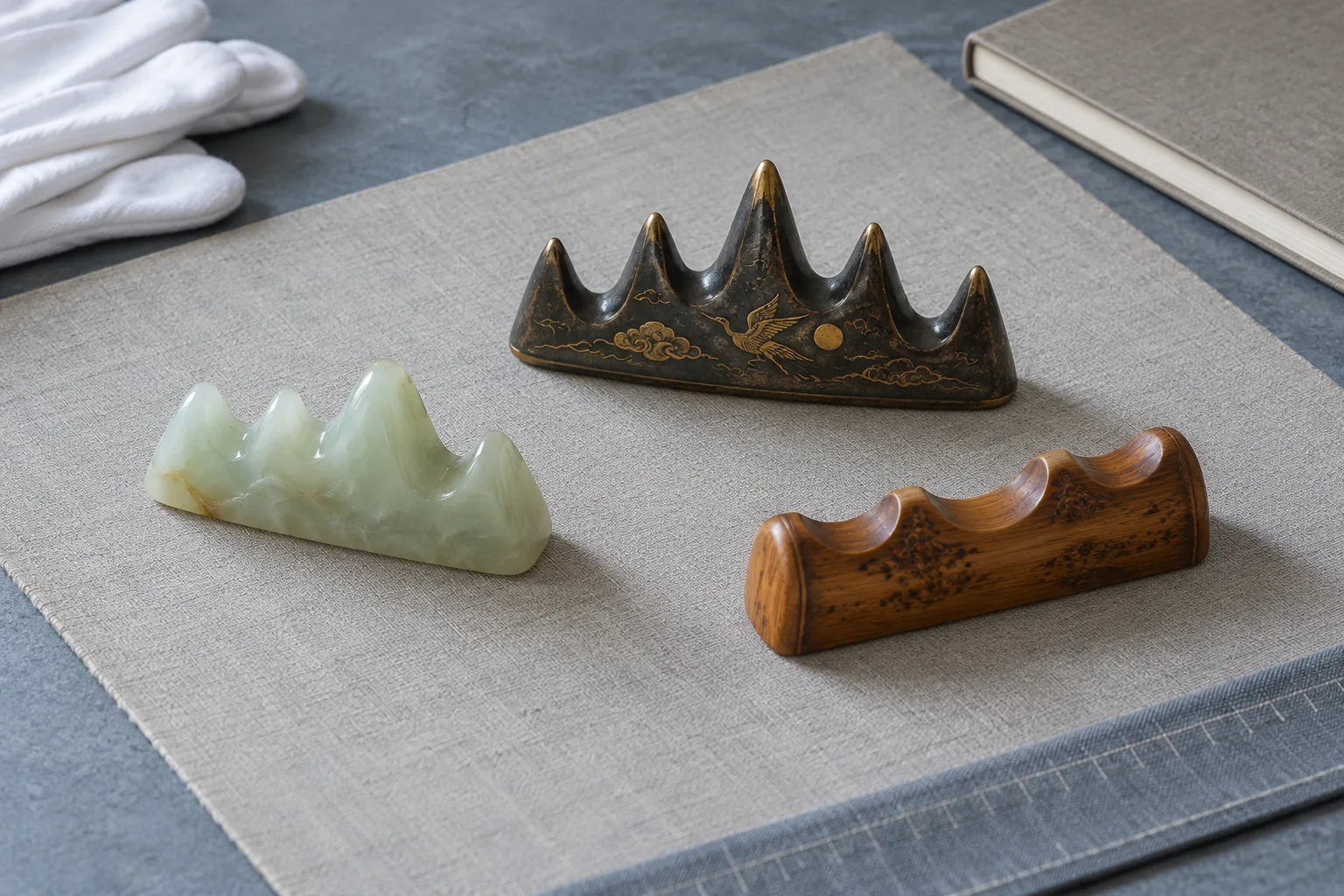
What surviving objects can—and cannot—tell us
Start with the museum record
A useful object page separates title, date, material, dimensions, provenance and curatorial interpretation. Keep those fields distinct. “Qing dynasty,” “1793” and “rock crystal” are different kinds of information; one should not silently expand them into a story about a named owner or workshop. The same discipline matters when reading seals, inksticks and other small studio objects.
Look for contact and scale
Dimensions reveal whether a groove could plausibly take one shaft or several. Rounded saddles may protect a handle; a broad base resists tipping. Surface wear, ink traces or repairs can be suggestive, but absence of visible wear is not proof that an object was never used. Polished and precious examples could move between practice, display, gift exchange and collecting. Treat function as a question tested against form and evidence, not a certainty supplied by beauty.
Avoid a single origin story
Literary references, excavated objects, transmitted collections and later catalogues do not always align neatly. Museum databases also revise attributions as research advances. It is safer to say that brush rests have a long documented presence in Chinese writing culture and that surviving examples span different materials and periods than to name an unsupported inventor or absolute first example. Date the particular object in front of you, and mark uncertainty openly.
A six-pass method for looking
Read the object in order
- Name the job. Identify where a brush shaft could rest and how the tip would remain clear of the table.
- Measure the rhythm. Count peaks, grooves or sockets; compare their spacing with the stated dimensions.
- Identify material cautiously. Use the museum record before guessing stone, ceramic, metal, bamboo or wood from colour alone.
- Separate making from decoration. Note casting, carving, moulding, glazing, engraving, inlay and polish before interpreting motifs.
- Read the record. Keep dynasty, precise date, attribution, provenance and curatorial commentary in their proper categories.
- Test the story. Ask which claims are visible, which are documented and which remain plausible but unproved.
Using a rest today
Choose a stable base with smooth contact points and enough width for the brushes you actually use. Place it where the loaded tip cannot touch finished paper or sleeves. Wipe splashes promptly, following the needs of the material; do not imitate museum conservation methods on a modern practice tool. The rest supports pauses, but brush control still comes from posture, loading and movement, explored in Chinese calligraphy brushwork.
Continue through the desk
Follow the object back into the full calligraphy section. Compare how absorbency changes on calligraphy paper, how the inkstone organises water and ink, and how the brush returns to a point. The brush rest is small, but it makes the desk legible as a sequence of actions: prepare, write, pause, adjust and begin again.