Chinese Inksticks: Soot, Moulds and the Scholar’s Desk
中国墨锭:烟料、墨模与文房生活
A Chinese inkstick is a working material, but it can also be a designed object with a name, image, inscription, box and collection history. Soot and glue make the dark solid that releases ink when gently ground with water. A carved mould can turn that material into a rectangle, disk or other form whose relief and words invite a second kind of reading.
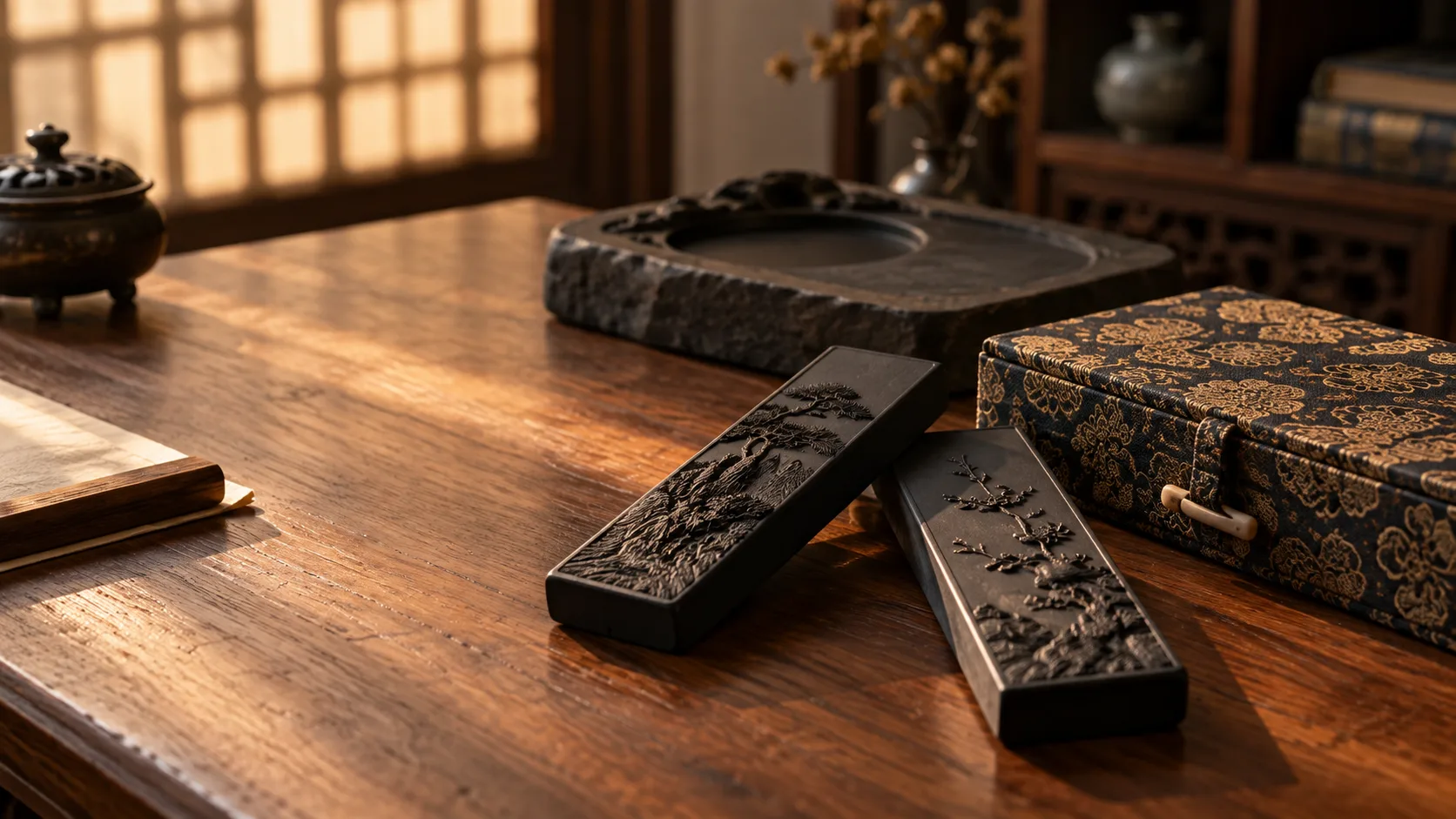
This guide complements the practical account of ink in the Four Treasures of the Study. It concentrates on surviving inksticks as material evidence rather than ranking recipes or authenticating antiques. For the larger setting in which brush, ink, paper and stone meet, begin with Chinese Calligraphy.
From soot to solid ink
Carbon provides the colour
Traditional black ink is carbon based. Museum accounts describe carbon collected from burning resinous pine or vegetable oil, commonly distinguished as pine soot and lampblack. The National Museum of Asian Art’s technical introduction to ink emphasises that these fine particles must be held together before they can become a portable solid. A photograph cannot reliably reveal which soot source or recipe was used; preserve the museum’s wording instead of diagnosing a formula by colour.
Glue binds, moulding shapes and drying sets
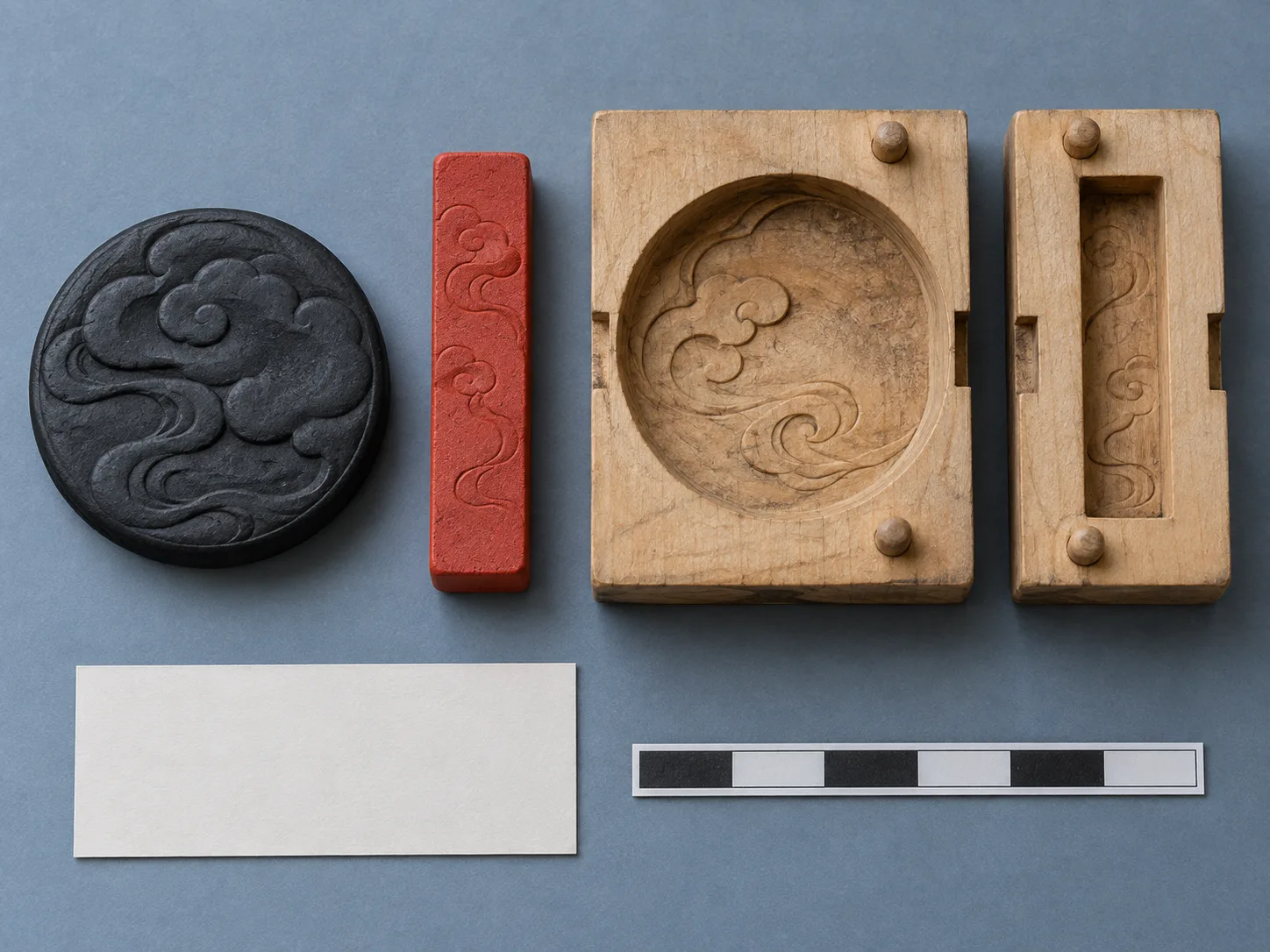
Animal glue is mixed with the carbon, and documented recipes may include other ingredients or surface decoration. The prepared mass is pressed into a carved mould and dried. The British Museum’s dated 1621 ink cake explains this sequence and shows how a working substance could hold crisp relief. “Inkstick,” “ink cake” and “ink tablet” describe overlapping forms in English catalogues; use the title chosen for the object while noting its actual shape.
Grinding turns a solid into liquid
A small amount of water and repeated controlled grinding release suspended carbon into usable ink. The maker, binder, age and storage history all affect how a particular stick behaves, so appearance is not a dependable quality test. Study historic pieces without wetting or rubbing them. For the working surface that receives the stick, continue with Chinese inkstones.
Moulds turn material into image
Form can carry pictures and words
Rectangles are familiar, but round cakes and other shapes also survive. Reliefs may show landscapes, plants, animals, auspicious subjects or historical allusions; inscriptions can name a design, maker, patron or date. The Metropolitan Museum’s round ink cake with cyclical imagery, dated to the late nineteenth or early twentieth century, combines zodiac animals, a Western-style clock face and a poem. Its catalogue identifies ink with gold, reminding us that surface colour is part of an object-specific record rather than a universal recipe.
A motif needs its own evidence
The British Museum’s 1621 cake places a “One Hundred Swallows” design after a painting on one face, a colophon-like inscription on the other and a dated record on the side. Its catalogue interprets the swallows as a rebus for one hundred officials. That reading belongs to this documented work; a bird motif elsewhere does not automatically carry the same meaning. Use inscriptions, comparison and curatorial research together, just as a carved mark is approached in Chinese seals and seal carving.
Designs could circulate beyond one object
Late-Ming ink makers Cheng Dayue and Fang Yulu were associated with illustrated design compendia as well as decorated ink. The National Palace Museum records an original Wanli-period imprint of Cheng’s Garden of Ink Cakes, written and edited by Cheng Dayue. A printed design book is evidence for the circulation of images, not proof that every later cake bearing a famous name came from a sixteenth-century workshop.
Read names, sets and boxes carefully
A maker’s name and an object’s date may differ
The Met catalogues an ink tablet decorated with five pines under the name Cheng Junfang, yet dates the surviving work to the late Qing or early Republic period—centuries after the named Ming maker’s lifetime. The record discusses literary allusions in the pine and stag designs. Keep all parts of such a catalogue entry together: artist or workshop attribution, production date and motif interpretation answer different questions.
Sets connect objects to manufacturers
A set can preserve a coordinated programme of shapes, decoration and packaging. The National Museum of Asian Art’s set of four inksticks is dated 1871, made of soot and glue with gold pigment and lacquer, and attributed to the Hu Kaiwen Ink Shop, established in 1765. Those details support a specific manufacturing history; they do not turn every gilded or shop-marked stick into the same product.
Boxes and provenance belong to the biography
The National Museum of Asian Art’s 1891 inkstick in a brocade-covered box distinguishes soot-and-animal-glue ink with gilding from a paper box covered in silk brocade. Its provenance traces the object from collector Pang Yuanji to Charles Lang Freer in 1918 and then into the Freer collection. Recording inkstick and container separately makes material, ownership and later presentation visible.
Use a six-pass museum method
Begin with the catalogue, not a visual guess
Record the institution, accession number, title, date wording, dimensions, materials, manufacturer or attribution, provenance and access date. Separate what the catalogue states from what you infer. Gold, lacquer, cinnabar colour, fragrance and unusual shape are documented for particular works, but no single decorative feature proves age or quality.
Move through six questions
- Material: What carbon, binder, pigment, gilding, lacquer or mixed media does the record identify?
- Making: What is known about mixing, moulding, drying, finishing and packaging?
- Form: Is the object a stick, cake, tablet, set or part of a larger writing ensemble?
- Images and words: Which motifs, inscriptions, names and dates are transcribed or interpreted?
- Use and condition: Is there documented grinding, wear, cracking, repair or unused presentation?
- Provenance and afterlife: Which makers, shops, owners, gifts, boxes and collection transfers are supported?
Practise with modern ink, protect historic objects
Never grind, wet, clean or test a historic inkstick. Water and abrasion consume the object, while uncertain ingredients may present conservation or sensitivity concerns. Use a modern stick intended for practice, keep it dry between sessions and follow its maker’s care instructions. Bottled ink is a practical modern choice, not a lesser cultural experience. To compare other ways ink and relief preserve marks, visit Chinese ink rubbings; to follow how images, inscriptions and later ownership share one format, read how to read a Chinese hanging scroll.