Chinese Paperweights: Form, Material and the Scholar’s Desk
中国镇纸:形制、材质与文人书案
A Chinese paperweight can be a long bar laid across a sheet, a compact animal in metal, or a polished form in hardstone. Its basic task is modest: to steady loose paper on the writing table. Yet surviving objects also show careful casting, carving, auspicious imagery and histories of court or private collection. Function and appreciation therefore meet in the same small object.
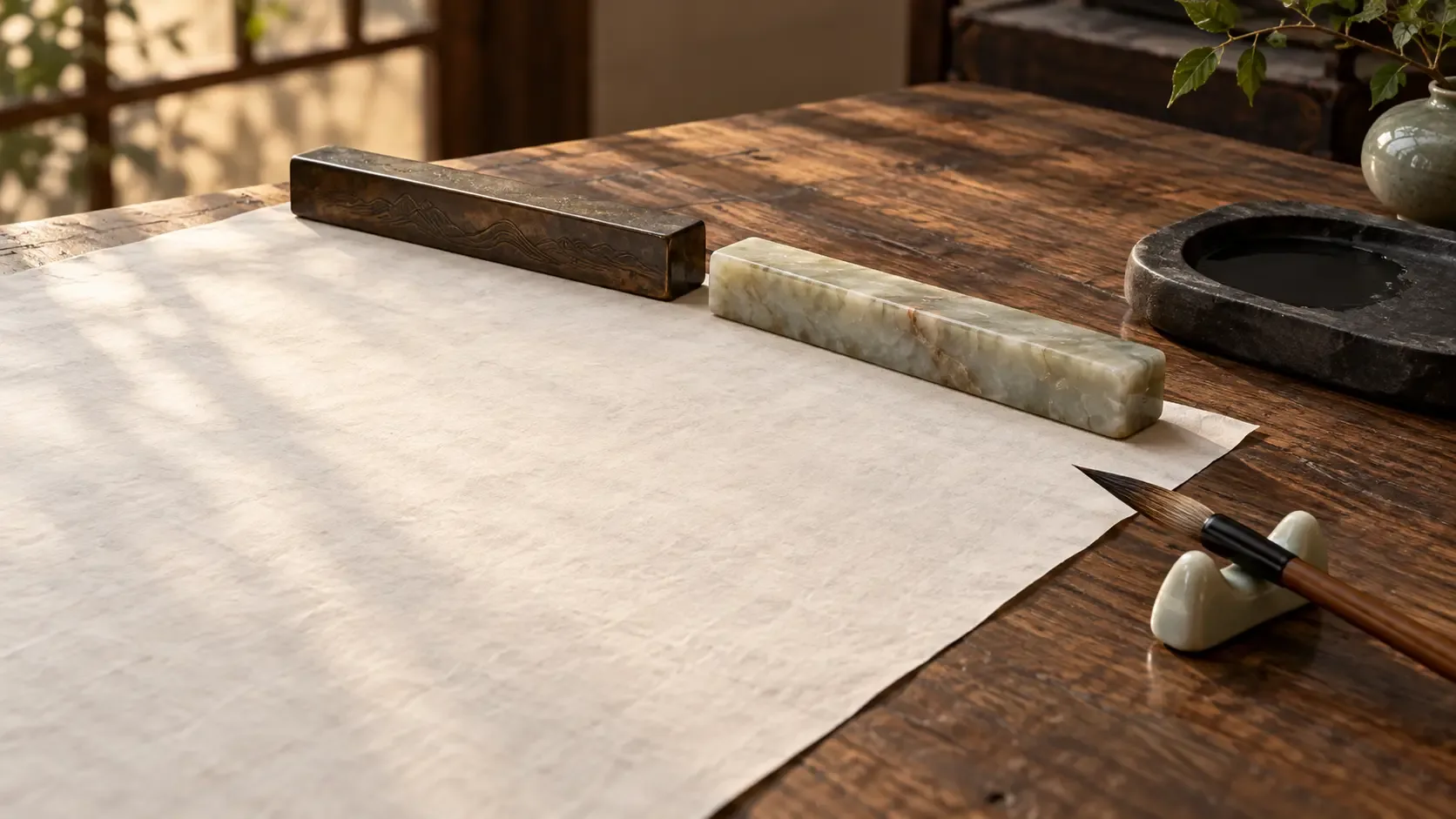
This guide uses dated museum records as specific evidence rather than treating every paperweight as one timeless type. It belongs beside our guides to the Four Treasures of the Study and Chinese calligraphy paper. The familiar terms zhenzhi (镇纸) and zhenchi (镇尺) can overlap in modern usage; the latter often suggests a ruler-like bar. For a historic object, follow the collection record, dimensions and construction before choosing a name.
Begin with pressure, placement and the sheet
A paperweight assists the moving hand
Brush writing takes place on light, flexible material. A weight can keep an unused edge from lifting, limit a sheet’s movement as the brush changes direction, or help manage a curl. It does not flatten every crease or replace a suitable working surface. The needed weight and placement depend on the paper, the size of the sheet and the writer’s movement.
Long bars distribute pressure along an edge and can be moved as work advances. A compact sculptural weight concentrates pressure in a smaller area. Neither form is automatically earlier, more authentic or more useful. Ask first what the object could physically do, then how its decoration changes the experience of the desk.
The writing table held more than four famous tools
The Hong Kong Palace Museum’s account of a Qing court case of scholar’s objects places paperweights alongside brush pots, brush rests, water droppers and seals around paper, brush, ink and inkstone. It explains that the fitted compartments of such cases protected objects of different shapes and materials, and that some cases could unfold into tables. A paperweight should therefore be read as one element in an arranged working system, not as an isolated ornament.
Recognize several forms without forcing one origin story
Bar-shaped weights make their function visible
A low rectangular bar has an obvious working logic: its length can secure a paper edge while leaving much of the surface open. Bars may be plain or decorated, single or paired. A ruler-like appearance does not prove that a piece was used for measuring, just as a modern trade name does not establish an old date. Look for dimensions, wear, inscriptions, a fitted box and reliable ownership history.
Animal figures join useful mass to imagery
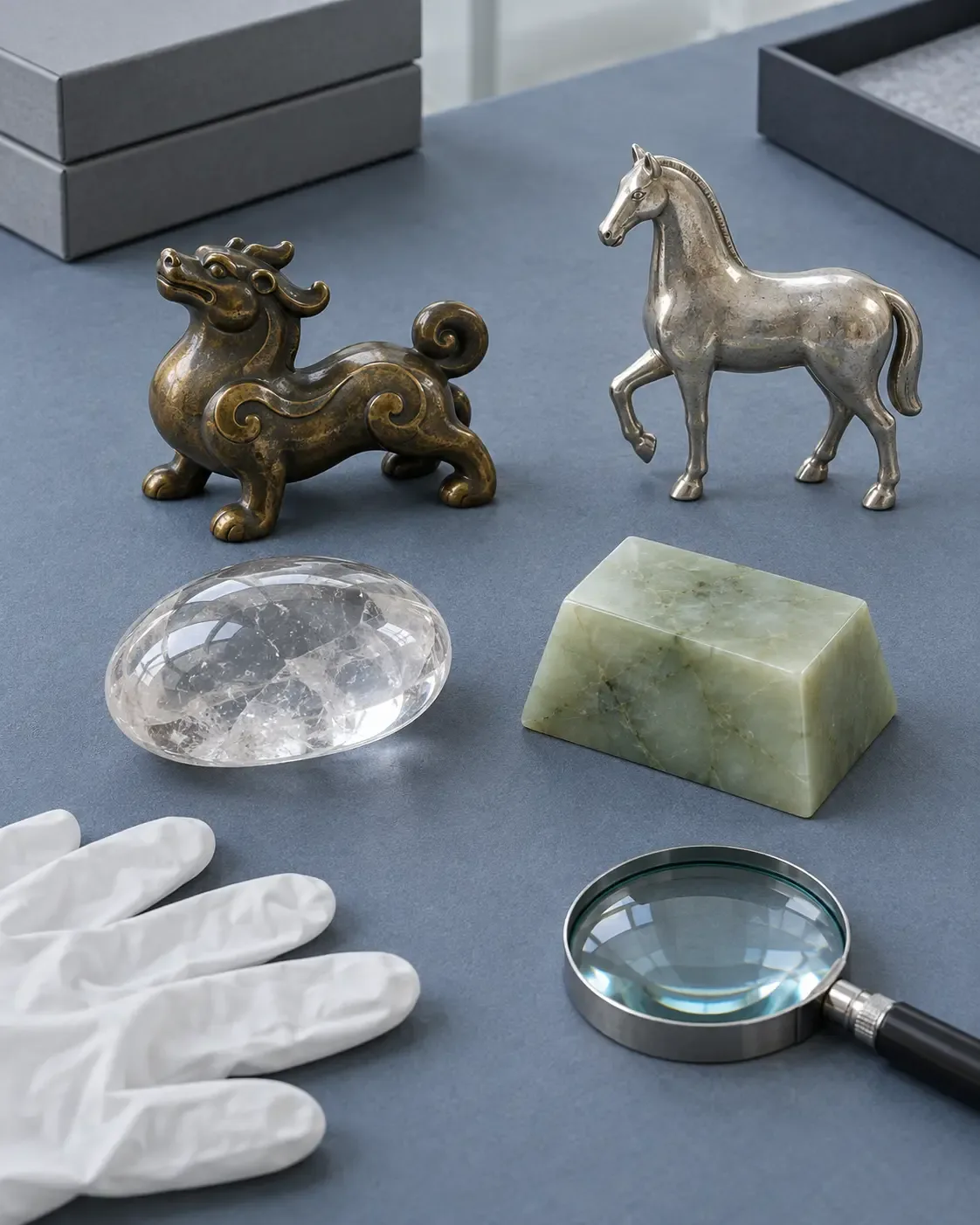
The Metropolitan Museum of Art identifies a fifteenth- to sixteenth-century copper-alloy qilin as an auspicious ornament or paperweight for a scholar’s desk. Its catalogue connects the creature, in a Confucian tradition, with the appearance of a sage ruler. That interpretation belongs to this documented object and context; it should not turn every animal-shaped weight into the same symbol.
A thirteenth- to fourteenth-century silver-and-lead standing horse at the same museum “may have served” as a paperweight. The cautious wording matters. A stable base and useful mass support the possibility, but the record does not present the function as certain. Museum verbs such as “served,” “may have served” and “possibly” carry different evidential weight.
Let material narrow the questions
Metal permits casting, fine modeling and concentrated mass
Bronze and other copper alloys can carry modeled bodies, chased details, gilding or patina; silver offers a different color, value and working history. Examine seams, hollow areas, fills, repairs and corrosion before assuming that an apparently solid figure has one uniform weight. Never polish an old surface merely to make the metal brighter: patina, residues and tool marks can belong to the object’s history.
Hardstones turn translucency and color into part of the desk
The Met catalogues an eighteenth-century rock-crystal paperweight and a Qianlong-period jadeite paperweight. These entries show that “paperweight” can describe objects in very different stones and shapes. Material identification must come from the record or analysis, not color alone: pale green does not automatically mean jade, and transparency does not by itself identify rock crystal.
Stone invites attention to polish, inclusions, carving and the way light travels through an object. Those qualities may make a paperweight pleasing to handle or display, but visual appeal does not erase use. Equally, a catalogue title describing function does not prove that every surviving surface mark came from daily writing.
Read imagery, attribution and collection history separately
Auspicious motifs are object-specific evidence
Animals, plants, clouds and archaizing patterns may carry literary, political or auspicious associations. Begin with what the catalogue actually identifies, then ask whether an inscription, comparable object or documented setting supports a fuller reading. Avoid assigning a fixed Daoist, Buddhist or Confucian meaning to a motif merely because it appears on a scholar’s object.
Labels preserve uncertainty as well as knowledge
A museum title, date range and medium are research conclusions, not a transcript of the object. They may change as curators compare new evidence. Record the accession number and wording you consulted. Distinguish a dynasty label from a precise production date, a collector’s attribution from a modern curatorial one, and a fitted court set from a later group assembled for sale or display.
Use a six-pass method in a museum or study collection
Move from structure to context
- Identity: note the catalogue title, date range, place, medium, dimensions and accession number.
- Footprint: observe the base, length, height and the area that could contact paper.
- Mass: infer cautiously whether the object is solid, hollow, filled or mounted; do not lift a collection object without permission.
- Surface: separate casting, carving, polish, gilding, patina, wear and later repair.
- Image: identify the motif only after describing the physical form; test symbolism against object-specific evidence.
- Context: ask whether the record documents a writing table, fitted case, court workshop, private collection or later reclassification.
Preserve the difference between looking and testing
Do not place a historic weight on fragile paper, rub its base, remove tarnish or test whether it “works.” Collection handling belongs to trained staff following institutional procedures. For calligraphy practice, use a stable modern weight with smooth, clean contact surfaces and enough mass for the chosen sheet. Keep ink and water away from valuable objects.
A small object can reorganize the whole desk
A paperweight reveals that calligraphy depends on more than the brush tip. Paper behavior, hand movement, clear working space and the sequence of tools all matter. It also shows how practical equipment could become sculpture, precious material and a bearer of cultivated associations without ceasing to be equipment.
Continue with Chinese brush rests to compare another accessory that combines use and display, or return to the calligraphy overview. Readers interested in attentive practice can also explore calligraphy and Taoist cultivation, while keeping the material history of a paperweight distinct from claims about any owner’s religious identity.