Chinese Brush Washers: Water, Form and the Scholar’s Desk
中国笔洗:洗笔、造型与文人书案
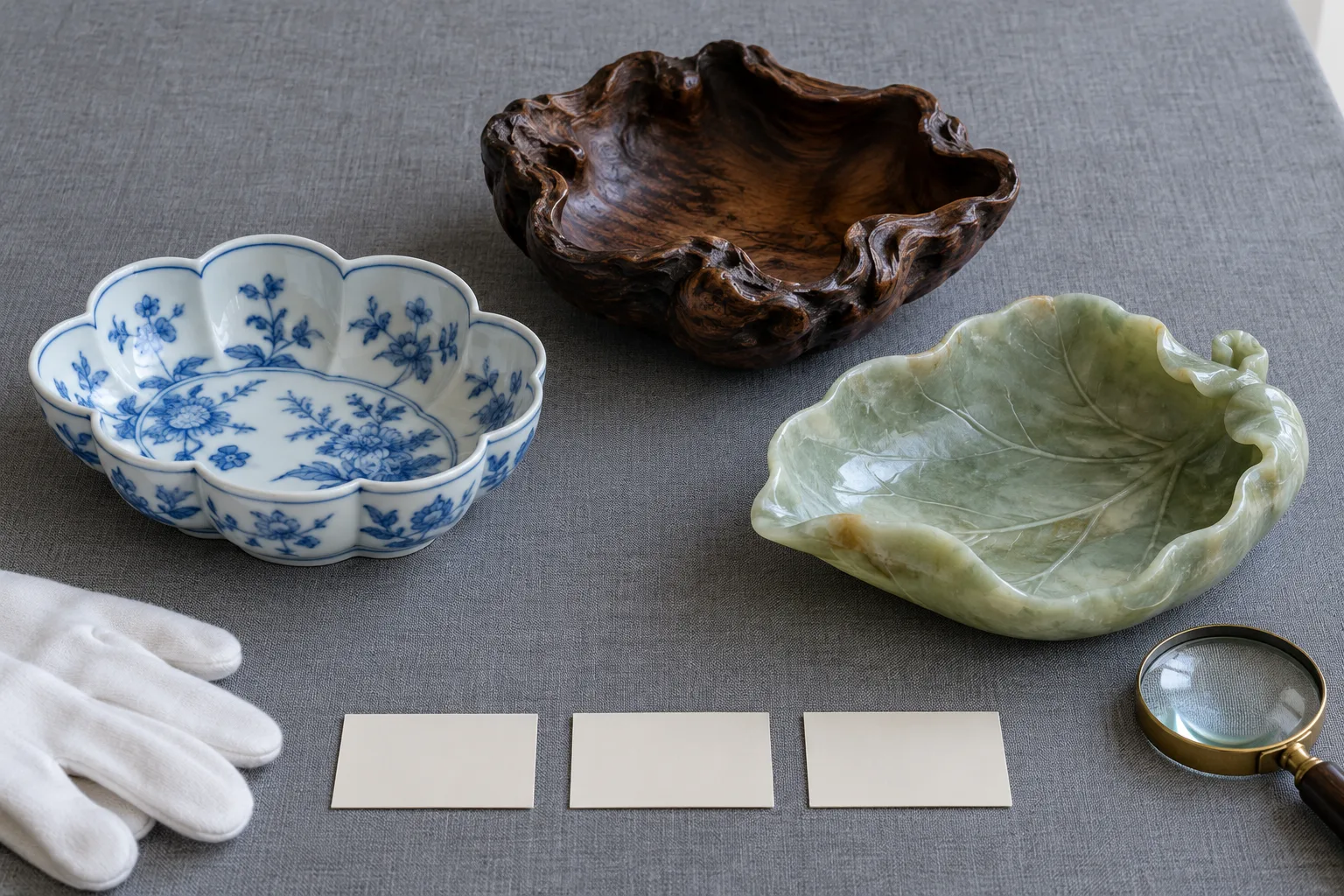
A Chinese brush washer, often called a bixi (笔洗), holds water for rinsing an ink-laden brush. Its job seems simple, but the form sits at an unusually rich crossing of writing practice and object making. A shallow porcelain basin can turn glaze into a pool of colour; burl wood can preserve knots and whorls; jade or another stone can transform a leaf, fruit or archaic vessel into a compact desk object.
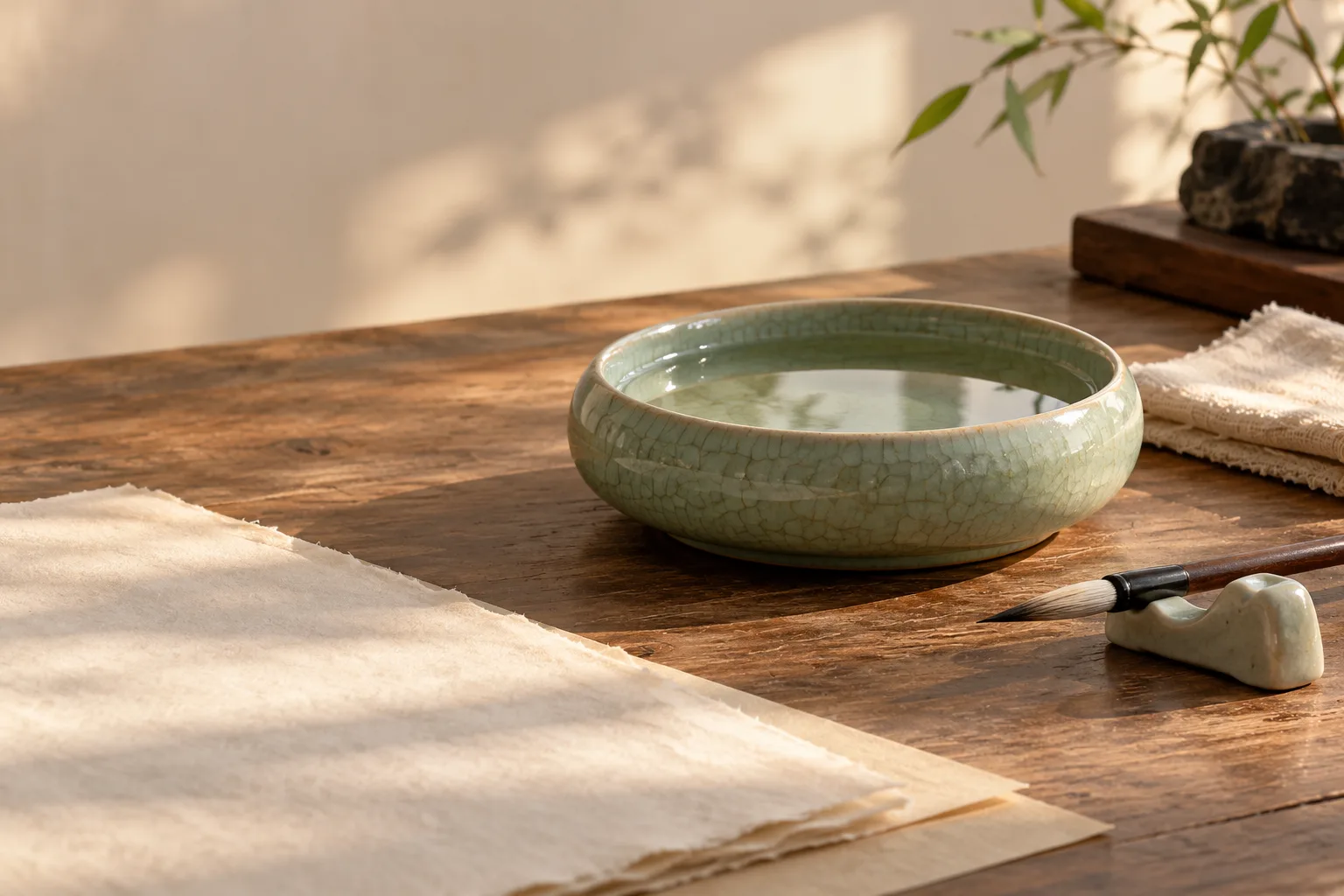
This guide starts with what the vessel could do, then asks how material, shape, condition and museum documentation change what we can responsibly say. “Brush washer” is not a self-evident visual category: catalogues may distinguish a water pot, washer or small dish differently, and an older vessel could later be reassigned to the scholar’s desk. Function is therefore a question to investigate, not a label to project onto every shallow bowl.
Begin with water and the working brush
Rinsing is different from storing or metering
A washer receives the brush and the water loosened from its hairs. That differs from the upright storage provided by Chinese brush pots, the low temporary support of brush rests, and the controlled addition of drops from water droppers. These objects can appear together, but each manages a different moment in the writing process. A convincing identification should match the proposed action to the vessel’s opening, depth, stability and scale.
A broad opening makes rinsing plausible
Many documented washers have a broad mouth and a low or moderately deep basin, allowing a wet brush to enter without striking a narrow neck. A stable foot or flat base limits spilling. Yet these features are not exclusive to washers; dishes, water pots and other containers can share them. The National Palace Museum catalogues a Jun-ware object of the twelfth to fourteenth century as a water pot or brush washer. Residual ink supports a history connected with writing, while the double label preserves uncertainty rather than pretending the original use is settled.
Names and uses can change over time
Later collectors could bring older or differently intended vessels onto the desk. A National Palace Museum catalogue entry for a Ming jade rectangular washer cites the brush-washer discussion in Wen Zhenheng’s Changwu zhi and notes that forms not originally made as washers could be repurposed. This is a useful warning: catalogue name, original manufacture and later use are related evidence, not interchangeable facts.
Materials change form and handling
Porcelain makes glaze part of the basin
On a ceramic washer, glaze covers a surface repeatedly encountered through reflected light and water. The Metropolitan Museum of Art’s peach-bloom-glazed porcelain brush washer, made at Jingdezhen in the Kangxi period, is only four centimetres high but nearly twelve centimetres across. Its low proportions suit the museum’s identification, while variations in the copper-red glaze give the modest basin visual intensity. Shape, paste, glaze, foot and secure catalogue history must still be read together; colour alone cannot establish a reign or kiln.
Wood preserves contour and grain
Wood can make the material’s own growth the subject. The National Palace Museum’s eighteenth-century gnarled-wood washer follows a shell-like outline, with a hollowed interior and polished cross-section that exposes swirling burl grain. That example demonstrates how little a desk vessel needs to resemble a regular ceramic bowl. Grain direction, cracks, fitted repairs and the relation between natural contour and carving matter more than a generic claim that irregularity equals age.
Jade and stone encourage translation between forms
Stone washers may borrow the shapes of leaves, fruits, animals or earlier bronzes and ceramics. Carving can open a basin while leaving stems, veins or creatures in relief around it. Weight, translucency and polish change how the object is handled and viewed. A shallow hollow and wide mouth may support identification as a washer, but material prestige or auspicious imagery does not prove actual use. Nor does a leaf-shaped stone vessel become Wudang-related merely because a viewer finds a Daoist resonance in natural form.
From practical vessel to object of looking
Leaves, fruit and shells bring nature to the desk
A washer can compress a garden, shoreline or orchard into the hand’s reach. Lobed rims echo petals; curled leaves create spouts or handles; wood grain can resemble moving water. Such likenesses enrich use without fixing a single meaning. Before naming lotus, peach, lingzhi or another subject, compare the full object, not one silhouette. Then separate what is visibly represented from later associations supplied by catalogues, poems or collectors.
Glaze, grain and polish reward changing light
Water can deepen a glazed colour, reflect the rim and alter the apparent depth of the basin. Polished wood reveals growth patterns as the object turns, while translucent stone changes with backlighting. These sensory effects help explain why a functional vessel could become collectible. They do not license experiments on historic objects. Filling, wetting or cleaning an antique may mobilize salts, stain porous material or worsen old repairs; observation belongs under museum or conservation guidance.
Inscriptions and marks need corroboration
A poem, studio name, cyclical date, reign mark or collector’s seal may be evidence, but only after accurate reading and material examination. Text can be copied, added later or misread; a reign mark is not automatically a production date. Record where it occurs, how it was cut, written or fired, whether it crosses damage, and how specialists relate it to construction and provenance. A single online photograph cannot authenticate the vessel.
Read a brush washer responsibly
Use six passes from label to provenance
- Identity: record the catalogue title, stated date, place, material and dimensions.
- Openings: examine mouth, basin depth, rim, foot and any handles or pouring features.
- Material: distinguish throwing, moulding, glazing, hollowing, carving, polishing and later mounting.
- Condition: map residue, wear, cracks, fills, repairs and surface alteration without cleaning them.
- Function: test the proposed use against form and evidence, not by putting water in an antique.
- Provenance: separate documented ownership or excavation from visual resemblance and modern storytelling.
Residue can inform, but conservation comes first
Ink staining may support a history of writing use, as in the Jun-ware catalogue entry, but residue needs analysis and context. A black deposit could be later, restorative or unrelated. Chips at the rim may reflect handling; a fitted stand or repaired foot may belong to a later collecting life. Do not scrape, swab, fill or chemically test a historic object without a conservator. Safe study records condition before interpreting it.
Keep the Wudang connection evidential
The Palace Museum’s overview of scholar’s-studio objects places washers among a broad family of writing and desk implements. Such objects circulated in many secular and religious settings. A naturalistic form, cloud motif or Daoist subject is cultural evidence, not proof of Wudang manufacture, temple ownership or use by a named practitioner. Those claims require inscriptions, archives, excavation or continuous custody. The same standard strengthens the study of Chinese inkstones and brushes.
Return to Chinese calligraphy for the wider relationship between scripts, tools and ways of looking, or continue with Chinese calligraphy brushes. A brush washer becomes most informative when practical possibility, material pleasure and documented history are allowed to answer different questions.