Chinese Calligraphy Brushes: Hair, Handle and the Working Point
中国毛笔:毫料、笔管与笔锋
A Chinese calligraphy brush is not simply “hair on a handle.” Its working point is built from selected hairs arranged into a tapered bundle, fixed into a shaft and made to hold, release and redirect ink under changing pressure. Length, diameter, construction, preparation, water load and wear all matter. A beautiful handle may preserve courtly taste or collecting history, but it does not by itself tell us how the brush once moved.
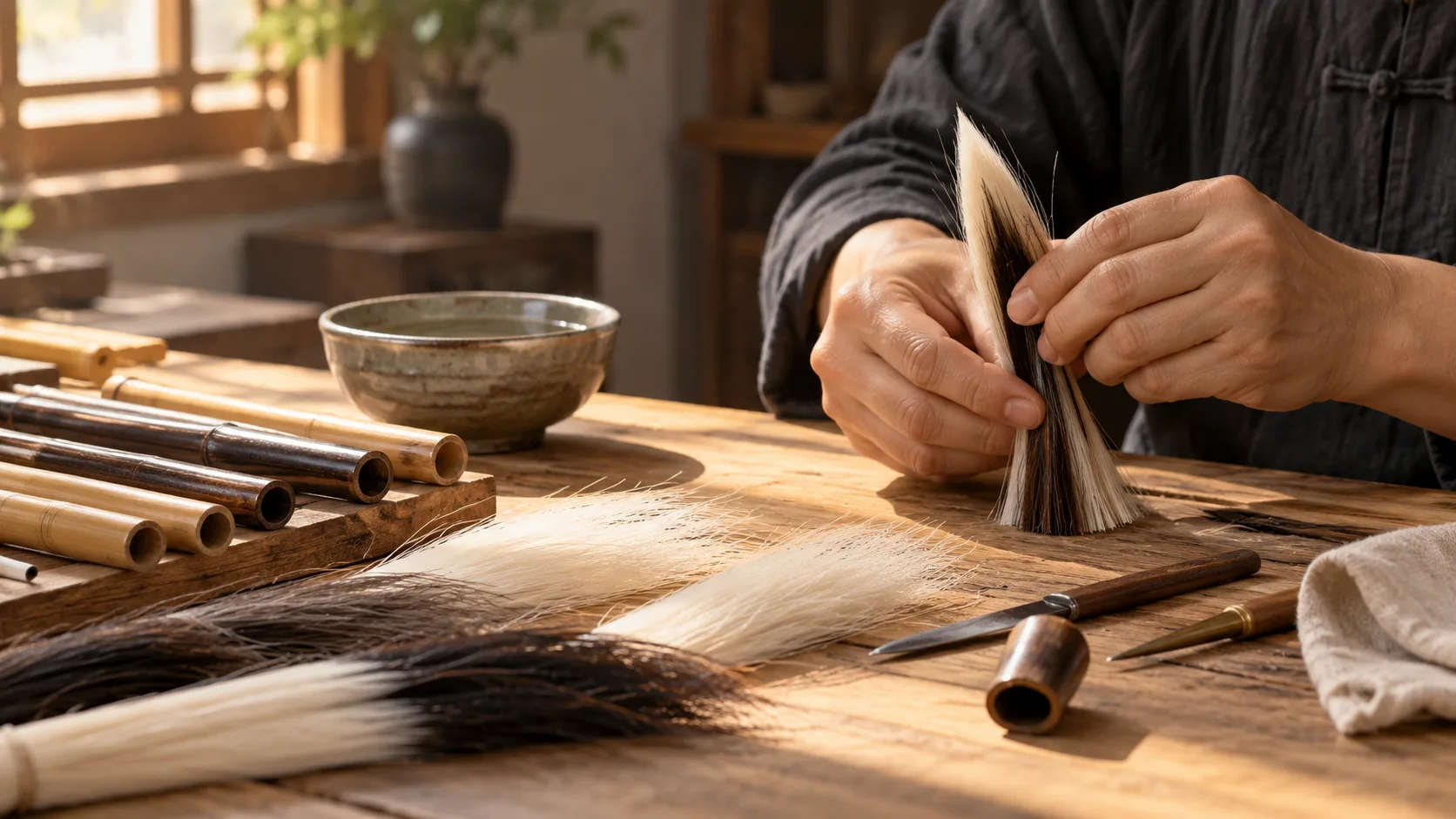
This guide extends the practical brush introduction in the Four Treasures of the Study and keeps a clear boundary from brush technique and the living line, which explains grip and movement. Here the brush is read as a made object: bundle, point, handle, cap, traces of use and catalogue history. For the wider system of brush, ink, paper and stone, begin with Chinese Calligraphy.
A working point is a built bundle
Many hairs become one responsive tool
The Asian Art Museum’s introduction to Chinese calligraphy notes that a brush tip may combine one or several kinds of animal hair. The finished tuft can come to a fine point while retaining enough body for broad lines and dots. That range does not reside in a single magic hair: it comes from the selection, length and arrangement of many hairs, the shape of the belly and the way the bundle returns after pressure.
Construction has changed over time
A Palace Museum lecture on the scholar’s studio in the imperial collection distinguishes an older core-wrapped method, associated especially with brushes of the Wei, Jin, Sui and Tang periods, from the later sanzhuo or loose-tuft method. The earlier construction used a firm central core wrapped with paper and hair; some worn heads could be replaced while the shaft remained. The looser construction removed that paper-wrapped core and could hold more ink. By the Ming and Qing periods it had become common, especially for large brushes. These are historical construction families, not instructions for dating an unprovenanced brush by sight.
A name cannot predict the whole response
Size, taper, hair length, the relation between inner and outer hairs, moisture and the condition of the point all affect performance. Two brushes sold under the same hair name may therefore behave differently. The useful question is not “Which material is best?” but “What line, scale, paper and ink load is this particular brush suited to?” Pair that question with the surface tests in Chinese calligraphy paper and the ink preparation described in Chinese inkstones.
Hair terms describe traditions, not guarantees
Retain the catalogue’s exact wording
Museum and workshop vocabularies do not always map neatly onto zoological English. The Asian Art Museum guide lists rabbit, “wolf,” goat, badger and mouse whisker among possible fibres, while another official account explains one “wolf-hair” category as weasel hair. The Palace Museum separately catalogues goat hair, rabbit-derived purple hair and sable hair in individual objects. Rather than silently forcing these terms into one modern species label, record the Chinese term, the institution’s translation and any scientific identification as separate levels of evidence.
Softness and resilience are relative
Goat-hair brushes are often described as soft and highly flexible; rabbit or weasel-hair brushes are often described as firmer or more resilient; mixed bundles may be designed to combine tendencies. These are broad working descriptions, not quality rankings. A long soft tuft can still produce a fine line, and a firm point can spread under water and pressure. The Palace Museum’s discussion of the traditional “four virtues”—a sharp point, an even tip, a rounded body and resilient return—describes qualities of the assembled brush, not four independent promises supplied by a label.
Compare modern brushes under controlled conditions
For brushes you own, record the maker or seller, product name, stated hair, size and date. On the same practice paper, use the same ink to compare a fine line, a widening stroke, a turn and a return to the point. Note how much water the tuft carries, how quickly the belly opens and whether the point gathers again without twisting it by hand. This small comparison teaches more than choosing by prestige alone. It is a studio exercise, never a test to perform on a historic or borrowed brush.
Handle, cap and wear carry separate evidence
Describe each part before interpreting it
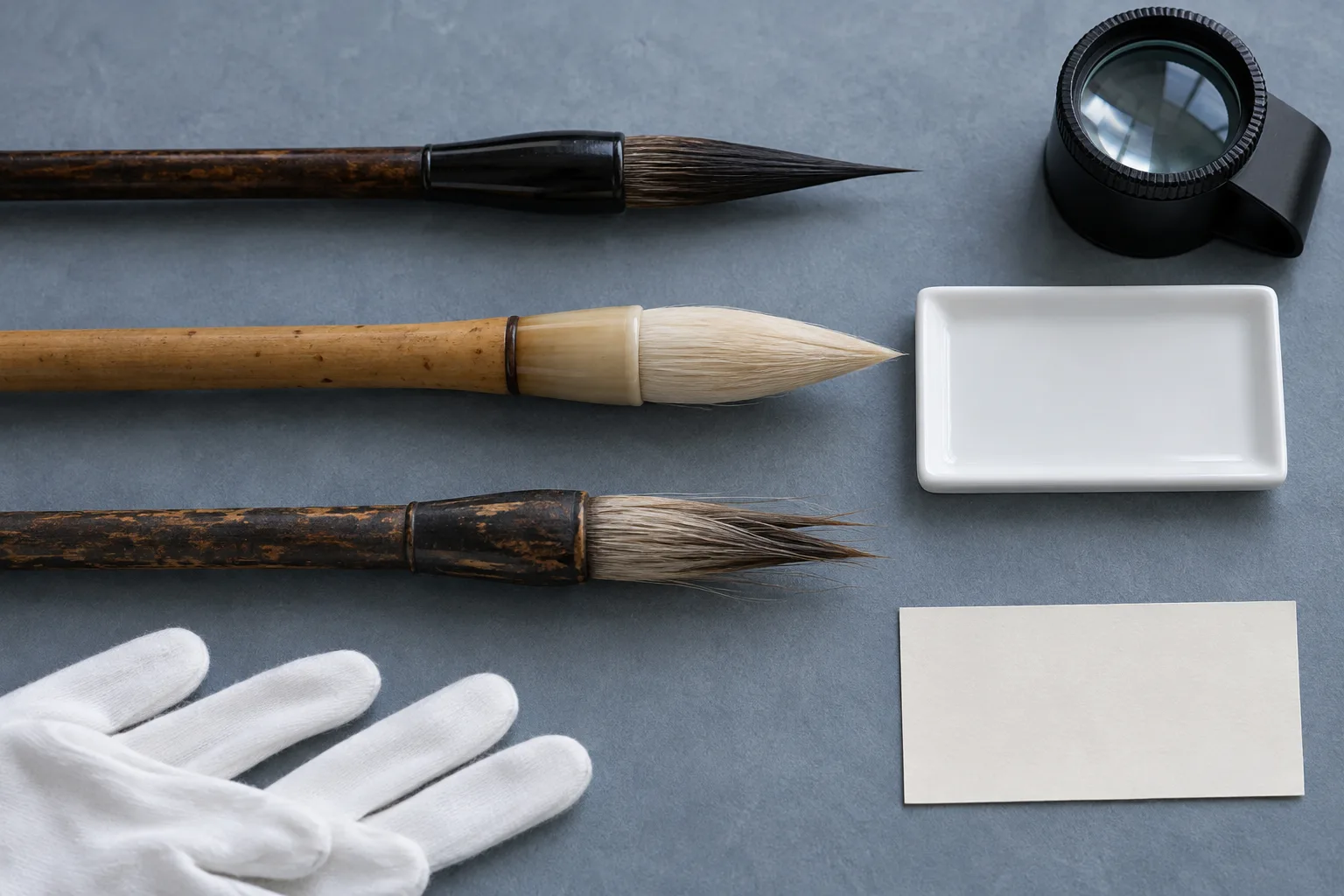
Brush shafts have been made from bamboo, wood, lacquer, porcelain, jade and other materials. Caps, ferrules, inscriptions, fittings and cases may survive even when the original tuft has changed or disappeared. A Palace Museum record for a Ming bamboo brush with sable hair, for example, separately records its bamboo cap, carved decoration, inlaid rim, reign mark and gourd-shaped tuft. Breaking the object into parts prevents a decorative shaft from swallowing the history of the working head.
Luxury does not prove writing performance
The Palace Museum lecture notes that porcelain, jade, ivory and enamel shafts could serve appreciation and collecting as well as use, while a practical handle should sit comfortably and move freely in the hand. The Metropolitan Museum’s eighteenth-century jade brush holder with two brushes is catalogued in the jade collection: its material, dimensions and provenance are central to the record. Such an object can reveal courtly display and collecting without becoming a universal model for the everyday calligrapher.
Wear is history, not a defect to erase
Staining at the root, lost or split hairs, a loosened fitting, replacement head, cap abrasion and old repairs can all belong to an object’s biography. They may indicate use, storage or later intervention, but no single trace proves a named owner or technique. Do not wet, comb, trim, glue or reshape a historic brush. Preserve its existing point and associated cap or case, and consult a qualified object conservator. The same evidence-first approach is used for Chinese seals, where material, carving, impressions and ownership must also be kept distinct.
Read a museum brush in six passes
Begin with the record, not the legend
Note the institution, accession number, title, date wording, dimensions, hair term, shaft material, cap or case, inscriptions, seals, provenance, exhibition history and conservation notes. Treat “Qing dynasty,” “Qianlong period,” “imperial workshop” and “used by” as different kinds of claim. A reign mark, costly handle or famous shop name is evidence to investigate, not automatic proof of date, patronage or use.
Move through six questions
- Identity: What does the catalogue call the object, and which parts are original, later or uncertain?
- Tuft: What hair term, colour, length, taper, bundle shape and condition are actually recorded?
- Construction: Is a core, wrapping, loose bundle, socket, ferrule or replaceable head documented?
- Handle: How do shaft, cap, fittings, inscription and decoration affect grip, display and meaning?
- Use: Which stains, wear, losses or repairs are visible, and what alternative explanations remain?
- History: Which maker, user, owner, transfer and treatment claims are supported by records?
Practise with known tools; protect old ones
Use modern, documented brushes to learn how preparation, water, ink and paper alter a point. Follow the maker’s care instructions, rinse only your own practice brush, let the tuft dry without being crushed and keep its label or receipt. Historic brushes and fitted writing sets should remain unchanged. To see how a prepared point becomes pressure, turn and rhythm on the page, continue to brush technique and the living line; to follow what happens after the mark is made, read the life of a calligraphy sheet.