WUDANG TAIJIQUAN · 武当太极拳

Bend the Bow to Shoot the Tiger (Wangong Shehu) in Wudang Taijiquan: The Five Body Bows (Wugong), Storing Elastic Power & Diagonal Fist Issue 武当太极拳“弯弓射虎”详解:一身备五弓、蓄劲如张弓与斜角长拳发力

How this late-form posture brings the classical maxim “store power like drawing a bow, issue power like releasing an arrow” to life by uniting the spine bow, two leg bows, and two arm bows.

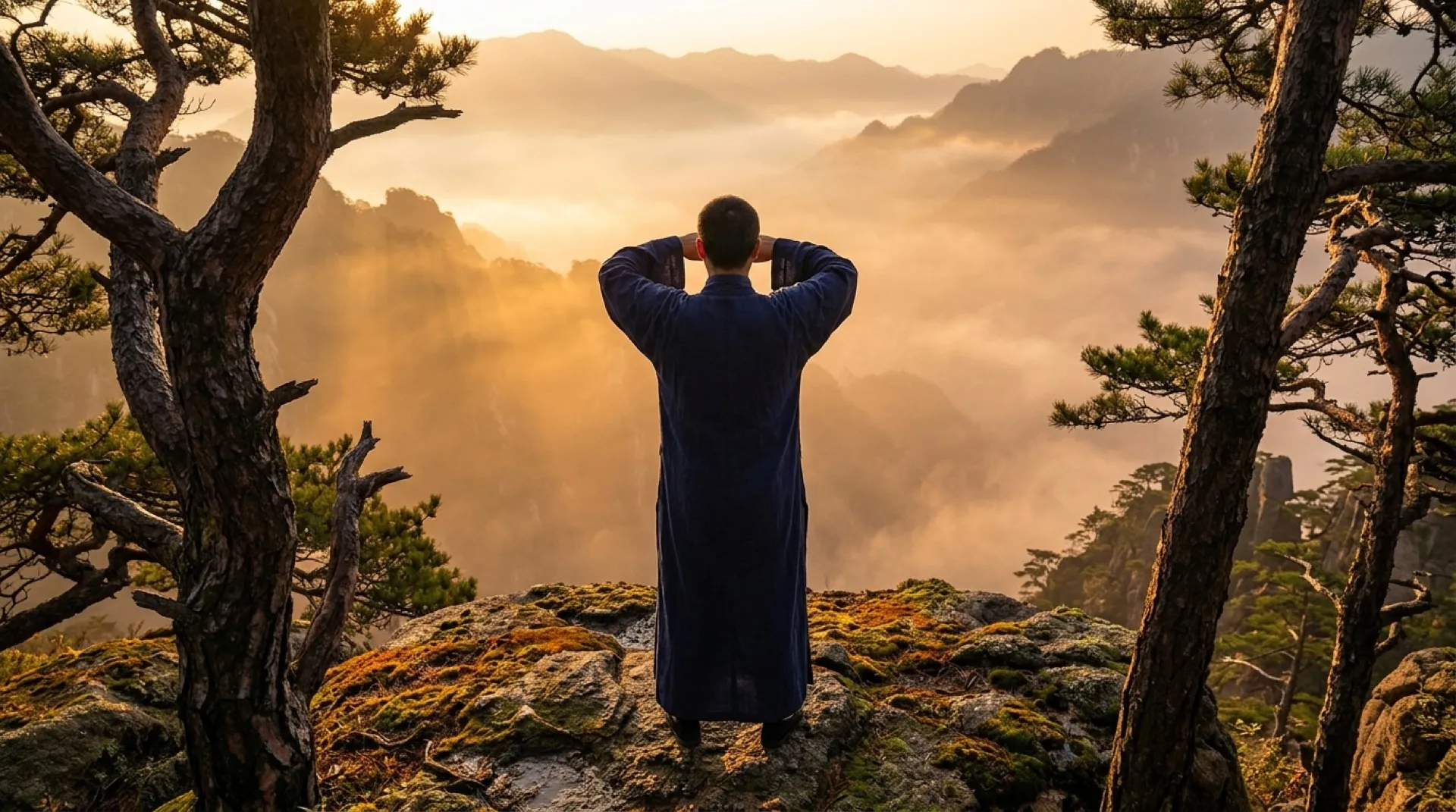
A figure in a long dark robe, seen from behind, standing with both hands clasped behind the head on a rock outcrop between pines, facing a valley of golden mist.

One of the most famous lines in the Taijiquan Classics (《太极拳论》) states: “Store power like drawing a bow; issue power like releasing an arrow; seek the straight within the curved; store first and only then issue” (蓄劲如张弓,发劲如放箭;曲中求直,蓄而后发). Nowhere in the traditional Wudang Taijiquan form is that archery principle made more visible than in “Bend the Bow to Shoot the Tiger” (弯弓射虎, Wangong Shehu).

Following Step Up to Seven Stars and Retreat to Ride the Tiger (and the spinning lotus kick), you settle into a grounded Bow Stance, swing both arms across the torso to coil the waist, and then expand into an archer’s full draw—one hollow fist arched high above the forehead holding the bowstring, the other punching diagonally forward along the arrow’s flight path.

1. What Does “The Whole Body Equipped with Five Bows” (一身备五弓) Mean?

In Wudang internal martial arts, an archer’s bow is not held merely in the hands—your entire musculoskeletal frame becomes a compound system of Five Bows (五弓, Wugong):

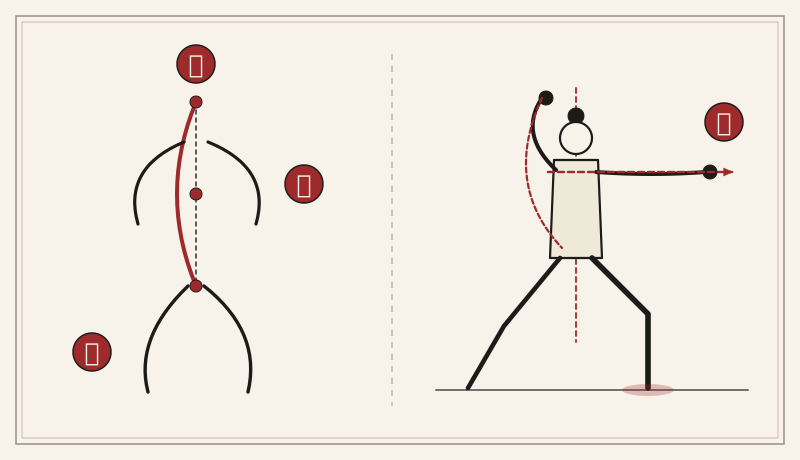
Classical ink-and-cinnabar diagram of Wudang Taijiquan Bend the Bow to Shoot the Tiger (Wangong Shehu) showing the Five Bows schematic on the left (spinal bow, two leg bows, two arm bows) and the full diagonal archer's fist posture on the right

The Five Bows (一身备五弓) and Diagonal Archery Mechanics in Wangong Shehu (武当太极拳“弯弓射虎”五弓合一图解).

  1. The Master Spinal Bow (身弓为主 · 含胸拔背): the spine between the crown (Baihui) and tailbone (Weilu) forms the primary bow stave, with the lumbar waist/Mingmen acting as the bow handle
  2. The Two Leg Bows (双腿弓 · 胯膝踝蓄弹): the hip and ankle joints form the two tips of each leg bow while the knee acts as the elastic bow handle rooted into the flagstones
  3. The Two Arm Bows (双臂弓 · 沉肩坠肘): the shoulder and wrist form the bow tips while the sunken elbow (Chenjian Zhuizhou) curves outward without ever locking straight
  4. Simultaneous Diagonal Draw & Release (弯弓射虎 · 蓄发相济): as the waist turns into the Bow Stance, the upper rear fist draws backward-and-upward above the temple while the lead fist issues diagonally forward (Six Harmonies)

2. Why “Pulling the Rear Hand” Makes the Forward Punch Twice as Stable

Echoing Chapter 22 of the Tao Te Ching (Dao De Jing)—“Bend and become whole; curve and become straight” (曲则全,枉则直)—a real arrow cannot fly if you only push the wooden bow forward without pulling the bowstring backward:

  • If you punch forward with one arm alone, your torso leans after the fist and you lose your central equilibrium.
  • In Wangong Shehu, as your lead fist spirals forward-and-inward (Shun/Ni Chansijin), your rear fist simultaneously arcs upward-and-backward above the temple. That opposite pull across the upper back (Tongbei) anchors your spine vertically and doubles the elastic snap of the forward fist.

3. Three Keys to Practising “Bend the Bow to Shoot the Tiger”

  • Coil Before You Draw (先蓄后发): As your front foot steps down after the lotus kick, let both arms sweep smoothly to the side-rear with an inhalation (storing the bow) before turning the waist to exhale into the two fists.
  • Never Lock the Punching Elbow: Even at the completion of the punch, keep a subtle curve in the forward elbow so the arm bow retains its spring (compare Section 2 of Baduanjin, “Drawing the Bow Left and Right”).
  • Direct the Gaze Through the Forward Fist: Your eyes look calmly toward the diagonal target ahead of the lower punching fist while your awareness fills the space behind your back.
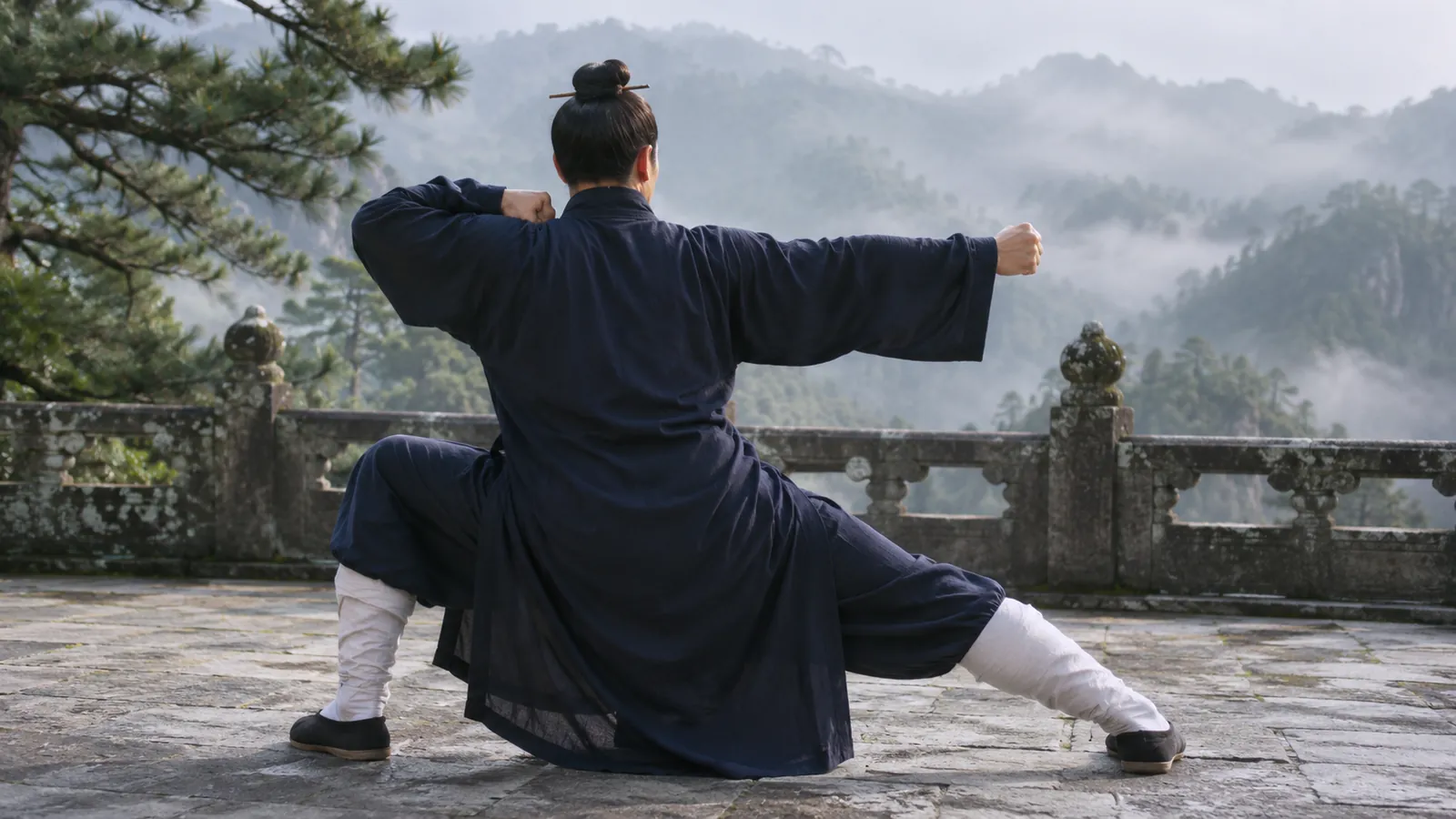
A practitioner in dark indigo Taoist robes and white cotton leg wraps seen from behind in a wide Bend the Bow to Shoot the Tiger (Wan Gong She Hu) stance of Wudang Taijiquan, both fists extended in a line at shoulder height, on a stone mountain terrace above misty pine slopes.

Bend the Bow to Shoot the Tiger (Wan Gong She Hu) at dawn: a wide, rooted stance with both fists opening to the sides like a drawn bow.

4. Training the Five Bows Between Wudang Mountain and Singapore

Connecting the living martial heritage near Wudang Mountain’s UNESCO World Heritage ancient Taoist temples with our regular classes in Singapore, Wudang.Org guides students from foundational stance work to full-body elastic power. Start with Wudang Tai Chi for Beginners, visit Start Here, or join our Singapore Tai Chi Retreat Camp.

Safety note: Keep both fists soft (“hollow fists”) and avoid snapping the elbow joint to a hard mechanical lock when issuing; traditional martial training does not replace medical care.

Seeker’s Q&A · Frequently Asked Questions

What are the “Five Bows” (Wugong 五弓) in Wudang Taijiquan?

The Five Bows are the primary Spinal Bow (from crown to tailbone with the waist as the handle), the two Leg Bows (from hip to heel with the knees as handles), and the two Arm Bows (from shoulder to wrist with the elbows as handles).


Why should I never lock my elbow straight when punching in Bend the Bow to Shoot the Tiger?

Locking the elbow destroys the elastic curve of the Arm Bow (“seeking the straight within the curved”), traps force in the joint, and exposes the elbow to injury or joint-locking.

How do the two fists coordinate in Bend the Bow to Shoot the Tiger (Wangong Shehu)?

As the waist turns into the diagonal Bow Stance, the upper rear fist draws upward-and-back above the temple to guard and counterbalance, while the lower front fist spirals diagonally forward at chest height—creating a balanced two-way draw.
