The David Vases: A Daoist Offering and a Dated Porcelain Landmark
大维德对瓶:道观供器与青花纪年坐标
The two tall blue-and-white porcelains known as the David Vases are famous not only for their dragons, phoenixes and commanding scale. A long inscription on each neck identifies a donor, a place, a recipient and a date equivalent to 1351. It turns the pair from beautiful survivors into unusually precise historical evidence.
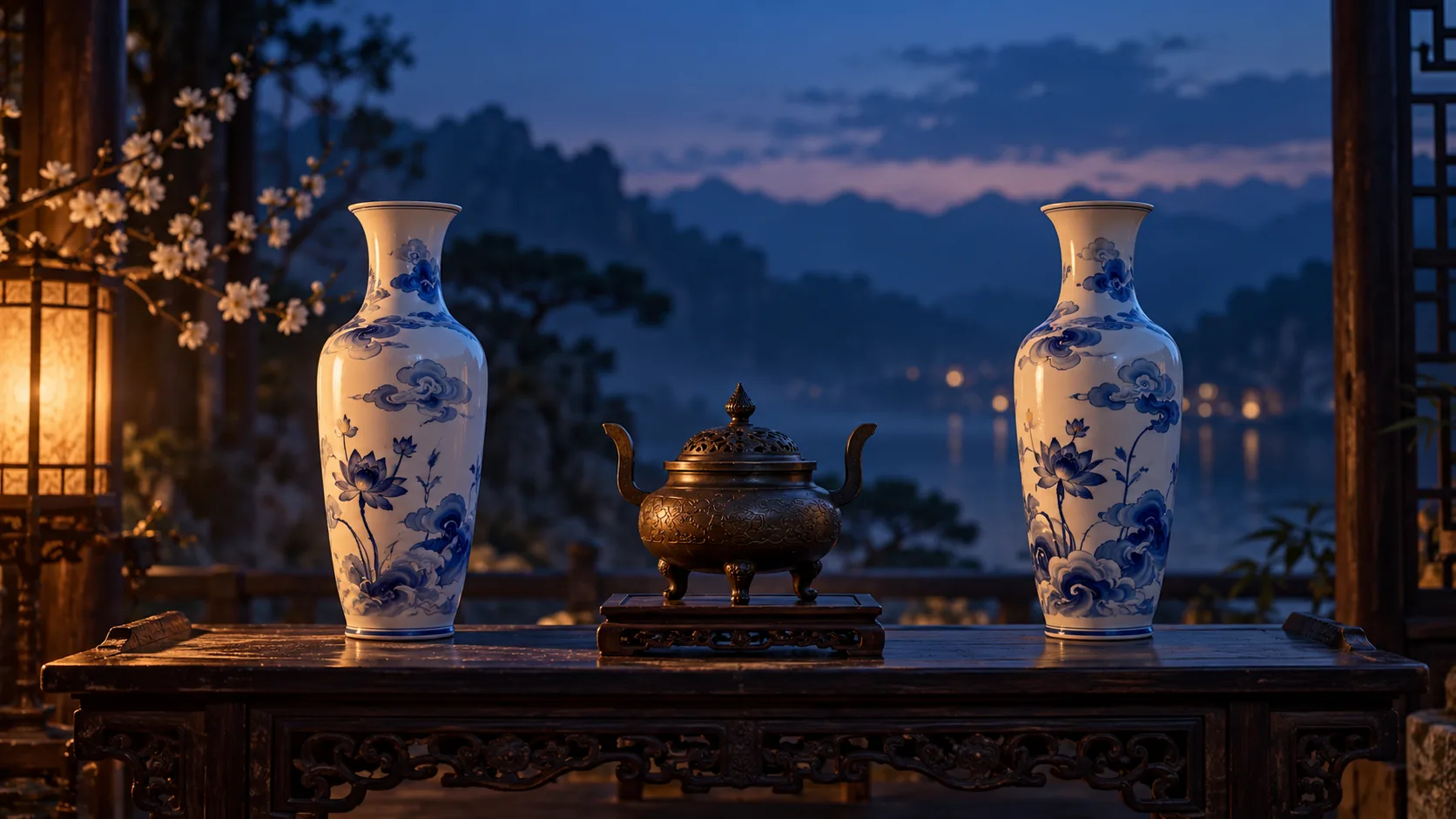
This article reads that evidence in two directions. The vases document a lay offering to a Daoist temple, while their secure date anchors the history of blue-and-white porcelain at Jingdezhen. They are not Wudang objects and should not be treated as a universal model for every Daoist altar. Their value lies precisely in the specificity of what they record.
Begin with the dedication, not the nickname
“David” names a modern collector, not the donor
The British Museum catalogues the pair as PDF B.613 and PDF B.614. Their familiar name comes from Sir Percival David, who brought the separated vases together in the twentieth century. The historical act named on the porcelain is different: Zhang Wenjin presented the vessels in the Yuan dynasty.
The text supplies an exceptional chain of particulars
The dedications locate Zhang in Yushan county in northeastern Jiangxi. They name the destination as the Original Palace at Xingyuan, now associated with Wuyuan county, and the recipient as General Hu Jingyi. They date the gift to an auspicious day in the fourth lunar month of the eleventh year of the Zhizheng reign, equivalent to 1351. This density of names and places is why the inscription matters as much as the painted decoration.
The offering was a set, not two isolated display pieces
The text records a pair of flower vases together with an incense burner whose present whereabouts are unknown. It also expresses a wish for the donor’s household to enjoy peace and well-being. Read alongside the site’s guide to temple worship, offerings and vows, the objects show how material gifts, named recipients and family intentions could meet in one donation.
Form and surface connect altar, bronze and kiln
A ceramic body recalls an older bronze vocabulary
The British Museum describes the vases as porcelain altar vessels of ancient-bronze form. Their long necks, swelling bodies and applied elephant-head handles originally carried porcelain rings. This is not evidence that they were metal copies. It shows artisans translating an established vessel language into a technically demanding ceramic body.
Dragons and phoenixes occupy a carefully ordered surface
Underglaze cobalt defines bands of dragons, phoenixes, peonies and plantain leaves. The two objects are a pair without being mechanically identical: one dragon faces right with a closed mouth, the other left with an open mouth, and smaller details also vary. Pairing therefore creates relation and balance, not perfect duplication.
The imagined altar must not replace the documented one
The inscription establishes that the vessels and an incense burner were offered to a Daoist temple. It does not preserve a complete floor plan, performance sequence or universal rule for arranging Daoist altars. Comparisons with Chinese incense burners or incense and offerings at Wudang temples can clarify material categories, but they cannot fill every gap in the 1351 setting.
Why 1351 changed the history of blue-and-white porcelain
A written date creates a firm comparison point
The British Museum’s Room 95 gallery guide calls the dedication the earliest known on blue-and-white wares and stresses what the date demonstrates: production at Jingdezhen was already well established by 1351. The vases do not mark the first experiment with cobalt. They prove that large, complex and confidently decorated works existed by that year.
Comparable Yuan wares reveal a broader ceramic language
A mid-fourteenth-century stem bowl with lotus pattern and a foliated plate with plants and melons at the Metropolitan Museum place underglaze cobalt on different shapes and scales. The Met notes that Jingdezhen potters mastered this method during the fourteenth century. The David Vases give that wider development an unusually exact dated landmark.
Dates guide attribution; they do not solve every object
Ceramic historians compare clay, glaze, cobalt, firing effects, shapes and excavated contexts with securely dated pieces. A single dated pair cannot make every similar dragon vase a 1351 work, nor can blue-and-white decoration alone prove a ritual function. The site’s guide to Chinese tea ware and ceramic form applies the same discipline: material, use and provenance must be read together.
Read the vases as evidence with boundaries
Separate inscription, object record and later biography
- Inscription: donor, offering, intention, place and 1351 date.
- Object: porcelain body, underglaze cobalt, paired form, dimensions and decoration.
- Ritual context: a documented donation to a named Daoist temple, but not a surviving ritual manual.
- Modern history: separation, reunion in the Percival David collection and museum display.
- Open questions: the lost incense burner, incomplete early provenance and the precise historical setting of use.
The modern collection story should remain visible
The museum records different twentieth-century acquisition histories for the two vases before Percival David reunited them. Both were long associated with the Sir Percival David Collection and are displayed in Room 95. A British Museum announcement describes their 2024 transfer with the wider collection; the object records list formal acquisition in 2025. Those dates belong to modern stewardship, not to the Yuan dedication.
A precise object can correct an oversized story
The vases do not prove that all Daoist offerings looked alike, that every blue-and-white vessel served a temple, or that a single kiln worked only for one patron group. They show something both narrower and richer: in 1351, one named donor commissioned an ambitious Jingdezhen set for a named Daoist sanctuary. That record joins religious life, household aspiration and ceramic technology without collapsing any one of them into the others.
Continue with Jiao community offerings for a different scale of ritual, or with Wudang stone inscriptions to compare how dates, patrons and sacred places are preserved in another material.