Daoist Ritual Robes: Garment, Image and Ceremonial Role
道教法衣:衣式、图像与科仪身份
A Daoist ritual robe is not simply a decorated coat. Its cut changes the officiant’s silhouette; its images organize a cosmos across the body; its weight and width become visible when the wearer turns, bows or raises the arms. Museum cases preserve remarkable textiles, but they can also make a moving garment appear flat and self-contained.
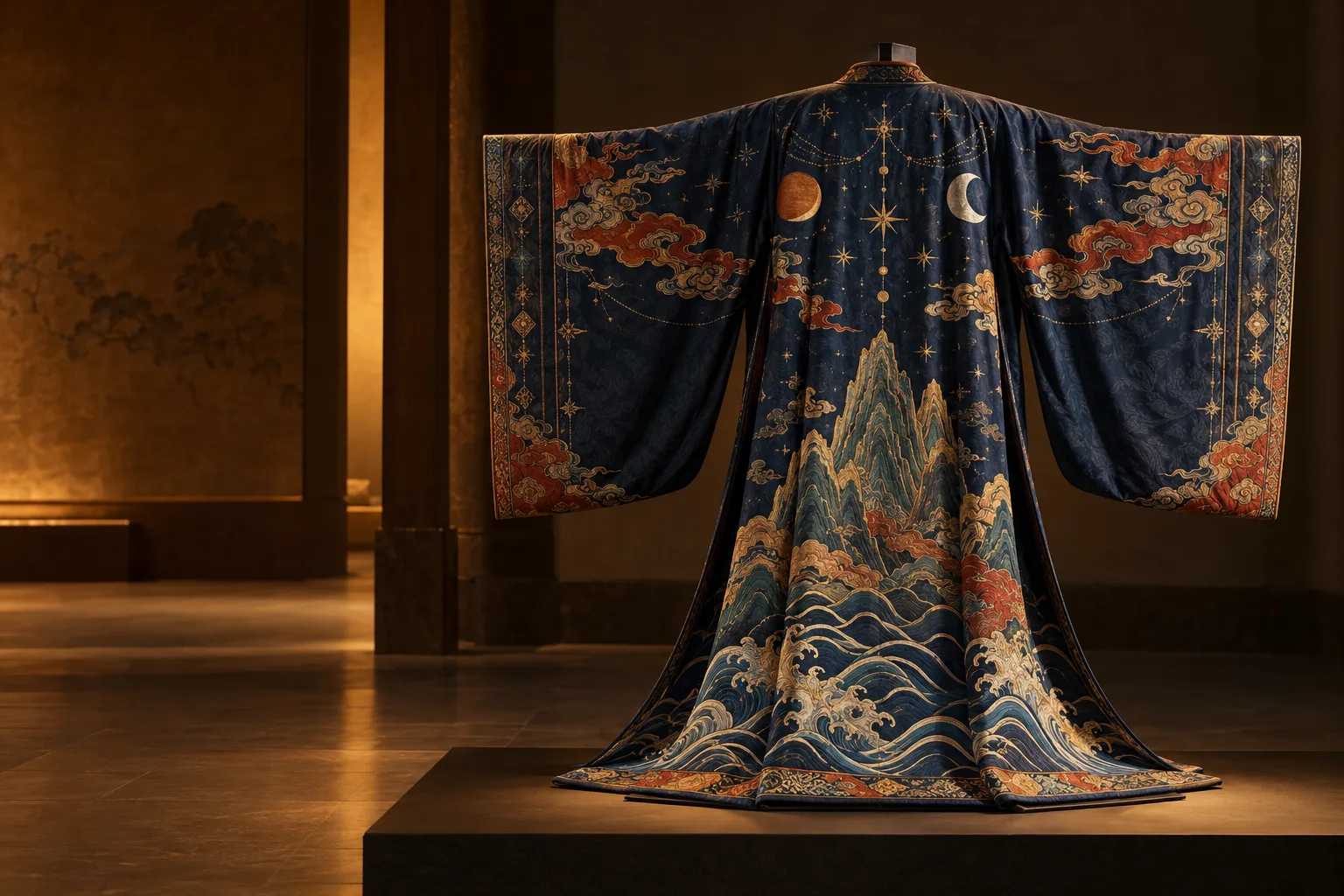
This guide begins with dated objects and museum records, then returns them to ceremonial use. It complements the overview of Daoist festivals and rituals, the guide to jiao community offerings and the practical page on addressing Daoist clergy at Wudang. None of the museum robes below is presented as a documented Wudang object.
Identify the garment before interpreting its images
Jiangyi and daopao are related but not interchangeable
The RISD Museum’s exhibition From the Land of the Immortals distinguishes two recurring forms. The jiangyi, often translated as “robe of descent,” is a broad, poncho-like outer vestment associated with major ritual roles. The daopao is a sleeved Daoist robe. Names, ranks and uses vary across communities and periods, so the safest first step is to retain the catalogue term attached to a particular object.
Cut determines what the garment can do in motion
A wide rectangle can open into an emphatic square when the arms extend; a sleeved robe gathers and releases fabric differently. Borders may frame the body, while a central back field remains visible to people standing behind the officiant. These are not incidental tailoring choices. They connect image, movement and viewing position, but no photograph of an empty robe can reconstruct a complete choreography.
Construction is evidence alongside iconography
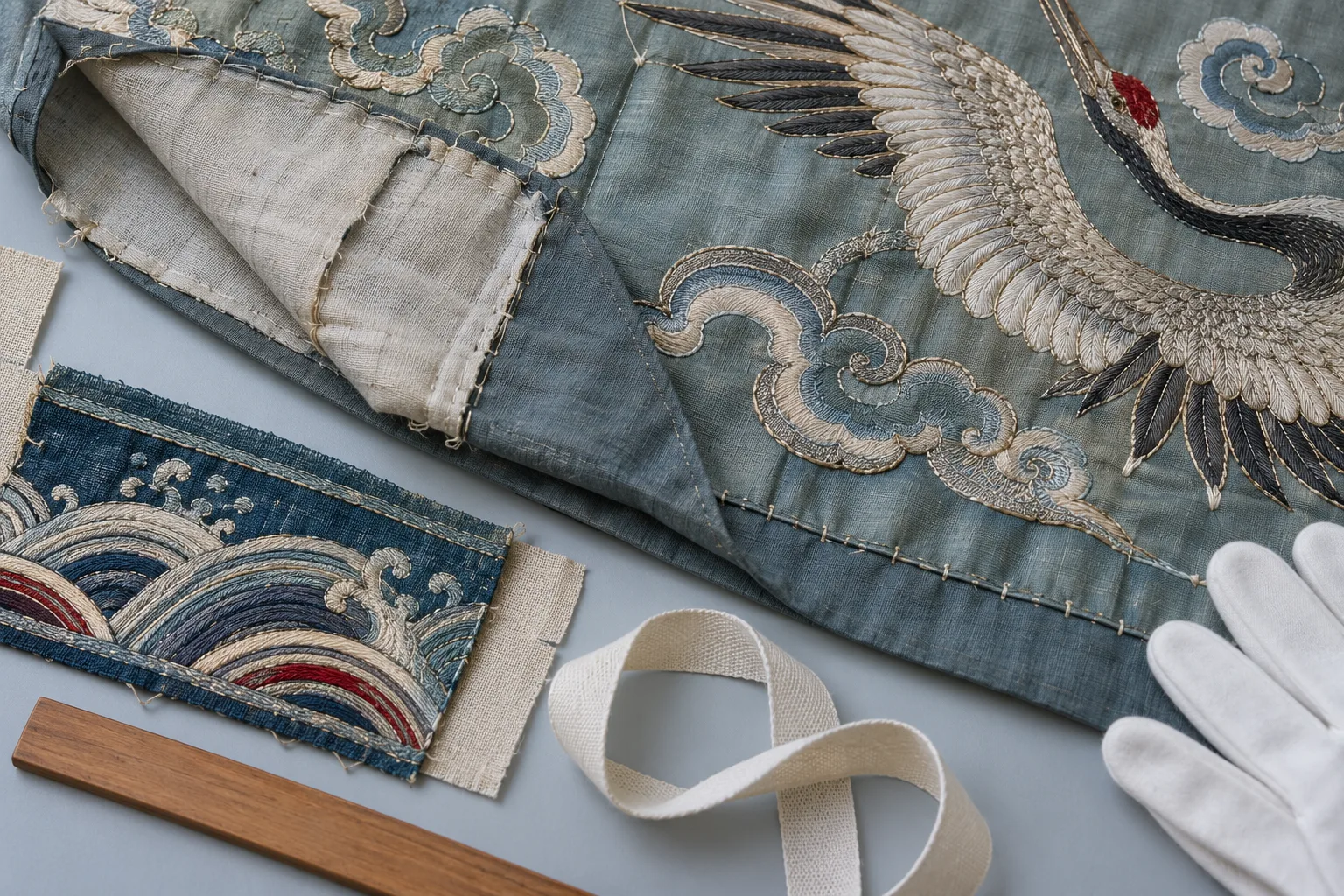
The Smithsonian’s nineteenth-century Daoist priest’s robe records continuous fabric widths, a centre-front opening, hand openings, embroidered borders and a silk damask lining. Looking at seams, lining, wear and later repairs can reveal how a robe was assembled and used. Motifs should not displace this material evidence.
Read the robe as an ordered field
Upper and lower zones can orient heaven and earth
The Metropolitan Museum of Art’s late-eighteenth-century robe with a celestial palace places the sun and moon above, cranes through the field, and mountains, waves and mythical creatures along the lower border. Read together, these images establish directions and levels rather than a random collection of auspicious emblems. The record describes one object; another robe may select and arrange its imagery differently.
A robe can map a pantheon around the officiant
A second Met vestment, dated to the late sixteenth or early seventeenth century, is densely embroidered with deities. The museum notes a scholarly interpretation that relates its arrangement to the orientation of a Daoist temple: major figures occupy the back, while lesser figures appear toward the front. This is a valuable reading of that robe’s program, not proof that every vestment is a portable floor plan.
Familiar motifs do not have one fixed meaning
Sun, moon, Big Dipper, cranes, dragons, sacred peaks, clouds and waves recur across Chinese religious, courtly and decorative arts. Context narrows their work. A crane may participate in imagery of longevity or transcendence; a tortoise entwined with a snake may mark the northern figure Xuanwu; a wave border may locate mountains within a cosmic landscape. Identification is the beginning of interpretation, not its end.
Return the textile to ceremony, hierarchy and time
Ritual clothing makes office visible
The Spencer Museum describes its jiangyi as an outer robe worn by a high-ranking priest in certain ceremonies. Its volume enveloped the wearer in cosmological signs and amplified movement. The point is not personal luxury: clothing distinguishes roles inside an ordered rite. Daily dress, ordination clothing and grand vestments therefore should not be collapsed into one “Daoist costume.”
Dated survivors are witnesses, not an unbroken timeline
A robe catalogued to the eighteenth or nineteenth century proves that this textile existed by the date and in the form documented. It does not by itself prove that every motif, stitch or ritual use remained unchanged from the Ming dynasty, or that present practice everywhere follows it. Compare object records, inscriptions, photographs, ritual manuals and living communities while keeping their evidential roles separate.
Display preserves the object but removes part of its life
A museum mount lets viewers study front, back, embroidery and scale without handling fragile silk. It also freezes fabric that once folded, sounded and caught light around a moving body. Conservation images of linings and stitches restore some material history, while ritual documentation restores some performative context. Neither should be forced to answer for what it cannot show.
Use a six-pass method in museums and temples
Separate observation from inference
- Identity: Record the catalogue name, date range, place, medium and dimensions.
- Form: Distinguish a sleeved robe from a broad outer vestment and note openings, borders and panels.
- Construction: Examine weave, embroidery, metallic thread, lining, seams, wear and repairs.
- Program: Map images by front, back, upper, lower, centre and border before decoding them.
- Use: Ask what the record actually says about wearer, rank, ceremony and movement.
- Limits: State what remains unknown and avoid assigning Wudang provenance without evidence.
At Wudang, respect the person before studying the robe
A living officiant is not a museum display. Do not touch clothing, interrupt preparation or ask someone to pose during a rite. Follow the temple’s instructions and request permission before making images; the guide to photography and respect in Wudang temples explains the practical boundary. If a garment appears in a public ceremony, describe only what you can responsibly observe and what participants choose to explain.
Let comparison sharpen, not flatten, the tradition
Set several dated robes beside one another. Differences in form, deity groups, borders, materials and scale are evidence of choice, region, workshop, rank or occasion—questions to investigate, not defects to erase. A careful reading moves from textile to image to ceremonial context and back again. Continue with the site’s guides to the Daoist pantheon and ritual calendars and community rites to place the garment within the larger religious world.