Jiao Rituals: Taoism’s Grand Community Offering
醮仪:道教大型共同体祭献科仪
The jiao is the largest thing Taoist liturgy does. Where a deity's birthday is a scheduled morning service, a jiao is a commissioned rite that can run for three, five, seven or more days, involves a purpose-built altar, a team of clergy and musicians, and is paid for by a whole community.
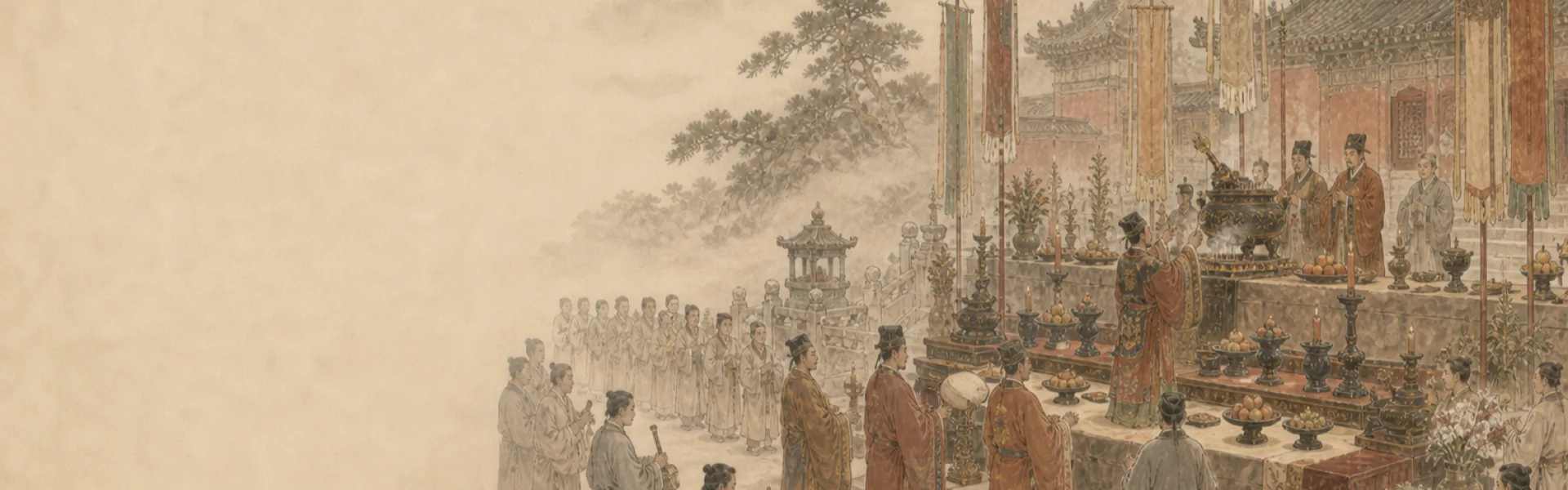
It is also the form in which Taoist ritual is most fully itself. If you want to see what this religion looks like when it is doing the thing it was organised to do, a jiao is the answer, and everything else — daily scripture, festival services, household rites — can be read as an abbreviation of it.
What a Taoist Jiao Ritual Is
A jiao is an offering. The word originally referred to a libation, and the rite retains that structure at its core: an approach to the celestial administration, a presentation, and a request, all conducted through documents.
Three features distinguish it from the rest of the liturgical repertoire. It is occasional rather than calendrical — it happens because someone commissions it, not because a date has arrived. It is communal — the beneficiary is a village, a temple's constituency, a market, a lineage, a town, and not an individual. And it is large, in duration, in personnel and in cost.
The purpose is stated in terms of renewal and security. A jiao restores right relations between a community and the powers that govern its territory, closes accounts, expels what should not be there and re-establishes the local order for a period. Different traditions name this differently, and the vocabulary is worth noticing: rites of peace and security, rites of completion, rites of universal deliverance.
Because it is commissioned, a jiao is also a social and economic event on a scale that is hard to overstate. Organising one requires a committee, a subscription, months of preparation, and the coordination of clergy who may come from several temples or altars. In many communities the jiao is the largest collective undertaking of the decade.
When Communities Commission a Jiao Ritual
Several distinct situations produce a jiao, and the type is usually named after the situation.
Completion. When a temple is built, rebuilt or substantially restored, a rite of completion is performed. This includes the consecration of newly made images, which is a separate operation with its own procedure — an image is not a deity's seat until it has been formally invested. Temple rebuilding is common, so this is the most frequently encountered occasion.
Peace and security. Communities hold cyclical jiao at intervals — every three years, every twelve, every sixty in some places — as a standing renewal rather than a response to crisis. The interval is often tied to the sexagenary cycle, and the recurrence is part of what makes the rite an institution rather than an emergency measure.
Crisis. Epidemic, drought, flood, fire, a run of accidental deaths or a disaster with many casualties can all prompt a jiao. This is the oldest documented use, and it is worth stating that the response is procedural rather than merely consolatory: the community submits a case.
Universal deliverance. The large-scale salvation rites of the seventh month are structurally jiao, and the biggest of them are indistinguishable from other jiao in form.
In each case, the rite is preceded by a formal announcement to the celestial administration, submitted days or weeks in advance. Nothing happens without notice. This is not decorum; it is the same administrative premise that runs through the whole tradition.
The Structure of a Jiao Ritual
Traditions vary considerably in detail, but the sequence has a recognisable shape and it is worth setting out because it explains almost everything a visitor will see.
Announcement. A document is dispatched, notifying the relevant offices of what is to be held, when, by whom and for whom. Names are listed.
Construction and purification of the altar. A ritual area is enclosed and made a cosmos in miniature. Boundaries are marked, directions assigned, guardians posted. From this point the space is not ordinary space, which is why visitors are asked to stay outside it.
Invitation. The deities are invited and installed. This is a distinct operation from addressing them: they must be present before anything can be presented.
Nocturnal announcement and the audience rites. The central sequence, usually repeated morning and evening across the days of the rite, in which the officiant presents the community's case in ascending order of seniority. This is where the great majority of the liturgical text is used.
The offering proper. The presentation for which the whole rite is named, at the culminating point of the schedule.
Deliverance and dispatch. The dead in the community's territory are provided for, and the deities are then formally seen off. The altar is dissolved and its boundaries lifted. Documents are burned, because the transaction must be filed.
The Jiao Altar as a Map of the Sacred World
The altar is the part most likely to be misread as decoration, and it is the part that carries the most information.
A full jiao altar is a diagram of the cosmos. Scroll paintings of the Three Pure Ones hang at the centre rear, with ranked deities arranged outward and downward from them in an order that reproduces the celestial hierarchy. Directional guardians occupy the corners. Lamps are placed according to a scheme. The officiant's position on the central axis is the point from which the whole arrangement is addressed.
The paintings are not incidental. Many communities own a set that is unrolled only for jiao, stored the rest of the time, and repaired rather than replaced. Some sets are two or three centuries old and are among the more important surviving objects of Chinese religious art, precisely because they were used rather than displayed.
Documents are the other central material. A jiao generates a substantial paper archive: the announcement, the petitions, the lists of subscribers, the memorial read at the offering. Some are read aloud, some are burned, some are retained. The physical document is not a record of the ritual; it is the instrument by which the ritual acts.
This is the point at which the administrative premise becomes fully visible. A jiao is a community's formal submission to a government, complete with correct forms, named applicants, an authorised agent, and a filed copy.
Roles within a Jiao Ritual
A jiao requires a team, and the roles are specified.
The officiant — the high priest of the rite — occupies the central position, performs the movements and pronounces the principal texts. This role requires ordination and rank, because the authority exercised is delegated and must be documented. The officiant announces his lineage and rank within the rite itself.
Supporting roles are traditionally enumerated: a cantor who leads the chanting, a supervisor of abstinence responsible for the purity of the arrangements, incense attendants, lamp attendants, and scribes who prepare the documents. The number of positions is one of the ways a jiao's scale is described.
Musicians are essential rather than ornamental. The liturgy is sung, and it is structured by percussion. Regional repertoires differ markedly — Wudang, Beijing, Suzhou, southern Fujian and Taiwanese traditions are all distinct — and in several cases the music is registered as intangible cultural heritage.
The lay committee is the other half of the operation and is often more visible than the clergy. It raises the money, keeps the accounts, orders the offerings, builds the temporary structures, arranges the opera troupe and the catering, and displays the subscriber list. In many jiao the committee's work runs for a year before the clergy arrive for a week.
How Communities Fund and Organise a Jiao
The economics of a jiao are public by design, and it is worth describing them plainly because they are frequently mistaken for corruption.
Funding comes from subscription. Households contribute according to means, sometimes by a fixed share per household or per adult male, sometimes by open donation, and the amounts are posted. Businesses and emigrant associations contribute. In some traditions, particular honorary roles in the rite are allocated by lot or by bidding, and blessed objects are auctioned with proceeds carried to the following cycle.
This is not a modern commercialisation. Publicly displayed subscription lists are attested for centuries and serve two purposes at once: they account for the money, and they record who belongs to the community. A jiao's donor board is a census as much as a receipt.
Householder Zhengyi priests are paid for their services, which is the normal arrangement for that branch of the clergy. Monastic Quanzhen clergy do not take personal payment; income from a rite goes to the monastery. Neither arrangement is more respectable, and the difference is structural rather than moral.
How to Observe a Jiao Ritual Respectfully
Jiao are not secret and visitors are common, but a few things make the difference between attending well and getting in the way.
Find out the schedule. A multi-day jiao has a shape, and most of the visually striking material is concentrated in a few segments — the opening, the main offering, the deliverance rite, the dispatch. Between these there are long stretches of recitation. The organising committee usually posts a programme.
Stay outside the altar area. The boundary is marked and it is real in the tradition's terms. Do not cross the central axis in front of the officiant, and do not walk between him and the altar. No flash, no video with sound, and nothing photographed from the front along the axis past the officiant. Ask before photographing individuals.
Expect noise, food and crowds outside the altar and concentration inside it. Both are normal simultaneously. The sociability of a Chinese ritual event is not a lapse in seriousness; the seriousness is located precisely, and everyone present knows where.
Sources and limits. This page draws on published studies of jiao liturgy in Taiwan, Fujian, Hong Kong and Jiangnan, on Lingbao ritual structure, and on temple and community records of subscription and organisation. Structures and terminology vary by region and lineage; what is described is a common shape rather than a fixed order. No liturgical text is reproduced and no ritual instructions are given.
Key Points About Jiao Rituals
A jiao is the largest Taoist rite: commissioned rather than calendrical, communal rather than individual, and lasting days rather than hours.
Its core is an offering conducted through documents — an approach to the celestial administration, a presentation and a request.
Occasions include temple completion and image consecration, cyclical rites of peace, crisis response, and large-scale deliverance rites.
Nothing begins without a formal written announcement dispatched in advance.
The altar is a diagram of the cosmos: Three Pure Ones at centre rear, ranked deities outward, guardians at the corners, the officiant on the axis.
Scroll sets used only for jiao are among the more important surviving objects of Chinese religious art, because they were used rather than displayed.
Documents are instruments, not records: the rite acts through them, and they are read, burned or retained accordingly.
Roles are specified — officiant, cantor, supervisor of abstinence, incense and lamp attendants, scribes — and musicians are essential, with sharply distinct regional repertoires.
Public subscription lists are centuries old and function as both accounts and a census; Zhengyi priests are paid, Quanzhen monastics are not.