Zhongyuan Festival: Ghost Festival, the Earth Official and Universal Salvation
中元节:七月十五、地官赦罪与普度
The fifteenth day of the seventh lunar month is the largest festival of the Taoist year after New Year, and the one most likely to be misunderstood by visitors. In English it is usually called the Ghost Festival, which is accurate about the subject matter and misleading about the tone.
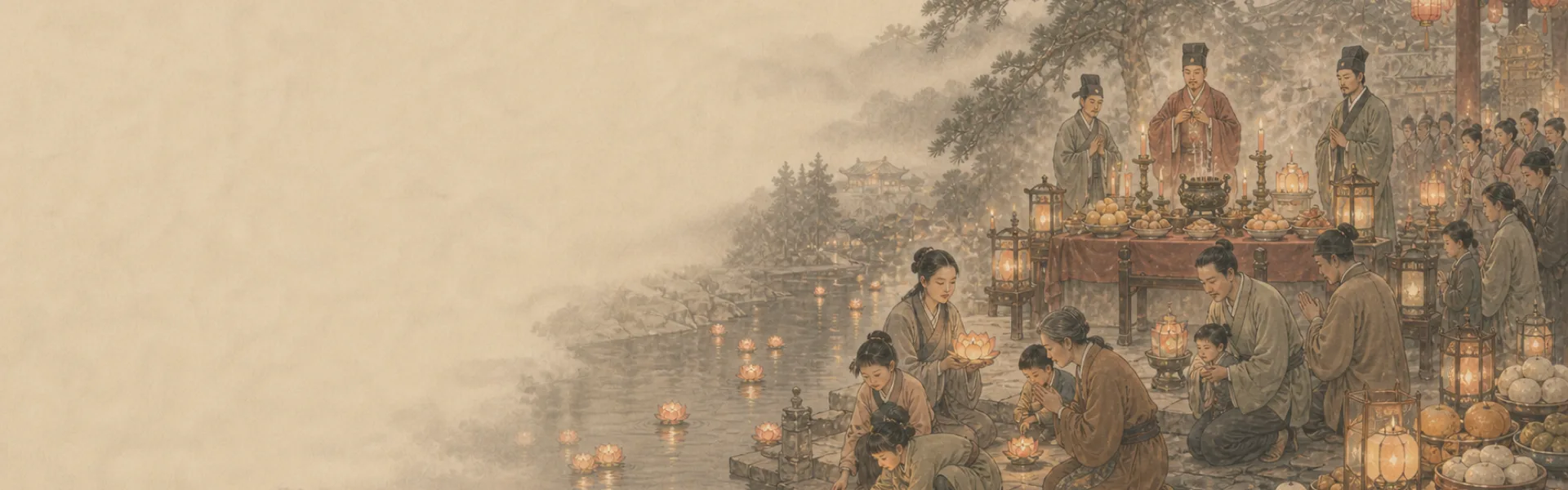
It is not a Chinese Halloween. There is no costume, no play at being frightened, and nothing celebratory about the dead. The occasion is closer to a large-scale administrative amnesty combined with a public relief operation, conducted on behalf of people who have no one else to act for them.
Why Zhongyuan and Yulanpen Share the Same Date
The first thing to establish is that two distinct religious observances fall on this date, with different names, different explanations and different liturgies. They coexist, they have influenced each other heavily, and most families observing the day do not distinguish them.
The Taoist festival is Zhongyuan, the middle of the three yuan festivals that divide the year into thirds. It belongs to the Official of Earth, the second of the Three Officials of Heaven, Earth and Water. Its logic is judicial and administrative: on this day the Official of Earth reviews records and remits punishment.
The Buddhist festival is Yulanpen, based on a scriptural story in which the monk Maudgalyayana finds his mother suffering in a lower realm and is told that he cannot rescue her by his own merit alone but must make offerings to the monastic community, whose collective merit can be transferred. Its logic is filial and merit-based rather than judicial.
The overlap is old and was never resolved, because there was no authority interested in resolving it. Taoist ritual absorbed the structure of transferable merit and universal salvation from Buddhism during the fifth century, when the Lingbao scriptures were composed; Buddhist practice absorbed the Chinese calendar and the ancestral framing. By the Tang the day was a general public occasion, and it has stayed that way.
Practically, this means that on the same evening in the same town you may find a Taoist temple performing a documentary rite addressed to the Official of Earth, a Buddhist temple performing a merit-transfer service, and a street association burning offerings with no clergy present at all. None of these is the correct version.
The Earth Official and the Remission of Sins at Zhongyuan
The Taoist explanation depends on the administrative premise. Moral accounting in Chinese religion is conceived as bookkeeping: conduct is recorded, records are held by officials, and consequences follow from the record. The Official of Earth holds jurisdiction over that domain.
On his festival he conducts a review. Sentences may be reduced, records amended, and detained souls released or advanced. The technical term is remission of sins — shezui. The mechanism is documentary: the correct way to participate is to have a petition submitted on behalf of a named person, living or dead, and this is precisely what a Taoist temple does on the day.
Two features of this are worth noticing. The first is that it is not a personal transaction with a merciful figure; it is an application within a system, and the liturgy has the form of a submission with names, dates and a seal. The second is that it is transferable. You can petition on behalf of someone who cannot petition for themselves, which is what makes the festival's charitable dimension possible.
Because the whole month is understood as the period when the lower administration's gates are open, many regions treat the seventh month as a whole rather than the fifteenth day alone. Businesses may avoid opening on inauspicious days within it, weddings and house moves are often postponed, and swimming is discouraged in some areas. Whether an individual believes any of this varies enormously; the customs persist independently of belief.
Who the “Ghosts” of Zhongyuan Are
The category that matters here is not the ancestral dead. Ancestors are cared for by their own descendants, at graves in the spring and at home shrines throughout the year, and they are not the problem the festival addresses.
The festival addresses the dead who have no one: people who died without descendants, who died away from home, who drowned or were killed in accidents or war, whose graves were lost, whose names are unknown. In Chinese religious logic these are the dangerous dead, not because they are malicious by nature but because they are unprovided for and therefore have needs that nobody is meeting.
The polite term used in Fujian and Taiwan is haoxiongdi, "good brothers". The euphemism is deliberate and revealing: you address them courteously, as you would address anyone whose help or forbearance you needed, and you avoid naming what they are.
This tells you what kind of moral idea the festival contains. The obligation runs to strangers, specifically to the strangers with the weakest possible claim on anyone. A community that spends money feeding and petitioning for unrelated, unnamed, long-dead people is expressing something fairly precise about the limits of kinship obligation. It is one of the few large-scale expressions of impersonal charity in traditional Chinese religious practice.
How Households Observe the Zhongyuan Festival
Household observance varies by region, but the common elements are recognisable.
An offering table is set out, often in the late afternoon or evening, and often outside the house or at the doorway rather than at the ancestral shrine — because the recipients are not family and are not invited inside. Offerings are cooked food rather than the raw or purely vegetarian offerings appropriate to high celestial deities. Rice, meat dishes, fruit, cigarettes and drinks are all common. The food is not wasted; it is eaten afterwards by the household.
Paper goods are burned: spirit money, and in many places paper clothing, since the dead in question are assumed to lack everything. Incense is offered. Some families invite a priest to submit a petition; many do not.
In parts of southern China, Hong Kong, Taiwan and Southeast Asia, small offerings appear on pavements, at roadsides and at the boundaries of housing estates through the month. If you are in one of these places in the seventh month, you will see this. The correct behaviour is simply not to disturb it — do not step over or on offerings, do not photograph people at prayer without asking, and do not treat burning offerings as street decoration.
The Zhongyuan Universal Salvation Rite
The communal form of the festival is pudu, universal deliverance. This is the large public rite, funded by a neighbourhood, a market, a guild, a temple's lay association or a whole town, and performed either at a temple or on a temporary altar erected in the open.
Its structure follows the Lingbao pattern established in the fifth century. The space is enclosed and purified; the celestial administration is notified in writing; the dead are summoned by proclamation, which is necessary because they must be given standing to attend; offerings are presented on a large scale; a scripture is recited; and the dead are then released, dispatched or transferred to a better condition. A document is burned at the end, because the transaction has to be filed.
The scale can be considerable: multi-day rites, altars several metres high, hundreds of tables of offerings, printed lists of donors displayed at the site. The economics are worth stating plainly, because they are not hidden: pudu is expensive, subscription is public, and the donor list is a social document as much as a religious one. This has been true since at least the Ming and is not a modern commercialisation.
Distinctive regional additions include floating water lanterns to guide the drowned, which is spectacular and photographed heavily, and in a few places in Taiwan a competitive climb for offerings mounted on a greased tower, an event that was banned for long periods as dangerous and has been revived in controlled form.
Regional Forms of the Zhongyuan Festival
The festival looks quite different depending on where you encounter it, and the differences are historically informative rather than incidental.
In Hong Kong, the largest observances are organised by Chiu Chow community associations, descendants of migrant communities from eastern Guangdong, and are held in parks and public spaces over several days with Buddhist and Taoist clergy, opera and rice distribution. Some are recognised as intangible cultural heritage.
In Taiwan, the seventh month is observed intensively through the whole month, with a formal opening and closing of the gates of the underworld at particular temples, and with pudu organised by neighbourhoods, temples, companies and government offices in succession. Keelung's observance is among the best known.
In mainland China the picture is more varied. In some areas the day is primarily a grave-visiting and paper-burning occasion with no clergy involved; in others large temple rites are conducted. Coastal Fujian and Guangdong resemble the Taiwanese and Hong Kong pattern closely, for obvious reasons of shared origin.
Across Southeast Asia the festival travelled with Chinese migration and often became a major community event, in some places with street opera and auctions of blessed objects whose proceeds fund the following year's rite.
How to Attend a Zhongyuan Observance Respectfully
The festival is public and visitors are not excluded, but a few things are worth knowing in advance.
The atmosphere at a large pudu is busy, loud and social rather than sombre — there is food, conversation, sometimes opera and often a substantial crowd. This is not disrespect. The solemn part is the liturgy at the altar, and the boundary between the two is understood by everyone present.
Practical courtesies: do not walk between the officiating clergy and the altar; do not step on or over offerings on the ground; no flash and no video with sound during the liturgy; nothing photographed from the front along the axis past the officiant. Ask before photographing individuals, especially families at their own offering tables. If offered food, it is acceptable to accept, and in most contexts refusing is the odder choice.
One thing to avoid entirely: treating the occasion as a curiosity about superstition. Many of the people present are performing an obligation on behalf of dead strangers, at their own expense, in a form that has been maintained for around fifteen hundred years. Whatever one makes of the metaphysics, that is not a trivial thing to be doing.
Sources and limits. This page draws on the Lingbao ritual tradition of universal salvation, standard studies of the Zhongyuan and Yulanpen observances and their interaction, and ethnographic accounts of festival practice in Fujian, Taiwan, Hong Kong and Southeast Asia. Regional variation is very large; the practices described are common forms rather than universal rules. No liturgical text is reproduced.
Key Points About the Zhongyuan Festival
The fifteenth day of the seventh lunar month carries two distinct observances: Taoist Zhongyuan and Buddhist Yulanpen, with different logics and liturgies.
Zhongyuan is the middle of the three yuan festivals and belongs to the Official of Earth, whose function is judicial: reviewing records and remitting punishment.
Taoist ritual absorbed transferable merit and universal salvation from Buddhism in the fifth-century Lingbao scriptures; the two traditions have shaped each other ever since.
The dead addressed are not ancestors but those with no one to provide for them — the unnamed, the drowned, the descendantless. In Fujian and Taiwan they are politely called "good brothers".
Participation is documentary: a petition naming a person is submitted, and merit is transferable, which is what makes charity for strangers possible.
Household offerings are set outside or at the doorway, use cooked food rather than pure vegetarian offerings, and are eaten by the family afterwards.
Pudu, the communal rite, follows the Lingbao pattern: enclose, notify in writing, summon, offer, recite, release, and file the document by burning it.
Public subscription and displayed donor lists are original features of the festival, not modern commercialisation.
A large pudu is loud and sociable; that is not disrespect. The solemnity is located at the altar, and everyone present knows where the boundary is.