Daoist Ritual Music: Bells, Drums, Chant and Ceremonial Time
道教科仪音乐:钟铃、鼓乐、经韵与仪式时间
Daoist ritual music is not a soundtrack placed behind a ceremony. Voice, percussion and instrumental playing help articulate the ceremony itself: they announce a beginning, carry a liturgical text, coordinate movement, mark a transition and shape the attention of ritual specialists and participants. At Wudang, this living practice is known as temple or monastic Daoist music (gongguan daoyue, 宫观道乐). This guide explains how to listen without reducing a rite to a concert or treating every sound as a universal symbol.
1. Music Makes Ceremonial Time Audible
Sound belongs to the action of the rite
In a Daoist ceremony, a sounded cue may be inseparable from what people are doing: entering, presenting an offering, reciting a text, changing position or closing a sequence. The article on Taoist festivals and rituals introduces calendars, offerings and community rites; ritual music is one of the means by which such ordered actions become perceptible in time.
This is why “background music” is a poor default description. A passage may support words, identify a stage of the liturgy or give a group a shared pulse. The same instrument can serve different functions in different settings, and the same ritual title does not guarantee an identical performance everywhere.
Beginnings, transitions and closures have sonic edges
A listener may notice a single stroke, a short percussion figure, a change from speech-like recitation to sustained melody, or the entry of an instrumental tune. Such changes divide a long sequence into recognizable units. They can also redirect attention from one ritual action to another without an explanatory announcement.
Do not assign a fixed meaning to a bell, drum or cymbal merely from its appearance. Meaning comes from placement in the sequence, the liturgical text, the ritual specialists’ practice and the occasion. A cue that opens one section may punctuate movement in another.
Silence and restraint are part of the form
Ritual sound is not continuous. Pauses allow spoken formulas, gestures or offerings to come forward; a thinning texture can be as significant as a louder entrance. Listening only for spectacular drumming misses the relation between sound and quiet.
A useful field habit is to note changes rather than guess meanings: “three drum strokes before the procession moved” is an observation; “three always represents a particular doctrine” is a claim requiring evidence from that specific tradition. This discipline also helps separate what is heard from what is later explained by a practitioner or source.
2. Voice, Percussion and Instrumental Tunes
Recitation and chant carry liturgical language
Peer-reviewed research describes recitation, chant and instrumental playing as integral parts of Daoist ritual. The vocal spectrum can run from measured recitation to clearly melodic chanting. Words may be delivered by a leader, answered by a group or sustained in a shared melodic line, depending on the rite and local tradition.
Calling every vocal passage a “song” can obscure its textual and ceremonial work. A better question is whether the voice is proclaiming, reciting, invoking, responding or extending a liturgical text. Readers exploring preparation and purification can compare this sonic dimension with the practices discussed in zhai rites.
Percussion can signal, coordinate and articulate
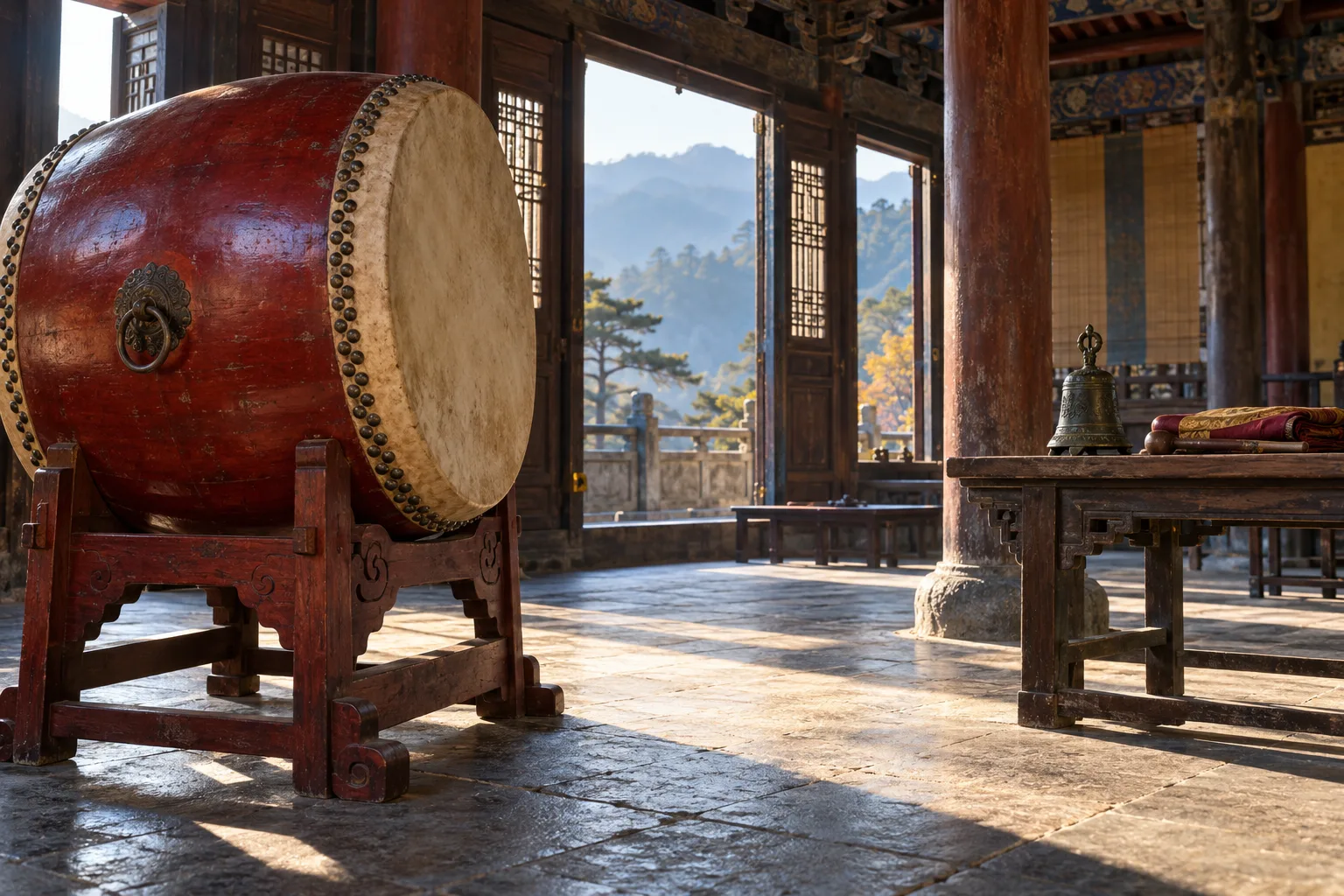
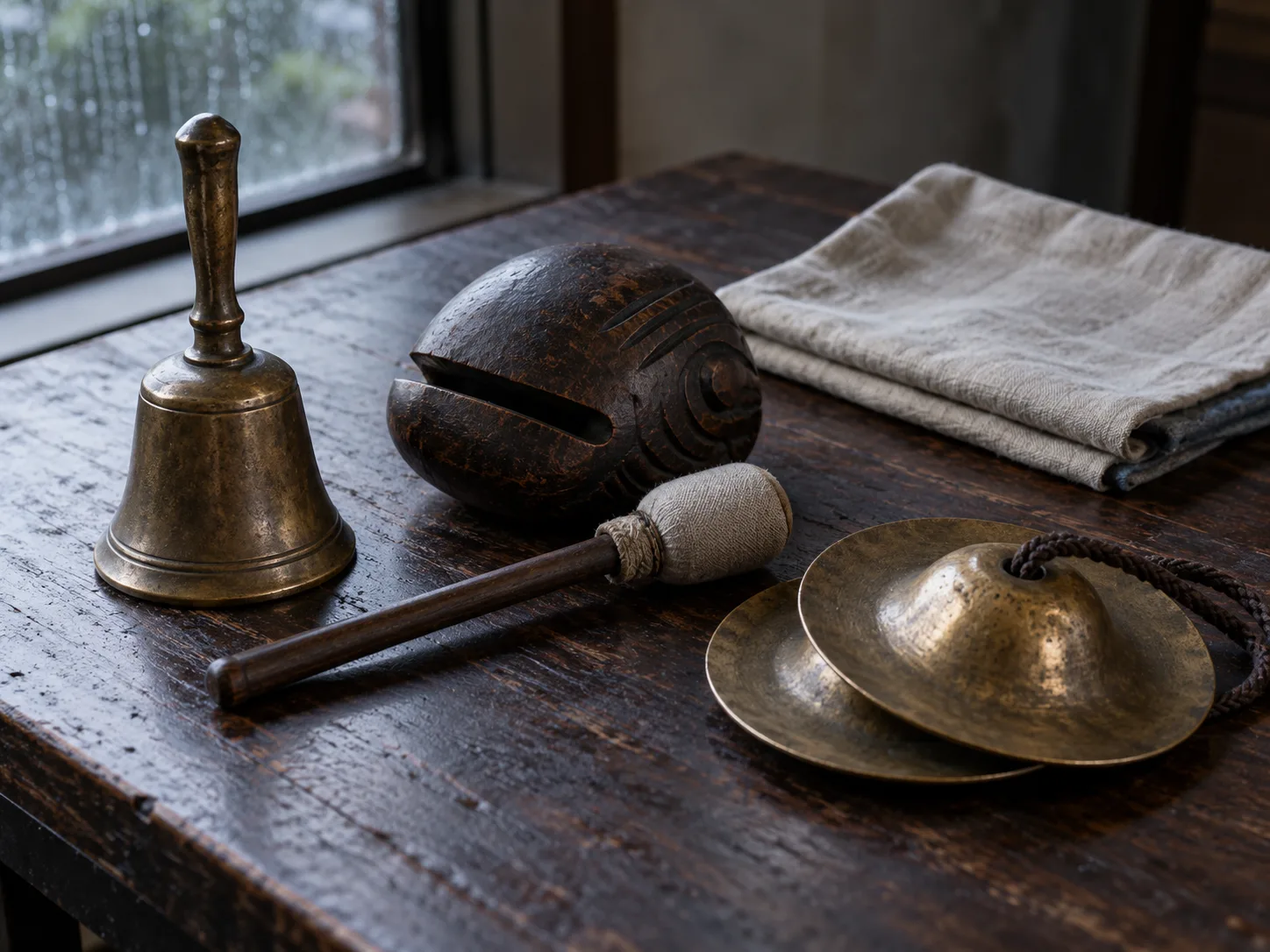
Bells, drums, wooden percussion and metal idiophones appear in many Chinese ritual environments, but an inventory is not a universal score. In practice, struck sounds can provide cues, maintain coordination, punctuate phrases or frame a transition. Timbre matters: a resonant metal tone, a dry wooden knock and a drum stroke occupy ceremonial space differently.
The visual authority of an object should not be mistaken for a complete explanation of its function. Like the garments introduced in Daoist ritual robes or the documentary tools examined in Daoist ritual seals, an instrument gains meaning through trained use in a larger ceremonial system.
Instrumental repertories are more than accompaniment
China’s national intangible-cultural-heritage record divides Wudang temple music broadly into vocal “rhyme-tunes” (yunqiang, 韵腔) and instrumental tune-types (paizi, 牌子), with further categories linked to occasion and function. This classification shows that Wudang’s practice includes named repertories and structured genres, not an undifferentiated wash of temple sound.
The record lists examples, but a visitor should not expect every item in every ceremony. Repertory depends on occasion, ritual program, available specialists and transmission. A short public demonstration may select material differently from an internal liturgical sequence.
3. Wudang Temple Music as Living Heritage
The national record is specific to Wudang
“Wudang Mountain Temple Daoist Music” is recorded in China’s national intangible cultural heritage inventory as traditional-music project II-69, announced in the first national list in 2006 and associated with Shiyan, Hubei. The record identifies vocal and instrumental categories and names liturgical contexts preserved in Wudang temples. It therefore provides Wudang-specific evidence rather than using a generic account of Chinese religious music.
Inventory status does not mean that a performance is frozen at the moment of inscription. It recognizes a body of knowledge, skills and practice whose continuity depends on people. For the architectural setting in which that practice has developed, see Wudang World Heritage.
Transmission preserves knowledge through practice
Ritual music is learned not only as isolated melodies but as a relationship among texts, cues, movements, occasions and ensemble roles. UNESCO’s guidance on living heritage stresses that transmission carries knowledge and skills while each enactment can vary. That principle is especially important here: continuity does not require every performance to be mechanically identical.
Written notation, recordings and inventories can aid study and safeguarding, but they do not replace embodied instruction. Timing a cue, aligning a response with a leader and understanding when not to play are forms of knowledge that become legible in practice.
Regional and institutional variation is normal
Musicological scholarship documents regional repertories, local styles and both stability and variation in Daoist ritual music. Wudang’s temple tradition should therefore be valued for its particular history without being treated as the single template for all Daoist communities. Zhengyi and Quanzhen settings, household and monastic specialists, local ensembles and different regions may organize sound differently.
Nor should a staged heritage concert automatically be read as a complete rite. A concert can transmit repertory and musicianship to a public audience; a ceremony organizes religious action. The two may share material while differing in duration, sequence, audience and purpose.
4. A Six-Step Guide to Respectful Listening
Identify the setting before naming the music
First ask what kind of event is taking place. Is it a scheduled public performance, a daily temple office, a festival, a memorial rite or a community offering such as the jiao? Programs and signs can help, but when information is unavailable it is better to leave the event unnamed than to improvise a label.
Then listen for relationships rather than collecting exotic objects. Who begins? Does a group answer? Does percussion coincide with movement? Does an instrumental passage bridge two vocal sections? These questions reveal structure without claiming access to meanings that have not been explained.
Follow six observable layers
- Setting: distinguish worship, rehearsal, demonstration and concert as far as the evidence allows.
- Voice: notice solo, group, response, recitation and sustained chant without assuming that every text is public.
- Cue: mark the sounds that precede or accompany an action, entrance or transition.
- Texture: hear how voice, percussion and melodic instruments enter, overlap or fall silent.
- Sequence: relate recurring sounds to the order of the rite rather than isolating a dramatic moment.
- Evidence: separate direct observation, program information, practitioner explanation and your own interpretation.
This method does not decode a ceremony. It creates an accurate listening record and makes later research possible. It also guards against the common mistake of turning all resonant sound into a claim about meditation, healing or “vibration.” Such health effects are not established by the heritage and musicological sources used here.
Let temple etiquette govern the recording
A ritual is not automatically a performance offered for unrestricted capture. Follow posted rules, staff guidance and the practical advice in Taoist pilgrimage and temple etiquette. Do not block movement, cross a ritual boundary, use flash or place a microphone without explicit permission. If participants or worshippers are present, their privacy matters even where architecture may be photographed.
Respectful listening can mean putting the camera away. Attend to sequence, leave space for participants and avoid speaking over quiet passages. Afterwards, connect the sonic experience with other material dimensions of temple life, such as incense in Daoist ritual, while keeping each practice distinct.
Research note: Wudang-specific classification and inscription details come from the China Intangible Cultural Heritage national project record and the Hubei intangible-cultural-heritage record. The wider description of recitation, chant, instrumental playing and regional research follows Tsao Penyeh and Shi Xinming’s peer-reviewed “Current Research of Taoist Ritual Music in Mainland China and Hong Kong”. The discussion of living transmission uses UNESCO’s guidance on transmission of intangible cultural heritage. Instrument roles and listening cues are presented as context-dependent, not universal.