Daoist Footwear: Cloth Shoes, Cloud Shoes and Ritual Movement
道教鞋履:布鞋、云履与科仪步伐
Footwear is easy to overlook beneath the colour and embroidery of Daoist ritual dress, yet it completes the line from crown to floor. This guide follows Wudang.Org’s connected studies of complete dress, ceremonial objects, sound and respectful temple conduct. It is a method for historical and visual reading, not a dress code or guide to ritual performance.
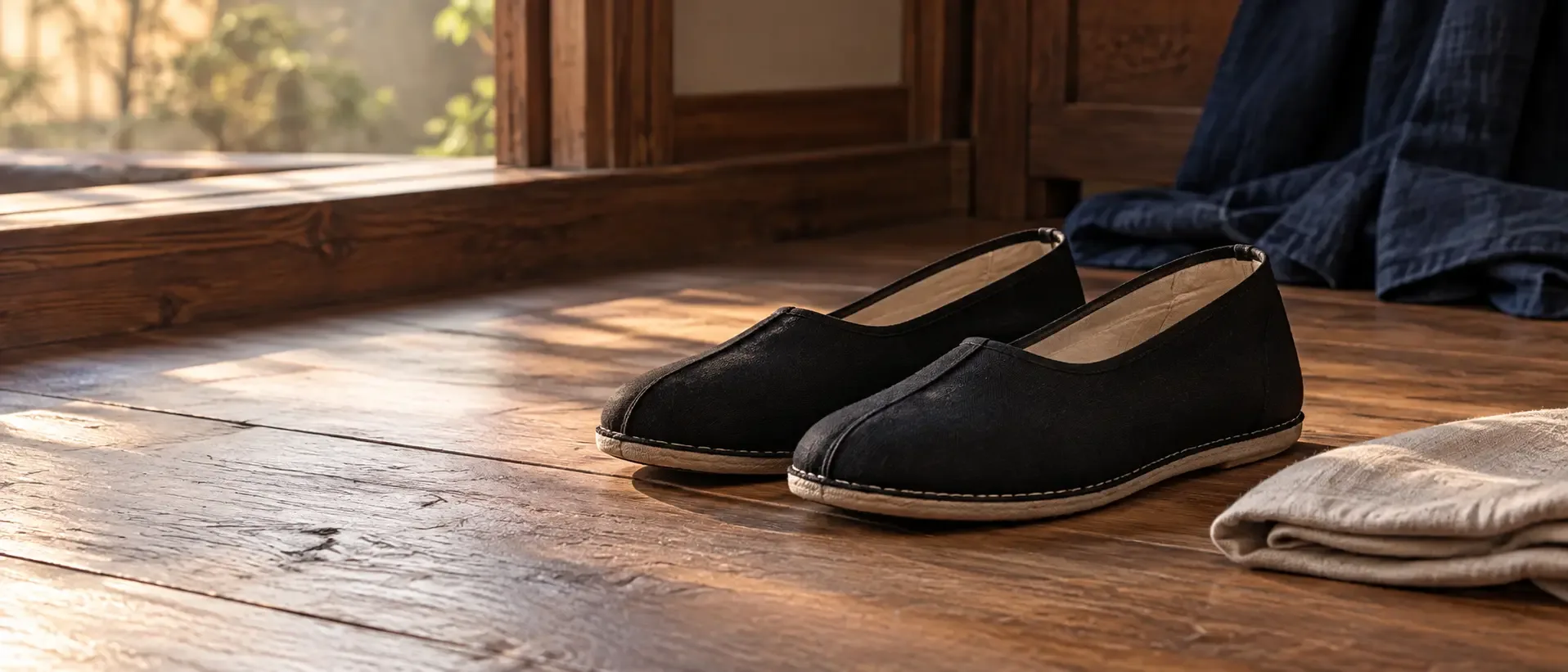
The central distinction is not “ordinary versus magical.” It is between evidence from a particular period or community and a timeless category invented after the fact. Plain cloth shoes, regulated medieval footwear, richly patterned cloud shoes and shoes shown in a portrait may all belong to Daoist histories, but they cannot be made interchangeable.
Footwear belongs to the complete vestment
From crown to the ground
Taiwan’s National Religion Information Network defines ritual vestment broadly as the clothing, headwear, footwear and attached objects worn when a Daoist officiates. That definition is useful because it restores the shoe to an ensemble: ritual robes, sash, crowns and headscarves, audience tablets and footwear work together rather than as separate curiosities.
Material objects answer different questions
A pair of shoes can show construction, wear, repair and decoration. It cannot by itself establish who wore it, whether it was consecrated, which rite it served or what rank the wearer held. For those questions, a catalogue needs provenance, an inscription, a dated manual, a photograph of use or an explanation from the community concerned.
Medieval rules joined symbolism to restraint
A prescriptive source, not a photograph of daily life
Livia Kohn’s Daoist Monastic Manual translates the early-seventh-century Fengdao kejie, a text concerned with institutions, sacred utensils, ritual clothing and conduct. Her related study Monastic Life in Medieval Daoism explains that its footwear rules favour leather, cloth or raw silk, restricted colours and restrained forms while associating the shoes with cosmic markings and careful handling.
Rules tell us ideals and boundaries
These passages are valuable because they show medieval authors distinguishing religious footwear from luxurious secular shoes and imagined divine slippers. They remain prescriptive: they tell us how writers thought proper shoes should be made and treated, not how every Daoist in every region actually dressed. Later embroidered shoes should not be declared “incorrect” merely because an earlier rule preferred simplicity.
Living cloud shoes form a different record
A named practice in Hong Kong
The Hong Kong Quanzhen ritual-music archive describes bright-red cloud shoes whose vamps carry cloud patterns and identifies them there as footwear for the high priest. The same page states that altar dress varies with position and ritual type. This is precise evidence for a named living regional tradition, not permission to label every red embroidered shoe a high priest’s cloud shoe.
Continuity includes change
Medieval regulations summarized by Kohn stress unornamented materials; the Hong Kong example is bright and embroidered. The contrast is historically useful. Religious traditions transmit categories while materials, visual languages, institutions and ritual needs change. Continuity does not mean that a single design has remained fixed since the seventh century.
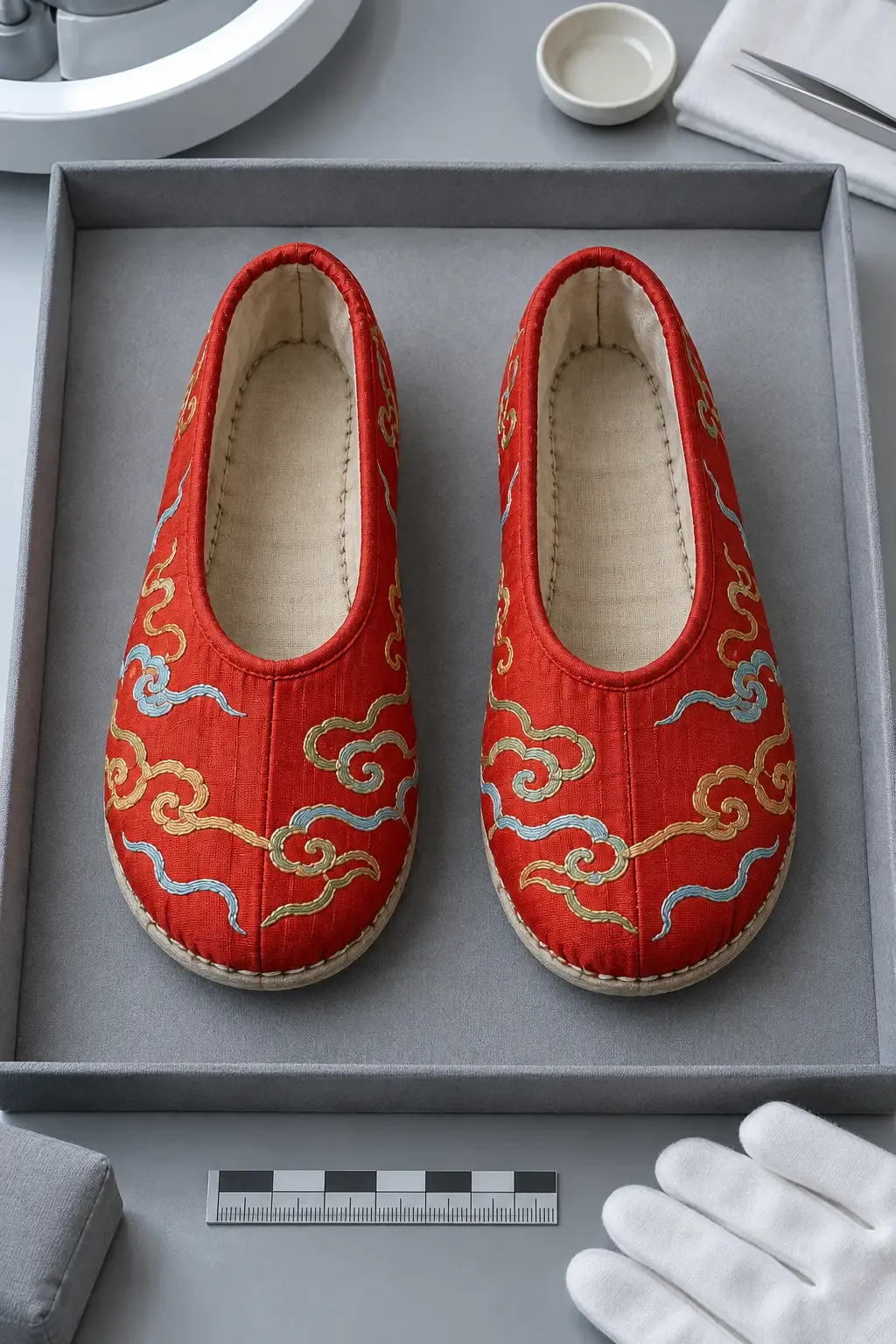
A portrait shows the ensemble at work
Cloud patterns are one part of a constructed image
A late-eighteenth-century portrait of a Daoist priest in the Royal Ontario Museum combines a jiangyi robe, glittering crown, ruyi sceptre and cloud-patterned shoes. The Berlin exhibition catalogue suggests that the image was kept for veneration in a Daoist temple. Footwear here helps construct an elevated religious presence together with the rest of the body.
An image is not an inventory
A painted shoe may simplify stitching, exaggerate colour or repeat an established pictorial convention. The portrait proves that cloud-patterned footwear belonged to this late-Qing representation; it does not prove that the surviving object in a shop or museum came from the same workshop, rank or ceremony. Representation and artefact must be recorded separately.
Shoes touch ritual movement without revealing choreography
Read posture, floor and occasion together
Footwear is the point where the dressed body meets the floor, so it participates in standing, turning, bowing and processional movement alongside ritual music. A contemporary scholarly overview of Daoist dignified liturgies treats vestments and implements as part of the order of the altar. Yet a sole, toe shape or cloud motif cannot reconstruct a sequence of steps. Claims about movement require a liturgical text, field documentation or authorized explanation of a specific rite.
A six-pass method for examining Daoist footwear
Move from object to context
- Preserve the source name. Record whether the catalogue says shoe, slipper, boot, cloud shoe or only ritual vestment.
- Describe construction first. Note cloth, leather, raw silk, layered sole, seam, binding, lining and repair before interpreting motifs.
- Read both shoes. Compare left and right for matched patterns, asymmetric wear, later replacement and display arrangement.
- Locate the ensemble. Ask which robe, crown, tablet, instrument and altar role appear with the footwear.
- Separate rule from observation. A medieval prescription, painted portrait, museum object and living institutional account are different kinds of evidence.
- State the limit. Do not infer consecration, lineage, rank, date or choreography from appearance alone.
Care, display and respectful looking
Shoes carry dust in daily life, but religious footwear may be stored and handled as part of sacred dress. Museums, temples and active communities therefore follow different protocols, and Wudang.Org’s guide to pilgrimage and temple etiquette offers a wider visitor context. Visitors should not try on, rearrange, step over or reproduce ceremonial footwear without permission. A new pair can possess current religious importance, while an old pair without provenance may remain difficult to identify.
Sources and interpretive limits
This article combines a medieval translated manual, historical scholarship, a government religion glossary, a living Hong Kong archive, a museum portrait catalogue and current ritual studies. Together they support a history of changing footwear within complete Daoist dress. They do not establish one universal shoe taxonomy, a single design shared by all lineages or a visual test for rank and authenticity.