Daoist Mirrors: Reflection, Cosmology and Ritual Evidence
道教铜镜:映照、宇宙图式与科仪证据
A round bronze mirror can hold two very different surfaces. One side was polished to return a face or a light; the other could carry a knob, inscriptions, directional animals, deities, mountains, trigrams or narrative scenes. In Daoist contexts, that decorated back might present the cosmos in miniature. Yet imagery alone does not prove that a mirror served in ritual.
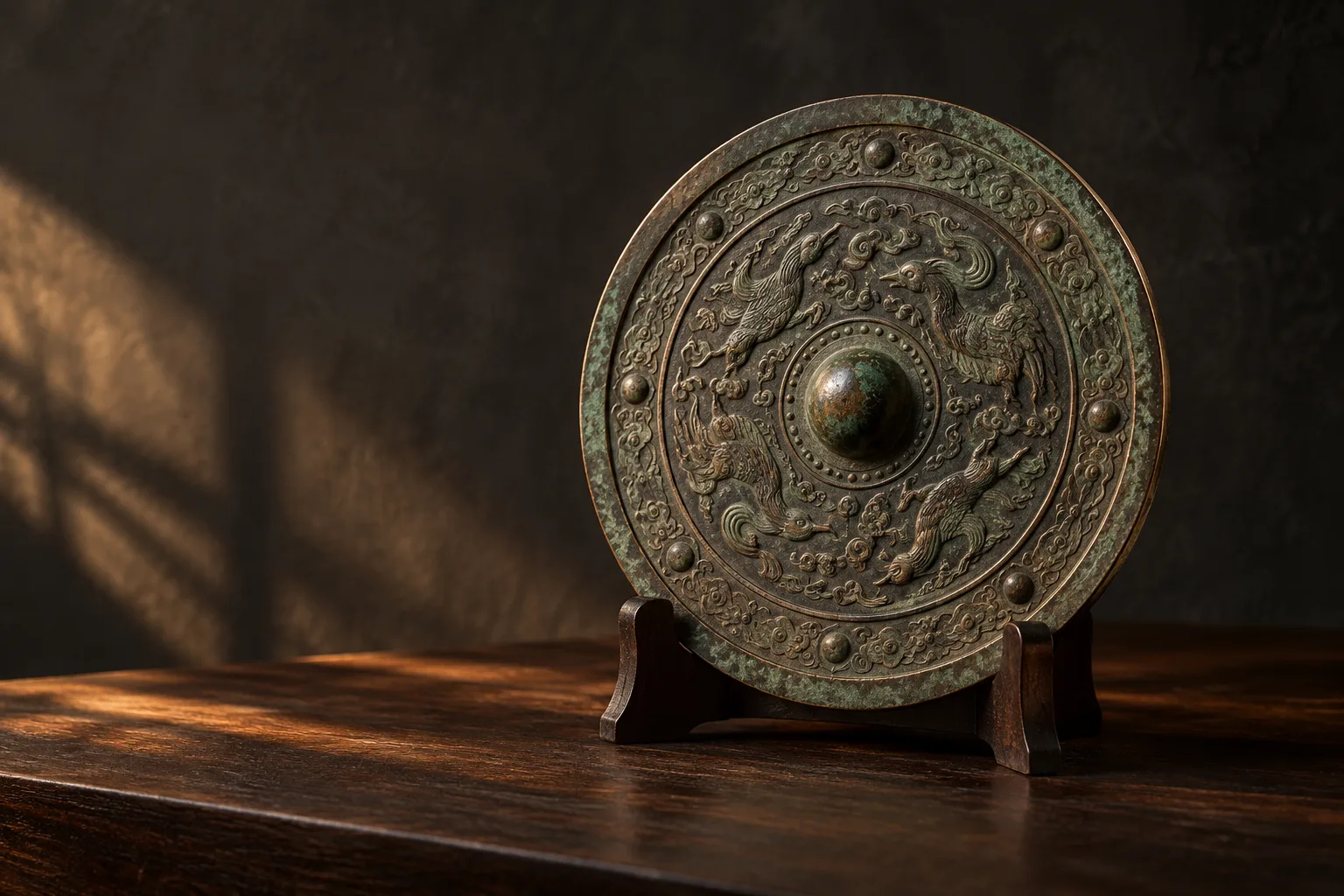
This guide connects the site’s overview of Daoism with Taoist festivals and rituals, the Daoist pantheon, ritual seals and talismans. It asks how to move from object to interpretation without turning every old mirror into a magical instrument or every cosmological pattern into evidence of ceremonial use.
Begin with the mirror as a made object
Front, back and central knob do different work
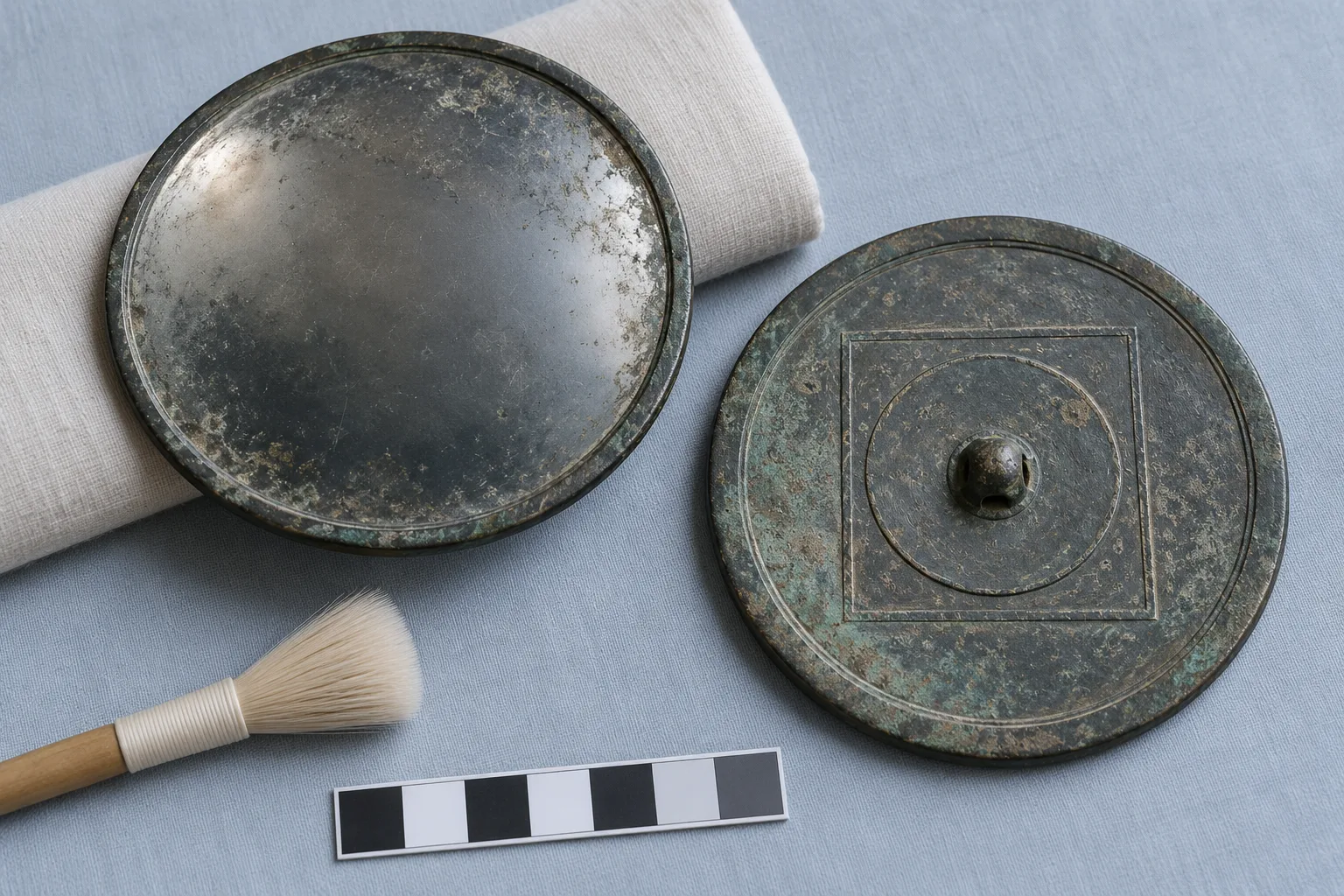
The reflective face and the decorated back should be read separately before they are read together. Museum mirrors often survive with a dark, corroded or abraded face, but their original identity depended on polishing. The reverse was cast or worked in relief around a central knob. A cord could pass through a pierced knob, making the object easier to hold, suspend or secure.
Do not call the front “plain” and the back “the image” too quickly. Reflection was part of the object’s action, while the back carried durable marks. Edge thickness, rim profile, knob shape, casting seams and surface wear can be as informative as the most recognizable deity.
Casting and polishing leave different evidence
A Cleveland Museum record for a Warring States mirror explains that stamped clay moulds could repeat small units before molten bronze was poured. Its curators also leave the dominant mountain-like pattern’s meaning unresolved. This combination of technical precision and interpretive restraint is important: a repeated form can be identified without assigning it a religious meaning.
Patina is not the mirror’s original colour, and present dullness is not evidence that it never reflected. At the same time, aggressive polishing can erase corrosion history, scratches and residues. Museum objects should be examined through collection records and by qualified conservators, not “restored” experimentally.
Shape and scale change the viewing experience
Many mirrors are circular, but lobed and flower-shaped examples also survive. A Song-period octafoil mirror in Cleveland frames two immortals above waves within an eight-lobed outline. Its shape, relief and central knob coordinate an image around a hand-sized object rather than a wall picture.
Scale matters. A small mirror may invite close, turning inspection; a larger example can organize multiple rings of text, animals and celestial signs. Neither size nor shape alone establishes an owner, altar position, burial use or ritual function.
Cosmology can be mapped onto the back
Circle, square and directions can order space
The National Museum of Asian Art’s “Four Directions Mirror” has a circular field and a square earth diagram. Its inscription identifies “images of heaven and earth,” with celestial signs above and watercourses and sacred mountains below. The museum dates it broadly to the Tang or possibly Song dynasty, reminding us that even an important object can retain chronological uncertainty.
A square inside a circle is therefore more than an attractive geometry when an inscription explains it. Without such text or secure comparison, however, geometry should remain an observation rather than a complete interpretation.
Directional animals link time and space
A Sui-dynasty mirror presented in the Art Institute of Chicago’s Taoism and the Arts of China places the Green Dragon, Vermilion Bird, White Tiger and Dark Warrior around the central knob, with the twelve zodiac animals in an outer band. The exhibition reads the back as a map and calendar that divides both space and time.
Those associations are powerful, but they belong to an object, diagram and documented interpretive tradition. A tiger, bird or dragon on another mirror may participate in a different design. Identify the complete arrangement before treating one motif as a fixed code.
Deities and stories make the cosmos inhabited
Eastern Han mirrors can place Xiwangmu, the Queen Mother of the West, and Dongwanggong, the King Father of the East, among directional animals, attendants, chariots and mythical creatures. A Cleveland mirror dating to 100–200 CE shows these figures with the White Tiger and a horse-drawn chariot; the museum explicitly notes that the full meaning of the imagery is not understood.
Later mirrors could frame immortals crossing water or musicians within landscapes. Such scenes connect the object to stories and religious imagery, but a depiction of an immortal is not the same evidence as a record of ritual use. Iconography, ownership, find context and written testimony answer different questions.
Ritual use needs more than a Daoist-looking image
A dated inscription can anchor an object
A bronze mirror at the National Museum of Asian Art bears a forty-four-character dedicatory inscription dated to 202 CE. The text names the Five Emperors, the Sovereign of Heaven, the Yellow Emperor and the animals of the four directions, and closes with a wish that the recipient attain high office. Date, named figures and auspicious wish make this evidence unusually specific.
Even here, the inscription does not tell us every action once performed with the mirror. It anchors manufacture, imagery and dedication more securely than it reconstructs a complete ceremony. A named date is a starting point, not a licence to invent a ritual sequence.
Words can indicate ceremony more directly than motifs
The inscription on the “Four Directions Mirror” refers to prognostication and, in the Museum’s reading, suggests use by a Daoist priest in ceremonial rites. That is stronger evidence for ritual use than the presence of trigrams alone because the interpretation rests on the object’s text as well as its diagram.
Compare this with Daoist ritual seals: a seal’s authority emerges through inscription, institutional context and the documents it marks, not through shape alone. Mirrors likewise need converging evidence.
Burial, grooming, display and ritual can overlap without merging
Bronze mirrors appear in tombs, collections and ordinary material life as well as religious histories. The Art Institute notes funerary ideas around reflected light, while other museum records emphasize personal reflection, auspicious imagery or artistic design. These roles may intersect, but they should not be collapsed into one universal “Daoist mirror” function.
A responsible label says what kind of evidence supports each claim: object inscription, excavated context, historical text, museum interpretation or later comparison. When that evidence is missing, “Daoist imagery” may be more accurate than “Daoist ritual implement.”
A six-step method for reading a Daoist mirror
Move from surfaces to claims
- Separate the two faces. Record the reflective surface, decorated back, rim and edge before interpreting the design.
- Map the construction. Note alloy, casting, knob, cord opening, repeated mould units, polishing and later corrosion.
- Describe the whole diagram. Locate circles, squares, directions, animals, deities, inscriptions and narrative bands in relation to one another.
- Translate the level of evidence. Distinguish what the object shows from what a curator, text or comparison proposes.
- Test ritual claims. Look for inscriptions, priestly or altar context, excavated associations and documented use rather than relying on motifs alone.
- Keep uncertainty visible. Preserve disputed dates, unidentified figures and unclear functions instead of completing the story by guesswork.
Compare three kinds of evidence
Set the 202 CE dated mirror beside the “Four Directions Mirror” and the Cleveland deity-and-chariot mirror. The first gives a date and dedication; the second connects diagram, inscription and possible ceremony; the third offers rich iconography while openly retaining uncertainty. Together they show why no single clue does every job.
Then compare the mirrors with Daoist talismans. Both can organize words and images into a charged surface, but neither should be reduced to decoration or treated as a free-standing recipe. Historical action depended on trained people, institutions and context.
Let reflection remain part of the interpretation
A mirror is not only a bronze disk with a picture on its back. Its two sides join reflected light, bodily viewing, portable form and a durable cosmological surface. That tension helps explain why mirrors could move among practical, funerary, auspicious and ceremonial worlds.
Useful starting points are the National Museum of Asian Art records for the dated 202 CE mirror with Daoist deities and the Four Directions Mirror; the Cleveland Museum of Art’s mirror with deities, chariot and White Tiger, octafoil mirror with two immortals and mountain-pattern mirror; and the Art Institute of Chicago’s cosmological mirror study. Their agreements and cautions support a method based on surfaces, inscriptions, context and explicit limits.