Zhai Rituals: Taoist Purification, Fasting and Preparation
斋仪:道教洁净、持戒与祭前准备
Zhai is usually translated as "fasting", which gets the practice about half right. Food restriction is part of it, but the word covers a wider idea: a period of deliberate purification undertaken before or as a religious act, involving diet, conduct, speech, dress, seclusion and, historically, confession.
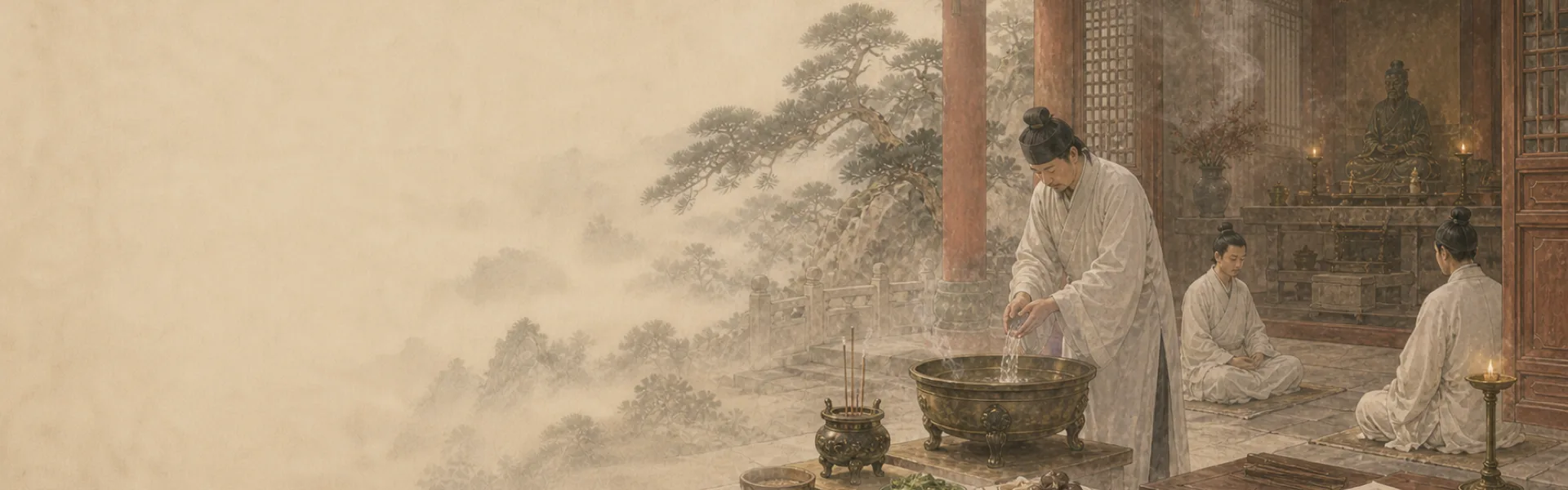
Zhai is the counterpart to jiao. Where a jiao presents an offering, a zhai prepares and cleanses. The two became so entangled that the compound term for large-scale Taoist ritual joins them, and much of what is now called a jiao contains a zhai inside it.
What the Taoist Term Zhai Covers
The character originally referred to purification before sacrifice, a usage older than Taoism and shared with the state cult and with Confucian ritual. Before an emperor sacrificed, he observed a period of abstinence and seclusion. The idea is that an approach to the powers requires the approacher to be in a fit condition, and that fitness is achieved by subtraction rather than by addition.
Taoism inherited this and developed it into something much more elaborate. By the fifth century there were named and graded zhai with defined procedures, durations and purposes, and by the Tang the repertoire was extensive enough to require classification.
Three senses of the word are worth separating, because English collapses them. Zhai can mean the abstinence itself — not eating meat, not drinking wine. It can mean the rite, a structured multi-day observance with liturgy. And it can mean the food: a temple's vegetarian meal is called zhai, and to "eat zhai" means to keep a vegetarian diet. All three are in current use and context decides.
The Early History of Taoist Zhai Rituals
The most consequential early form came from the Celestial Masters community in Sichuan from the second century onward. In that system illness was understood as the consequence of moral fault, and the remedy was a written confession submitted to the Three Officials of Heaven, Earth and Water, accompanied by a period of seclusion and abstinence.
This deserves attention because of what it established. It made moral accounting the mechanism of religious efficacy, it made the document the instrument, and it made the individual's own admission the necessary first step. Documentary ritual in Taoism starts here, and so does the conception of the divine world as a records office.
Some early zhai were severe. One well-attested form involved smearing the body with charcoal or mud and prostrating repeatedly over days as an act of self-abasement, performed in cases of serious affliction. It was criticised within the tradition, moderated, and eventually abandoned, but it is a useful corrective to any impression that Taoist practice was uniformly gentle.
The decisive systematisation came with Lu Xiujing in the fifth century, who codified Lingbao ritual, arranged the zhai into a graded set with prescribed procedures, and produced the threefold classification of the Taoist canon. He is the figure who turned an assortment of practices into a liturgical system, and his work is the reason later Taoist ritual has the shape it does.
What Purification Means in a Zhai Ritual
The components are consistent across traditions, though the strictness varies with the rite.
Diet. No meat, no wine. The five pungent vegetables — the allium group, garlic, onion, leek, chive and a fifth variously identified — are also excluded, on the grounds that strong odours are unsuitable in the presence of deities and are held to disturb the practitioner. Quanzhen monasteries observe this permanently rather than only during rites.
Conduct. Sexual abstinence. Avoidance of quarrels, of loud entertainment, of legal disputes, of anything that agitates. In stricter forms, restricted speech, since talk is treated as expenditure.
Body and dress. Bathing, clean clothing, and for clergy a change from ordinary gowns to vestments at the appropriate point. Hair bound properly. The physical preparations are not symbolic decorations added to an inward state; in this tradition the outward and inward are not sharply separated.
Seclusion. Withdrawal from ordinary business for the duration, in a designated place. For a major rite this may mean clergy entering the ritual precinct and remaining there.
Confession. Acknowledgement of fault, historically in writing, submitted rather than merely felt. This is the component that has receded most in modern practice but it is the one that carries the most of the original logic.
Why Zhai Ritual Uses Moral Bookkeeping
The moral logic of zhai only makes sense against the administrative premise that organises the whole tradition.
If the divine world is an administration holding records, then wrongdoing is an entry, not a stain. An entry can be amended, and the procedure for amending it is an application. Confession is therefore not primarily an emotional or therapeutic act; it is the submission that initiates the correction of a file.
Several features of Taoist practice follow directly. Merit and demerit are counted, sometimes literally, and popular ledgers of merit circulated widely in the Ming and Qing allowing people to keep score. Punishment is expressed as reduced lifespan or as posthumous detention, both of which are administrative outcomes. Amnesty is possible, and the festival of the Official of Earth in the seventh month exists to grant it. And merit is transferable, which is why one person can petition on behalf of another, including the dead.
This is a coherent moral system with an unusual shape. It is neither a matter of divine grace nor of purely internal virtue. It is closer to civil procedure, and it has the strengths and weaknesses of civil procedure: it is fair in principle, it is legible, and it invites the thought that the right paperwork might substitute for actual reform. Taoist writers were aware of that objection and address it, insisting that a petition without genuine change is void.
How Zhai and Jiao Rituals Work Together
The two categories were originally distinct. Zhai was inward-facing, penitential and preparatory; jiao was outward-facing, presentational and celebratory. From the Tang and Song onward they merged, and the standard term for Taoist ritual in Chinese joins them into a single compound.
The merger is visible in the structure of a modern large rite. Clergy enter a period of abstinence and seclusion before it begins; the ritual area is purified; there is a penitential segment in which faults are acknowledged on the community's behalf; and only then does the presentation of the offering proceed. The zhai has become the first half of the jiao.
Something was lost in the merger. In the earliest form the person seeking relief made the confession themselves. In the developed liturgical form a priest does it on their behalf, as an authorised agent. This is a gain in institutional reliability and a loss in directness, and it is a good illustration of what happens when a religion professionalises.
Vegetarian Zhai Food in Taoist Temples
The most common contemporary encounter with zhai is culinary. Quanzhen monasteries are vegetarian by rule, and many maintain a kitchen that serves clergy and, on festival days, large numbers of visitors.
Temple vegetarian cooking is a real cuisine with its own conventions: bean curd and gluten preparations, mushrooms, seasonal vegetables, and the avoidance of the pungent alliums, which means the flavour base is quite different from ordinary Chinese cooking. Imitation meat dishes have a long history in this tradition and are not a modern novelty.
The communal meal after a festival liturgy is a genuine part of the occasion rather than an appendix to it. Eating together is how a temple's lay constituency is constituted, and in many places the meal is the reason a family attends. Visitors are usually welcome. Where a donation is customary it is voluntary and unattended, and no one will ask.
Lay people who are not vegetarian often keep zhai selectively: on the first and fifteenth of the lunar month, on a particular deity's festival, during the seventh month, or for a fixed period in fulfilment of a vow. This partial observance is normal and is not regarded as a compromise.
What This Site Does Not Claim About Zhai Rituals
Dietary and abstinence practices are often presented in modern writing as health regimens with specified physiological benefits. This site describes zhai as a religious practice with a documented history and does not present traditional physiological claims as established fact.
Two things can be said without overreaching. First, the rationale given in the tradition is religious rather than nutritional: the point of abstaining is fitness to approach, not longevity, and the sources say so. Second, prolonged restriction of any kind has real physical consequences, and monastic diets were designed within an institution that could support them. Nothing here is a recommendation, and anyone considering a substantial change in diet should take ordinary medical advice.
The historically interesting point is a different one. Zhai shows a religion working out, very early, that the condition of the person matters to the validity of the act — and then building an institution around maintaining that condition. Most of what a Taoist monastery does on an ordinary day is a standing zhai.
Sources and limits. This page draws on early Celestial Masters material on confession and healing, Lu Xiujing's codification of Lingbao ritual, Tang and later classifications of zhai, Quanzhen monastic regulations, and studies of temple vegetarian practice. Terminology and strictness vary by lineage and region. No liturgical text is reproduced and no dietary or practice instructions are given.
Key Points About Zhai Rituals
Zhai means more than fasting: a period of purification covering diet, conduct, speech, dress, seclusion and historically confession.
The word carries three current senses — the abstinence, the multi-day rite, and the vegetarian food itself.
The practice predates Taoism in the state and Confucian cults, where an emperor purified himself before sacrificing.
The Celestial Masters treated illness as moral fault remedied by written confession to the Three Officials; documentary ritual in Taoism starts here.
Some early forms were severe, including charcoal-smearing self-abasement, which was criticised within the tradition and abandoned.
Lu Xiujing codified the graded zhai in the fifth century and devised the threefold canon classification, turning practices into a system.
Diet excludes meat, wine and the five pungent alliums; Quanzhen monastics observe this permanently, not only during rites.
Moral accounting is bookkeeping: faults are entries, confession is an application, amnesty is possible, and merit is transferable.
Zhai and jiao merged from the Tang onward, so the zhai became the first half of a large rite — and a priest now confesses on the community's behalf rather than the sufferer doing it directly.