Daoist Crowns and Headscarves: Dress, Rank and Ritual Context
道教冠巾:衣制、职司与科仪语境
Daoist headwear can look deceptively simple: a black cloth folded over a hair knot, a structured cap, or a many-petalled ceremonial crown. Yet these forms do more than complete an outfit. In different communities they can distinguish ordinary dress from altar service, make clerical identity visible, or mark a particular ritual role. The safest way to read them is through the Chinese terms, the wearer, the occasion and the source—not through shape alone.
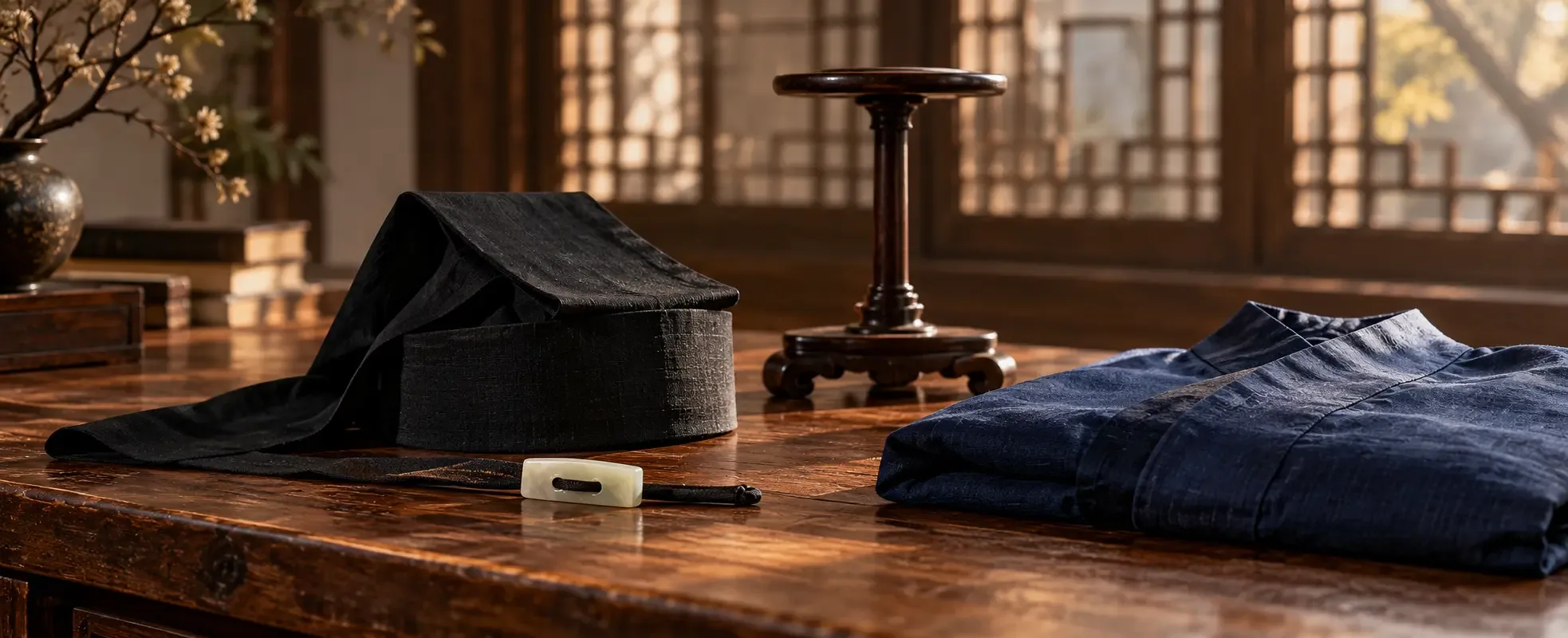
This guide extends Wudang.Org’s pages on ritual robes, audience tablets, registers and transmission, ritual music and ordination today. It offers historical and visual literacy, not a dress code, initiation guide or method for assigning rank to a living person.
Begin with two words: jin and guan
Cloth headwear and ceremonial crowns
Jin (巾) originally names cloth used to bind or cover the head; guan (冠) points toward a more structured crown or cap. In modern Daoist descriptions the terms can separate everyday or community dress from more formal ceremonial headwear, but actual usage is neither timeless nor uniform. Translation adds another problem: “cap,” “scarf,” “crown” and “headdress” overlap, so the original catalogue term should remain visible.
A field of clothing, not one uniform
Taiwan’s national religion information service defines ritual vestment broadly to include garments, headwear, footwear and attached objects used when a Daoist officiates. The Hong Kong Quanzhen ritual-music archive likewise shows that the clothing of altar participants varies with their position and the type of rite. These are strong reasons to resist the image of a single universal “Daoist costume.”
Dress makes a community visible
Quanzhen identity in history
Vincent Goossaert’s study of thirteenth-century Quanzhen institutions notes that distinctive robes and caps helped clerics identify themselves to one another and to lay communities. Dress was one element among names, discipline, itinerancy, liturgy and shared stories. The same study cautions that the detailed formation of a Quanzhen dress code remains poorly documented, so later lists should not automatically be projected back onto the order’s founders.
Recognition is not authentication
A cap can signal affiliation in a portrait or public ceremony, but it cannot by itself prove lineage, ordination, rank or date. Garments may be borrowed, remade, staged, preserved outside their original setting or represented by an artist. A reliable identification joins visual evidence to inscriptions, provenance, institutional records and the surrounding ritual ensemble.
Headwear changes with ritual role
The altar is differentiated
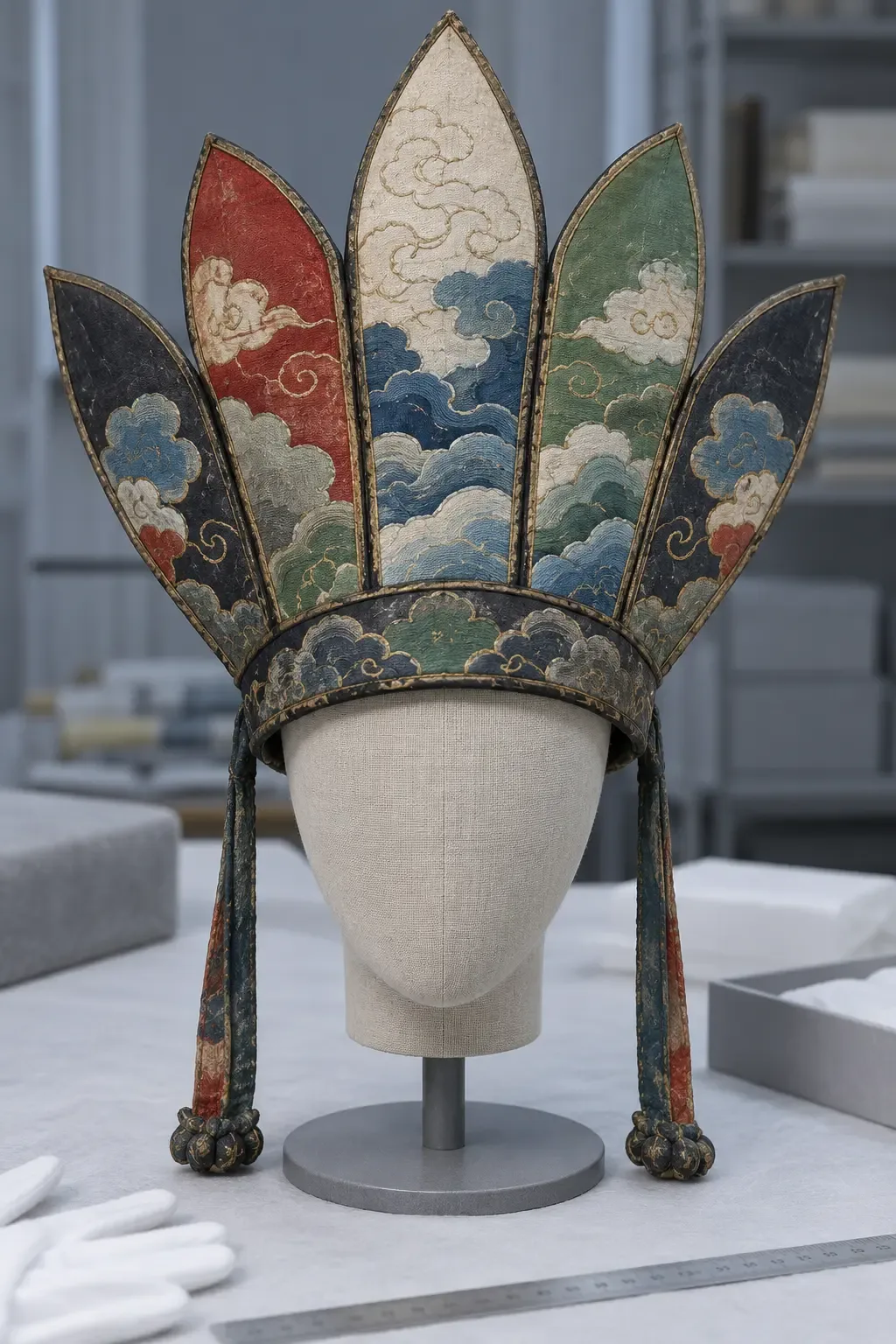
The Hong Kong archive describes a high priest’s Cihang cap used for a particular salvation ritual and a lotus-petal “Five-emperor” attachment worn when the officiant represents divine authority while expounding scripture. This is a valuable record of one living regional tradition. It is not a licence to call every petalled crown by the same name or to assume identical use in Zhengyi, Quanzhen and local ritual communities.
Read headwear with the whole body
A late-eighteenth-century portrait of a Daoist priest in the Royal Ontario Museum shows crown, jiangyi robe, ruyi sceptre and cloud-patterned shoes as a coordinated image of elevated status. The exhibition catalogue suggests the portrait served veneration in a temple. The crown becomes meaningful through that complete arrangement, not as an isolated fashion detail.
A five-petalled crown as a case study
Object record before symbolism
Taiwan’s National Cultural Memory Database records a Five Old Lords crown made from five elongated pentagonal textile panels fixed to a black band. Each panel bears one of the Five Old Lords, identified with the rulers of the five directions. The record dates the object to the 1960s and associates it with ritual use in Taiwan. Material, construction, imagery, place and date are all more secure starting points than a free-floating symbolic reading.
One name can conceal several distinctions
The Hong Kong “Five-emperor” attachment and the Taiwanese Five Old Lords crown share a five-petalled arrangement and directional imagery, yet their catalogues, ritual communities and stated uses are not identical. They should be compared, not collapsed. Even when English labels sound interchangeable, photographs cannot establish consecration, office or the precise ceremony in which an object was worn.
“Guanjin” can name an admission rite
Headwear becomes an institutional action
In contemporary Quanzhen usage, guanjin (冠巾) also names a rite through which an eligible resident practitioner is formally admitted. Regulations approved by the Chinese Taoist Association in 2015 describe application, qualified masters, a traditional ceremony, a certificate and subsequent registration. Here the compound does not merely label two objects; it names a recognized institutional passage.
Sik Sik Yuen’s Wong Tai Sin Temple documents its own Guanzhen admission and covenant rite, in which robe, headwear and a transmission document participate in establishing identity. The mainland management rules for Quanzhen guanjin activities describe a related but administratively specific system. Neither source should be used to define every Daoist admission practice everywhere.
A six-pass method for reading headwear
From silhouette to evidence
- Keep the source term. Record whether the catalogue says jin, guan, cap, crown, attachment or admission rite.
- Identify the wearer. Distinguish a historical person, living officiant, deity, actor, mannequin or unidentified portrait sitter.
- Describe construction. Note cloth, rigid frame, panels, ties, fasteners, embroidery and signs of repair before interpreting symbols.
- Read the ensemble. Robe, shoes, tablet, sceptre, instruments and altar position may clarify function.
- Locate the occasion. Daily residence, public procession, scripture exposition, salvation rite and admission ceremony are not interchangeable.
- State the limit. Say what the record supports and what remains unknown about consecration, lineage, ownership or rank.
Living traditions and respectful looking
Daoist dress remains living religious culture. Visitors should not try on, rearrange or copy ceremonial headwear without permission, and photographs should not expose private rites against a community’s wishes. A newly manufactured item can still be ritually important, while an old museum object may have lost its original context. Age and sacred status are separate questions.
Sources and interpretive limits
The evidence connects headwear to visible clerical identity, differentiated altar roles, coordinated ritual dress and contemporary admission procedures. It does not yield a universal taxonomy. The sources range from institutional regulations and living-community documentation to museum catalogues and historical scholarship; each answers a different question. Names, dates and functions therefore remain attached to their sources rather than being merged into one timeless costume system.