Double Ninth Festival: Chongyang, Longevity and Respect for Elders
重阳节:九月初九、长生观念与敬老传统
The ninth day of the ninth lunar month is the Double Ninth Festival, Chongyang. It is one of the oldest dates in the Chinese calendar and one of the few that has been continuously observed, repurposed and legislated about across more than two thousand years.
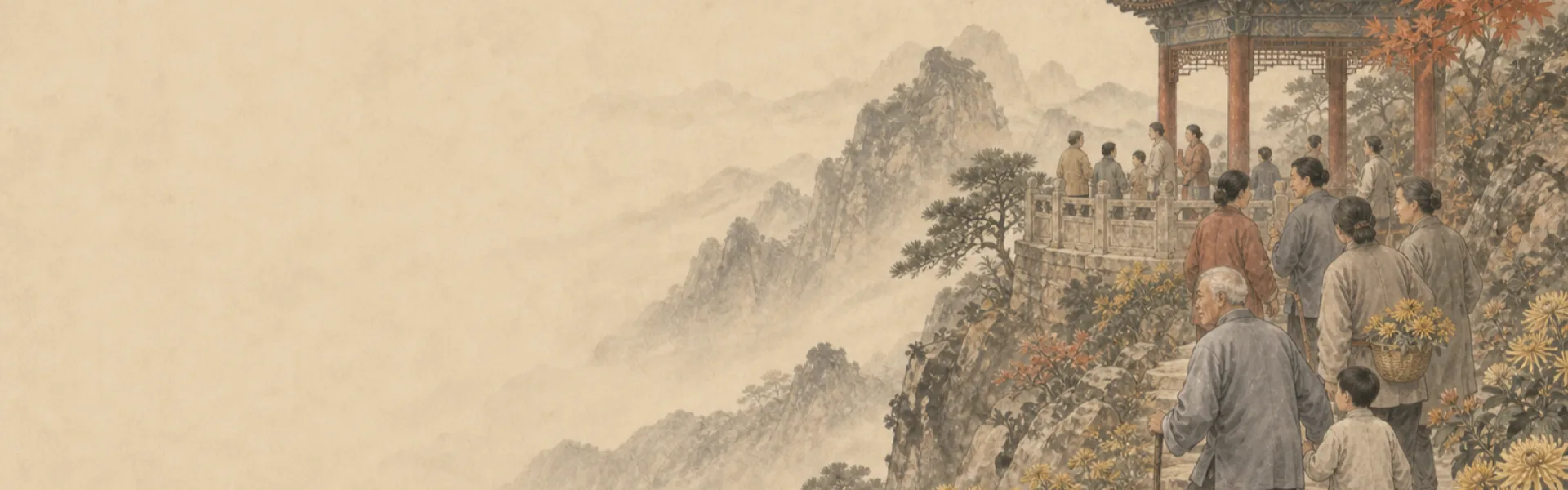
For Taoism it matters on three counts. The number logic is a clear worked example of how the cosmology assigns meaning to dates. The customs are tied to longevity practice. And in the modern Chinese calendar the day has become the national festival for respecting the elderly, which is a genuine continuity rather than a break.
Why the Double Ninth Festival Falls on the Ninth Day of the Ninth Month
In the numerology that underlies Chinese cosmology, odd numbers are yang and even numbers are yin. Nine is the largest single-digit odd number, so it is the most yang of the digits, and it is associated with Heaven, with the emperor and with completeness — hence nine ranks of officials, nine provinces, nine palaces.
The ninth day of the ninth month therefore doubles the maximum yang value. The name chongyang says exactly this: chong is "doubled" or "repeated", yang is the yang principle. Nothing mystical is being asserted; the date is significant because the calendar and the number system intersect there, in the same way that the fifteenth of a lunar month is significant because it falls at full moon.
An excess of yang is not straightforwardly good. In this system health and safety lie in balance, and a doubled maximum is an imbalance. That is why the traditional customs of the day are protective rather than celebratory in origin: the earliest recorded practices are about avoiding harm on a dangerous date.
This point is worth holding onto, because it is the single most common misreading of Chinese cosmology by outside readers. Yang is not "good" and yin is not "bad". They are complementary phases, and either in excess is a problem. A festival built on doubled yang is a festival about managing a peak, not about enjoying one.
Double Ninth Customs and Their Protective Purpose
Four customs recur in the sources from the Han and Six Dynasties onward, and all four have practical or medicinal rationales attached.
Climbing high. The best-known practice is to ascend a hill or tower on the day. The story usually told involves a family advised by a teacher to leave their village and climb a mountain carrying certain plants, returning to find that a pestilence had killed everything left behind. Whatever one makes of the tale, the underlying logic is avoidance: leave the low, enclosed, populous place on a dangerous day. Height also connects to the yang associations of the date, and to a broader Chinese practice of using elevation to mark occasions.
Chrysanthemum. The chrysanthemum flowers in autumn, is associated in Chinese medicine with clearing heat, and appears in longevity contexts from early on. Chrysanthemum wine — flowers steeped in rice wine — is the characteristic drink of the day, and chrysanthemum viewing is the characteristic outing. The flower's association with retirement, integrity and the scholar who withdraws from office comes largely from the poet Tao Yuanming in the fourth to fifth century.
Zhuyu. Sprigs of a strongly aromatic plant, usually identified as a species of Zanthoxylum or the related evodia, were worn in a pouch or in the hair. Aromatics used against illness and insects are a broad and practical category in Chinese custom, and this is a seasonal instance of it.
Cakes. Layered steamed cakes are eaten, the layers punning on height, since the word for cake and the word for high are near-homophones. Food puns of this kind are pervasive in Chinese festival practice and are usually the reason a particular dish attaches to a particular day.
The Double Ninth Festival and Longevity
The Double Ninth is where the festival calendar touches the longevity tradition most directly, so it is worth being careful about what that tradition actually claimed.
Chinese longevity practice covers a wide range. At the practical end it includes dietary regulation, seasonal adjustment of behaviour, breathing exercises, gentle movement, herbal supplementation and sexual regulation — a body of advice that overlaps heavily with ordinary medicine and much of which is unremarkable. At the other end it includes external alchemy, the attempt to produce an elixir from mineral ingredients, and later internal alchemy, which relocated the same operation inside the body and reread the mineral vocabulary as metaphor.
External alchemy was taken entirely seriously for centuries and killed people. Cinnabar is mercury sulphide, and lead and arsenic compounds were also used. Several emperors are thought to have died from elixirs. The internal turn in the Tang and Song was driven partly by this record, and internal alchemists were often explicit that the outer laboratory had been a misunderstanding.
What was actually being sought also needs care. The English word "immortality" suggests endless life in the ordinary body, and that is not usually the claim. The Chinese term for the goal, becoming a xian, points to refinement and a changed condition rather than mere duration. Ge Hong in the fourth century graded transcendents technically — those who rise to the heavens, those who remain on earth, and those who depart by leaving the body behind — which indicates a technical literature about states, not a fantasy of never dying.
This site describes these practices historically and structurally. It provides no instructions, and it does not present traditional physiological claims as established fact.
Ascension Traditions and Wang Chongyang
Two Taoist associations attach specifically to the date.
The first is that the ninth day of the ninth month is observed at Wudang as the ascension day of Zhenwu, the Perfected Warrior, whose birthday falls on the third day of the third month. The pairing of a birth date in spring with an ascension date in autumn is a common structure, and ascension is treated as a change of status rather than a death, so the day is marked with celebration rather than mourning.
The second is a matter of naming. Wang Zhe, the twelfth-century founder of the Quanzhen school, is universally known by his religious name Chongyang — the same word as the festival. Quanzhen monasteries and the many temples named Chongyang after him therefore carry an implicit connection to this date and to the ideas of doubled yang and refinement that it encodes.
Neither association should be overstated. The festival is far older than either, and its main content across Chinese society has never been specifically Taoist. But the coincidences are real and they explain why a visitor at a Taoist temple on this date may find the day being marked for reasons that have nothing to do with chrysanthemums.
Respect for Older People at Double Ninth, Past and Present
The link between the Double Ninth and old age is not a modern invention, though its current legal form is recent.
The connection runs through the number. Nine, the largest yang digit, was long associated with longevity, and the phrase for the ninth of the ninth is a homophone of a phrase meaning "long lasting". Poems and imperial banquets on the day frequently invoke long life, and the chrysanthemum wine was drunk for the same reason.
In 1989 the day was designated Seniors' Day in mainland China, and the 2013 revision of the law on protecting the rights of the elderly gave the designation statutory footing. In practice this means organised visits to elderly relatives, community events, health checks and media attention on ageing. Taiwan and other Chinese-speaking regions observe similar customs with different legal arrangements.
It is easy to be cynical about a state repurposing a festival, but in this case the repurposing tracks the festival's own logic closely. A day about the peak of yang, protective custom and long life was always partly about ageing. What changed was that the concern acquired an administrative form, which is, as it happens, exactly what has happened repeatedly to Chinese religious practice over two millennia.
Which Double Ninth Traditions Survive Today
Of the four classical customs, chrysanthemum and climbing have survived best. Autumn chrysanthemum exhibitions are held in many Chinese cities, and the day is a conventional occasion for a hill walk or a visit to a scenic height. Layered cakes are sold seasonally. Wearing zhuyu has largely disappeared and is now mostly encountered in poetry.
Grave visiting occurs on the Double Ninth in some southern regions and in Hong Kong, where it functions as an autumn counterpart to the spring grave festival. This is a regional pattern rather than a general one, and it is a good example of how a national date acquires local content.
For a visitor, the most likely encounter with the festival is not a liturgy but a crowd: parks, hills, temple approaches and scenic areas are busier than usual, particularly where a viewpoint is involved. At Taoist mountain sites the practical consequence of the date is congestion on ascent routes, which is worth planning around.
Sources and limits. This page draws on early accounts of Double Ninth customs in Six Dynasties and Tang sources, Ge Hong's classification of transcendents, standard studies of Chinese alchemy and longevity practice, and current mainland legislation on the rights of the elderly. It provides no health or practice instructions and does not present traditional physiological claims as fact.
Key Points About the Double Ninth Festival
The Double Ninth falls on the ninth day of the ninth lunar month; nine is the largest yang digit, so the date doubles the maximum yang value.
Excess yang is an imbalance, not a benefit. The earliest customs of the day are protective — about surviving a dangerous date, not celebrating a good one.
Yang is not "good" and yin is not "bad"; either in excess is a problem. This is the commonest outside misreading of Chinese cosmology.
The four classical customs are climbing high, chrysanthemum wine and viewing, wearing aromatic zhuyu, and eating layered cakes that pun on height.
Longevity practice ranges from unremarkable dietary and breathing regimens to external alchemy, which used mercury and lead compounds and killed people, including emperors.
"Immortality" misplaces the emphasis: becoming a xian points to refinement and a changed condition, and Ge Hong graded such states technically.
Wudang observes the day as Zhenwu's ascension, paired with his birthday on the third of the third month; ascension is a change of status, not a death.
Wang Zhe, founder of Quanzhen, is known as Wang Chongyang — the same word as the festival — which links many monasteries to the date by name.
The day became Seniors' Day in the mainland in 1989, given statutory footing in 2013; the association with old age runs through the number and long predates the law.