The Jade Emperor’s Birthday and Festivals of the Heavenly Court
玉皇诞:正月初九的意义与宫观仪式
A large part of the Taoist year consists of deities' birthdays. There are dozens of them, they are fixed to the lunar calendar, and they are the main reason a temple's activity is not evenly distributed across the year but concentrated into a few dozen dates.
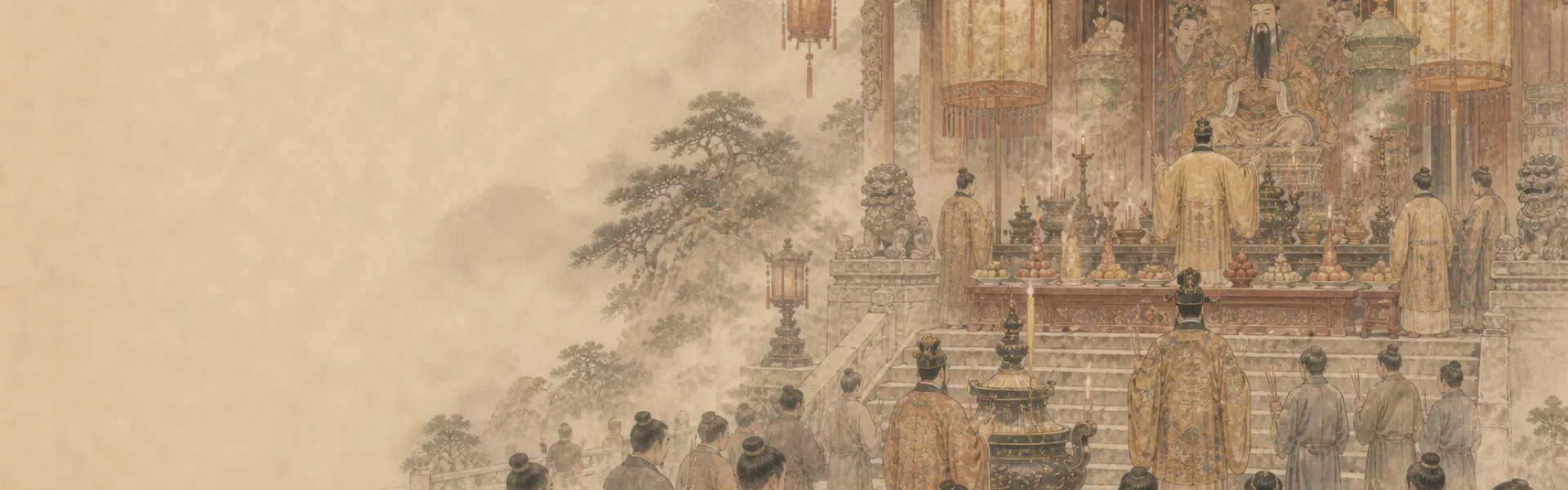
The most important of these is the birthday of the Jade Emperor, on the ninth day of the first lunar month. This page explains what a deity's birthday actually is in practice, what happens on the Jade Emperor's, and how the other Heavenly Court dates fit into the calendar around it.
What a Taoist Deity’s Birthday Means
The English word "birthday" is a reasonable translation of shengdan but it imports the wrong associations. These are not commemorations of a nativity in the Christian sense, and in most cases no one supposes the deity was born at all. What the date marks is a scheduled occasion on which that particular deity is formally addressed.
This follows directly from the administrative premise that organises Chinese religion generally. If the divine world is arranged like an administration, with ranks, jurisdictions and reporting lines, then dealings with it are scheduled rather than spontaneous. An office has hours. A festival date is the day on which a particular office is open, when a memorial submitted to that deity is in order, and when the temple that houses him conducts the appropriate liturgy.
Several practical things follow. Congratulation is the standard form: the liturgy of a birthday is largely one of offering respect and presenting requests, not of mourning or atonement. The scale of observance tracks rank and local importance rather than theological centrality — a minor local deity may draw a far larger crowd on his day than a high celestial figure does. And the dates are genuinely fixed points in the working year of a temple's clergy, planned months ahead, with rehearsals, ordering of supplies and coordination with lay associations.
Where a birthday date comes from is usually not recoverable. Some are attested in Song or Ming ritual compendia; some come from local gazetteers; some appear to have been assigned so that a deity would have a date. This is a case where the honest answer is that the tradition needed a calendar and produced one.
Why the Jade Emperor’s Birthday Falls on the Ninth Day of the First Lunar Month
The Jade Emperor's birthday falls on the ninth day of the first lunar month, which places it inside the New Year period, a few days before the Lantern Festival on the fifteenth. The number nine is not accidental: nine is the highest single digit and is associated with the emperor and with Heaven, so the ninth day of the first month is the most senior available date early in the year.
The Jade Emperor holds executive authority over the celestial administration. He is not the highest-ranking figure in Taoist theology — the Three Pure Ones stand above him — but he is the one who governs, and popular religion has long treated him as the effective head of Heaven. His elevation to that position was decisive under Emperor Zhenzong of the Song in the early eleventh century, for reasons that were as much political as religious.
Because his jurisdiction is general rather than specialised, his birthday functions differently from a specialist deity's. There is no particular problem you bring to it. It is closer to a New Year audience: the year has begun, and this is the occasion on which the whole community formally reports to the top of the administration.
In some regions, particularly Fujian and Taiwan, the observance is major and household-based as well as temple-based, with families setting up an offering table facing the sky in the courtyard or on the balcony, often on the eve. The offerings are characteristically vegetarian and set high, because the recipient is a celestial figure of the highest rank — height and purity of offering both encode status. In north China the day is more often observed at temples than at home.
How Temples Observe the Jade Emperor’s Birthday
The core of the day is a liturgy conducted by the clergy, usually in the morning, in the hall that houses the deity. If you attend, this is roughly what you will see.
The hall is prepared the day before: the altar is cleaned, fresh offerings are set, lamps and candles are arranged, and a written document is prepared. Clergy enter in vestments rather than everyday gowns. The rite proceeds through purification of the space, an invitation to the deity to be present, the presentation of offerings, the recitation of a scripture appropriate to that deity — for the Jade Emperor, the Jade Emperor Scripture — the reading of the document, and a formal conclusion.
Chanting is accompanied by percussion and wind instruments, with a distinct repertoire that varies significantly by region. Wudang, Beijing and Suzhou traditions of Taoist music are noticeably different from one another. The clergy move in patterned formations; the officiant occupies the central position on the axis, which is why visitors are asked to leave the exact-centre cushion free.
Lay people are generally welcome to be present. The usual expectations apply: keep to the sides, do not walk between the officiant and the altar, no flash photography, no video with sound, and nothing photographed from the front along the axis past the officiant. Incense is offered outside in the courtyard burner rather than inside the hall.
Larger temples may follow the morning liturgy with a longer rite, an opera performance on a temple stage, or a communal vegetarian meal. Whether any of this happens depends on the temple's size, its lay associations and local custom.
Other Festivals of the Taoist Heavenly Court
The Jade Emperor's day sits within a wider set of dates addressed to the upper administration. The most structurally important are the three yuan festivals, which divide the year into thirds and are addressed to the Three Officials of Heaven, Earth and Water.
Shangyuan, the fifteenth day of the first month, belongs to the Official of Heaven and coincides with the Lantern Festival. Zhongyuan, the fifteenth of the seventh month, belongs to the Official of Earth and is the great festival of universal salvation, commonly called the Ghost Festival. Xiayuan, the fifteenth of the tenth month, belongs to the Official of Water and is the quietest of the three. The reason Zhongyuan falls mid-year rather than at some other point is simply that it is the second of three evenly spaced divisions.
Other significant dates in the celestial calendar include the birthday of the Most High Lord Lao, the deified Laozi, on the fifteenth day of the second month; the Queen Mother of the West, generally the third day of the third month; Zhenwu, the Perfected Warrior of Wudang, on the third day of the third month, with his ascension marked on the ninth of the ninth; and the Great Emperor of the Eastern Peak on the twenty-eighth of the third month. Local variation in these dates is common and should be expected rather than treated as error.
How to Read Lunar Dates for Taoist Festivals
All of these dates are lunar, which means they move against the Gregorian calendar. The ninth day of the first lunar month can fall anywhere from late January to late February. If you want to attend a specific festival, you have to convert the date for the year in question, and the temple's own announcement is the reliable source.
The Chinese calendar is lunisolar: months follow the moon, so each begins at a new moon and the fifteenth is close to full, while the year is kept in step with the seasons by inserting an intercalary month roughly every three years. This is why a fifteenth-day festival always falls at full moon — a fact that is often presented as mystical and is simply arithmetic.
One consequence worth knowing is that an intercalary month can duplicate a month number, and temples then have to decide which of the two carries the festival. Practice varies, and this is an ordinary source of discrepancy between calendars and between temples.
The Jade Emperor’s Year-End Reporting Cycle
The clearest illustration of the administrative premise is the sequence at the end of the lunar year, which is domestic rather than temple-based.
The Stove God, resident in the kitchen, is understood to observe the household through the year and to report on it. On the twenty-third or twenty-fourth day of the twelfth month, depending on region, he departs to make that report. Households see him off, and the offerings are characteristically sweet and sticky — sugar, malt candy, glutinous cakes. The stated reason is usually that this will encourage a favourable report, or make it difficult for him to speak in detail. The joke is deliberate, and it is also a precise expression of how the relationship is imagined: a household managing its relations with an inspector.
The gods are then received back in the early days of the new year, commonly the fourth day, and the kitchen image is renewed. Between departure and return there is a gap in supervision, which in some regions is taken as a licence for activities better not observed.
None of this is a folk corruption of a purer Taoist doctrine. It is the same conception of divine administration operating at household scale, and it is where most people in China have actually encountered it.
Why the Jade Emperor’s Festival Dates Survived
Deity birthdays have proved unusually durable. They survived the end of the imperial state that had sponsored many of them, the disruption of the mid-twentieth century, and urbanisation. Several reasons combine.
The first is that the dates are embedded in the agricultural and social year rather than dependent on institutional support. A date fixed to the lunar calendar and observed at home requires no clergy and no building. The second is that festivals are sociable. Temple fairs, opera, food and reunion carry the religious content along with them, and the social attraction is not diminished by scepticism about the religious claim. The third is that the calendar is shared across religious boundaries: Zhongyuan is observed by Taoists and Buddhists with different liturgies and different explanations, and by many families with neither.
A visitor should therefore expect the crowds at a festival to be a mixture — devotees, families observing custom, tourists, and people who came for the opera. That mixture is normal and historically typical. It is not a modern dilution of something formerly pure.
Sources and limits. This page draws on Taoist liturgical calendars published by temples and national associations, Song and Ming ritual compendia for the earlier attestation of dates, and ethnographic studies of festival practice in north China, Fujian and Taiwan. Dates and customs vary regionally; where a single practice is described, it is a common form and not a universal rule. No liturgical text is reproduced here.
Key Points About the Jade Emperor’s Birthday
A deity's birthday (shengdan) is less a commemoration of a nativity than a scheduled occasion on which that deity is formally addressed.
This follows from the administrative premise: if Heaven is an administration, dealings with it are scheduled, and a festival is the day the office is open.
The Jade Emperor's birthday is the ninth day of the first lunar month — nine being the number of Heaven and the emperor.
He holds executive authority but not the highest rank; the Three Pure Ones stand above him. His elevation was decisive under Song Zhenzong in the early eleventh century.
Observance is household-based as well as temple-based in Fujian and Taiwan, with a sky-facing offering table and vegetarian offerings set high.
The three yuan festivals — first, seventh and tenth months, fifteenth day — divide the year in thirds and address the Officials of Heaven, Earth and Water.
All dates are lunisolar, so they move against the Gregorian calendar; a fifteenth-day festival falls at full moon by arithmetic, not mystery.
The Stove God's departure on the twenty-third or twenty-fourth of the twelfth month, with sweet offerings, is the administrative model at household scale.
Festivals survived because they need no institution, because they are sociable, and because the calendar is shared across religious boundaries.