Daoist Audience Tablets (Hu): Courtly Form and Ritual Address
道教朝笏:朝仪形制与科仪奏达
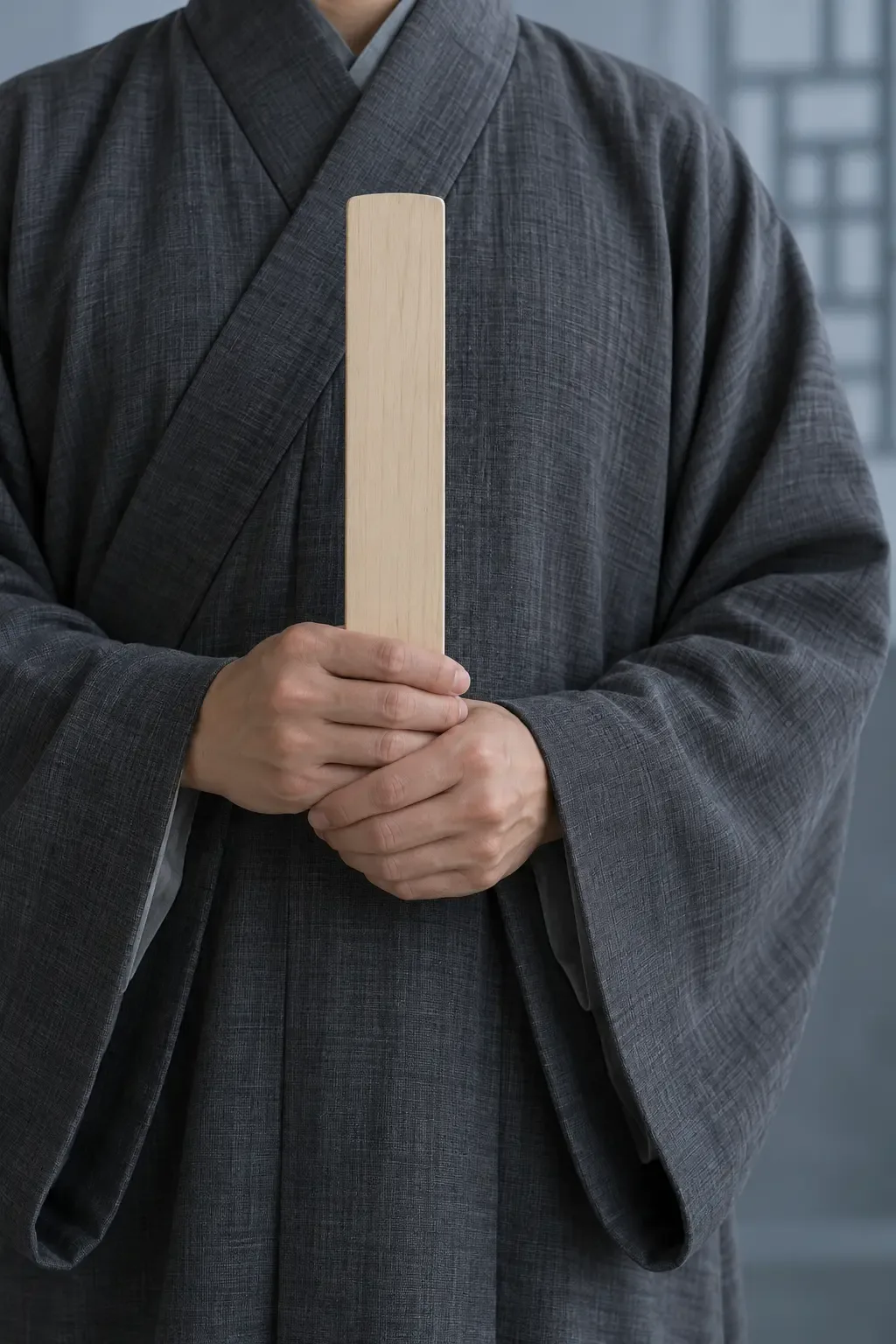
A long, narrow tablet held before the body appears in Daoist sculpture, ritual manuals and surviving implements. It is commonly called hu (笏) or chaojian (朝简): an audience tablet whose form recalls the equipment of court officials. Within Daoist settings it helps make a ritual address visible—an embodied sign that a person stands in an ordered relation to a sacred administration.

This guide complements Wudang.Org’s pages on petitions and memorials, ritual seals, registers and transmission, ritual robes and ordination today. It offers historical and visual literacy, not instructions for performing a rite or identifying a practitioner’s rank.
Begin with the object
Hu, chaojian and “audience tablet”
English labels vary. “Audience tablet” usefully preserves the object’s relation to formal audience, while “ritual tablet” is broader and can be ambiguous. The Global Daoism Archive lists chaojian or hu among ritual implements. Shape, material and finish differ across periods and communities, so the name should be joined to context rather than inferred from a silhouette alone.
Not every “tablet” is the same implement
A hu should not be collapsed into a lingpai, or command plaque, nor into a spirit tablet representing a deceased person or deity. The British Museum’s wooden lingpai, engraved with a wind deity and ritual characters, shows why translation alone is unsafe: its catalogue also calls it a “Daoist ritual tablet,” yet its imagery and command-plaque function belong to a different object family.
From court audience to Daoist ritual
A courtly prototype
The audience tablet had an older life in the visual and ceremonial world of government. Daoist communities adapted bureaucratic forms—offices, ranks, petitions, seals and audiences—to describe relations with sacred powers. The tablet’s restrained surface and frontal position could therefore evoke disciplined attendance more effectively than a decorative emblem.
Adaptation, not an unchanging line
Similarity does not prove that one standardized court object passed unchanged into every Daoist tradition. Materials, names and gestures varied, and later communities could reinterpret older forms. It is more accurate to speak of selective adaptation within changing ritual systems than of a single invention with one fixed meaning.
Gesture, rank and ritual address
Making an audience visible
Held before the torso, the tablet organizes hands, gaze and posture into a formal frontality. Together with vestment, written memorial and seal, it can frame ritual speech as an authorized address rather than casual conversation. That visual grammar helps viewers understand why a seemingly plain object matters.
Prescriptions depend on status and setting
Livia Kohn’s translation of the medieval Fengdao kejie notes that participants in scripture recitation either folded their hands or held a ritual tablet depending on rank. This is valuable textual evidence, but it belongs to a specific manual and historical setting. It should not be turned into a universal rule for all Daoist traditions, temples or modern practitioners.
Images as evidence
A dated stele from 567
A small stone stele in the Smithsonian’s National Museum of Asian Art depicts Lord Lao seated in a niche with two standing attendants holding hu tablets. Its inscription dates the dedication to 567. The image establishes that tablet-bearing figures belonged to a sixth-century Daoist visual setting; it does not by itself tell us the full procedure of a contemporary rite.
A surviving nineteenth-century object
The Allen Memorial Art Museum preserves a mid-nineteenth-century wooden example with black lacquer and gilding, measuring 42.5 centimetres high. Its documented museum record gives material and scale, but its earlier provenance is unknown. That gap is a reminder that an object can be authentic evidence without carrying a complete biography.
A six-pass method for reading a tablet
Move from record to interpretation
- Read the catalogue noun. Note whether the source says hu, chaojian, audience tablet, command plaque or simply ritual tablet.
- Check the date and medium. Stone representation, carved wood and modern reconstruction answer different questions.
- Observe the profile. Record length, curvature, widening ends, inscriptions and surface treatment without deciding function too early.
- Study the hands and company. A frontal attendant in an audience scene offers different evidence from a deity engraved on a portable plaque.
- Connect nearby documents. Petitions, seals, registers and robes can reveal a wider system of office and address.
- State the limit. Say what the source demonstrates—and what remains unknown about lineage, gesture, owner or occasion.
Among documents and ritual implements
The hu is best understood within an ensemble. A petition gives an address linguistic form; a seal may authenticate it; a register can connect a person to transmitted status; robes make office visible; and the audience tablet disciplines bodily presentation. These objects do not all perform the same task, but together they show how material culture can organize communication with a celestial bureaucracy.
Living traditions, access and respect
Present-day uses differ by institution, lineage, office and occasion. Museum displays and public photographs cannot disclose every rule governing consecrated objects or restricted texts. Visitors should not handle, copy or stage a tablet without permission, and an unverified replica should never be presented as a lineage object. For contemporary practice, ask the relevant community and accept that some details are not public.
Sources and limits
What the evidence supports
This account combines a dated early image, a museum object, a translated monastic manual and scholarship on medieval ritual action. Yang Wu’s open-access study of ritualized prostration in medieval Daoism is especially useful for understanding how bodily acts moved between secular and religious settings; Kohn’s Daoist Monastic Manual anchors the rank-dependent prescription. The Metropolitan Museum’s overview of Daoism and Daoist art provides a broader caution: Daoist objects arise from diverse practices, and their functions are not always recoverable from appearance. None of these sources licenses a single, timeless choreography.