Laozi’s Birthday: From the Sage Laozi to the Divine Lord Lao
老君诞:从老子到太上老君
The fifteenth day of the second lunar month is the birthday of the Most High Lord Lao — Laozi, considered as a deity. It is one of the more instructive festivals on the Taoist calendar, because understanding what is being celebrated requires holding two quite different things in mind at once.
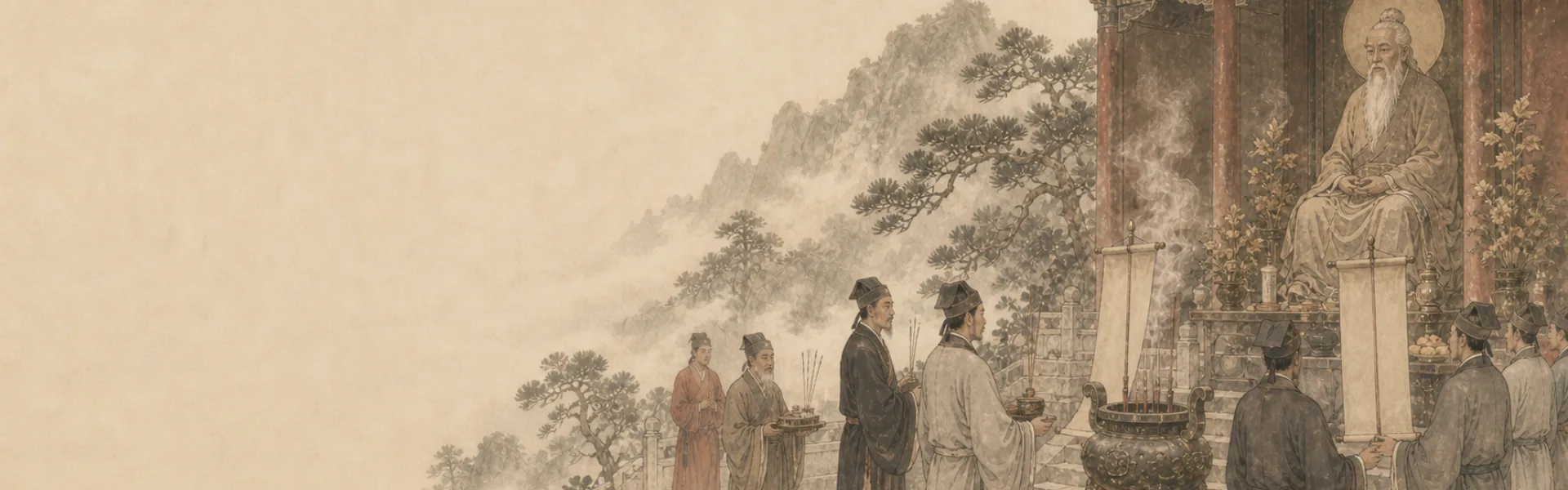
One is a book and the tradition of thought around it. The other is a god with a body, a biography, a rank in the celestial administration and a temple network. English uses the single word "Taoism" for both, which is the source of more confusion about this religion than any other single translation problem.
For a concise guide to how the remembered sage, the text and the divine Lord Lao became connected, begin with Who Was Laozi?
Laozi the Sage and Lord Lao the Deity
Chinese distinguishes daojia, the Taoist current of thought associated with the Tao Te Ching and the Zhuangzi, from daojiao, the Taoist religion with its clergy, liturgy, temples and pantheon. The two are related but they are not the same thing, and the religion did not grow out of the book.
The religion assembled during the later Han from several sources: existing state and local cults, techniques of longevity and healing, apocalyptic and messianic movements, and organised communities such as the Celestial Masters in Sichuan. It then adopted the Tao Te Ching as a foundational scripture and Laozi as a foundational figure. The adoption was genuine and consequential, but it was an adoption.
So the deity whose birthday this is stands in a peculiar relation to the philosopher. He is not simply the author of the book, promoted. He is the personification of the teaching itself as it appears in the human world — which is a different claim, and a more interesting one.
A reader who keeps this distinction in view will find a great deal of Taoist material suddenly makes sense. A reader who does not will keep wondering why a book that says almost nothing about gods is the founding text of a religion full of them.
The Date and Sources for Laozi’s Birthday
The date usually given is the fifteenth day of the second lunar month. Some traditions and some regions give other dates, and the variation is normal rather than a defect.
The historical Laozi is barely documented. The earliest substantial account is in Sima Qian's Records of the Grand Historian, compiled around the first century BCE, which gives a name, an office as an archivist at the Zhou court, a meeting with Confucius, a departure westward, and the composition of a book at a frontier pass at the request of a gatekeeper. Sima Qian himself reports competing versions and does not resolve them.
Modern scholarship generally treats the Tao Te Ching as a compiled text reaching its present form around the fourth to third century BCE, drawing on earlier material, rather than as the work of one identifiable author. Manuscript finds at Mawangdui and Guodian have shown that the text circulated in variant orders and wordings.
None of this settles anything about the festival, because the festival is not about the historical man. A birthday was needed for a deity who had a temple network and an imperial cult, and one was fixed. This is worth saying plainly rather than presenting the date as an ancient certainty.
Taishang Laojun: The Most High Lord Lao
In the Taoist pantheon, Laozi appears as Taishang Laojun, the Most High Lord Lao, and is identified with the third of the Three Pure Ones — the Heavenly Worthy of the Way and its Virtue.
The three exist because the Tao itself has no form, and liturgy needs someone to address. The first, the Heavenly Worthy of Primordial Beginning, represents origin. The second, the Heavenly Worthy of Numinous Treasure, represents cosmic order and the transmission of scripture. The third represents the teaching as it operates among human beings, and that is the position Laozi occupies. He is the point at which an impersonal principle becomes something a person can be taught.
Iconographically he is the easiest of the three to identify: he is shown as visibly aged, usually white-haired and white-bearded, often holding a fan, sometimes a scroll. The other two are shown as ageless. The age is doctrinal, not decorative — it marks him as the one who appears in history.
He is not, however, the highest figure in the Taoist system, and he is not the same kind of figure as the Jade Emperor, who holds executive authority. Rank, jurisdiction and function are separate axes in this pantheon, and Laozi is high in rank while holding no administrative portfolio.
The Taoist Doctrine of Lord Lao’s Descent
The distinctive Taoist claim about Laozi is that he appears repeatedly. Rather than a single human life, the tradition describes a series of manifestations in successive ages, each time as a teacher or adviser to rulers, under different names.
This is set out in texts from the Han onward, and the underlying logic is coherent. If the third of the Three Pure Ones represents the teaching in the human world, then his activity is not confined to one lifetime. The teaching becomes available whenever conditions permit, and each appearance is the same principle taking a form suited to its moment.
The doctrine had a long and contentious history. One branch of it — the claim that Laozi travelled west and taught the barbarians, appearing there as the Buddha — became the notorious Conversion of the Barbarians argument, used polemically in Buddhist-Taoist disputes for centuries. It was condemned and its texts ordered destroyed under the Yuan in the thirteenth century. It is worth knowing about because it shows how a metaphysical doctrine functioned as a weapon in an institutional rivalry, and because it explains why some Taoist material about Laozi reads as territorial.
Set the polemics aside and the descent doctrine still does something important. It resolves the awkwardness of a religion whose founding sage is a barely documented figure by relocating the question. What matters is not when he lived but that the teaching has recurred, and that recurrence is precisely what the festival marks.
Where Laozi’s Birthday Is Observed
Several sites are associated with Laozi, and each stresses a different part of the story.
Louguantai, west of Xi'an in Shaanxi, is traditionally identified as the pass where the book was written at the gatekeeper's request. It has been a Taoist site since at least the Tang, holds important Tang stelae, and is a functioning monastery with a college attached.
Taiqing Palace at Luyi in Henan is identified as his birthplace and is the focus of the largest observance of the day, with a temple fair drawing very large crowds. The site has Tang and Song stelae, including an imperially inscribed one.
Qingyang Palace in Chengdu is where, by tradition, he later appeared and left a sign; it is an active urban monastery and the seat of the provincial Taoist association.
On the day itself the liturgy follows the standard birthday pattern: preparation of the hall, purification, invitation, offering, recitation — here of the Tao Te Ching itself or of a scripture in Lord Lao's name — presentation of a written document, and formal conclusion. What distinguishes the day is the recitation: this is one of the few occasions when the text a general reader may already know is used liturgically, chanted in unison to instrumental accompaniment.
The Political History of the Lord Lao Cult
The cult of Laozi was heavily political for long stretches, and the festival's prominence is partly a residue of that.
Under the Tang, the imperial family, surnamed Li, claimed descent from Laozi, whose surname was traditionally given as Li. This was not a private devotion. Laozi was given imperial titles, his birthplace was elevated, temples were built at state expense, and the Tao Te Ching was for periods a set text in the civil examinations. Taoism enjoyed formal precedence over Buddhism at several points during the dynasty as a direct consequence.
Song emperors continued state patronage, though their attention shifted to other figures — most consequentially in the elevation of the Jade Emperor under Zhenzong in the early eleventh century. Later dynasties patronised Taoism selectively, the Ming with particular intensity at Wudang.
The pattern is consistent enough to be worth naming: Chinese states did not usually adopt religions, they ranked them, funded them, titled their gods and used them. Understanding this makes the architecture, the stelae and the festival calendar legible. A great deal of what looks like devotion in the physical record is also administration, and the two were not felt to be in conflict.
What Laozi’s Birthday Celebrates
Stripped of the polemics and the imperial history, the day marks a fairly precise idea: that the Tao, which has no form and gives no instructions, has nonetheless been made available in a form that can be taught, and that this happens repeatedly rather than once.
That is why the recitation of the text matters more here than the biography of the man. The claim is not that a particular sage was born on this date. The claim is that the teaching entered the world and is still in it, and the appropriate way to mark that is to read the text aloud.
Visitors should expect the practical form to be modest at most temples — a morning liturgy, a scripture recitation, ordinary numbers of worshippers — and very large at Luyi, where the temple fair is a major regional event. Neither is more authentic. As with most Chinese festivals, scale reflects local investment rather than doctrinal weight.
Sources and limits. This page draws on Sima Qian's account of Laozi, the Mawangdui and Guodian manuscript evidence for the text's transmission, standard studies of the Lord Lao cult and Tang state patronage, and published temple liturgical calendars. Dates for the festival vary by region. No liturgical text is reproduced, and the historical claims about Laozi's life are presented with the uncertainty the sources actually carry.
Key Points About Laozi’s Birthday
The festival falls on the fifteenth day of the second lunar month and honours Laozi as a deity, not as a historical philosopher.
Chinese distinguishes daojia (the current of thought) from daojiao (the religion). The religion adopted the Tao Te Ching and Laozi; it did not grow out of them.
As the Most High Lord Lao he is the third of the Three Pure Ones, representing the teaching as it operates in the human world.
He is shown as visibly aged, usually with a fan; the other two Pure Ones are ageless. The age is doctrinal — he is the one who appears in history.
High rank does not mean executive authority: that belongs to the Jade Emperor. Rank, jurisdiction and function are separate axes.
The descent doctrine holds that he manifests repeatedly in successive ages, which relocates the question from biography to recurrence.
One branch of that doctrine became the Conversion of the Barbarians polemic against Buddhism, condemned and suppressed under the Yuan.
Principal sites are Louguantai in Shaanxi, Taiqing Palace at Luyi in Henan (the largest observance) and Qingyang Palace in Chengdu.
The Tang imperial house claimed descent from Laozi, which made the cult a state matter; Chinese states ranked, funded and titled religions rather than simply adopting them.