Lunar New Year Through a Taoist Lens: Customs, Gods and Family Habit
道教眼中的农历新年:习俗、神明与家庭习惯
In Singapore, Lunar New Year usually means a cleaned house, a reunion dinner, mandarin oranges and red packets. Behind those familiar things sits an older idea: that a household is also a small administrative unit of a larger, unseen order, and that the turn of the year is when accounts are settled and relations are renewed. This page walks through the season in the order it unfolds, and keeps three layers apart: what Taoist tradition says, what is wider Chinese custom, and what is simply how your family does it.
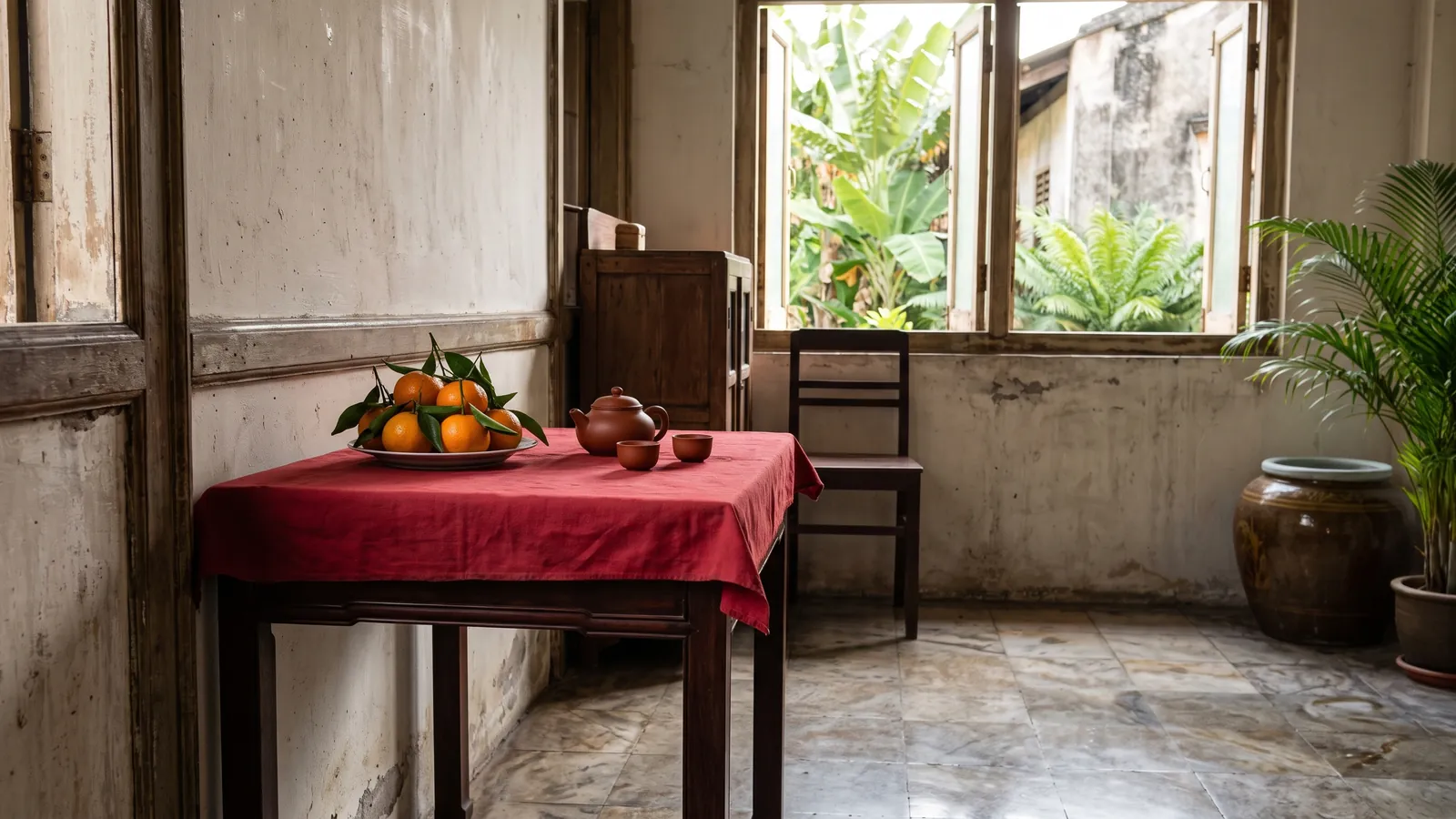
The New Year falls between 21 January and 20 February, because it follows the Chinese calendar, which counts lunar months and keeps them in step with the solar year. In 2027 it falls on Saturday 6 February; in later years, check a calendar. If you want to read about the turn of the year that comes before it, see Dongzhi, the winter solstice, about six weeks earlier; the New Year preparations themselves usually begin in the twelfth lunar month.
1. The Kitchen God leaves (送灶)
Start with the idea, because the customs follow from it. In Chinese popular religion, which Taoism shares and shapes, Heaven is imagined as an administration with ranks, offices and reports. The Kitchen God (Zao Jun, 灶君) is the household's resident official. Tradition holds that he watches the family through the year, and that late in the twelfth lunar month he goes up to report to the Jade Emperor.
The date differs by region. As commonly described, it is the 23rd day of the twelfth month in much of the north and the 24th in much of the south. Neither is the "correct" one, so use whichever your family keeps. Households see him off with sweet and sticky offerings such as sugar, malt candy or glutinous cakes. The usual explanation is that this encourages a kind report, or makes it hard for him to say much. The humour is deliberate, and it shows how the relationship is imagined: a household managing its dealings with an inspector. The Baopuzi (a fourth-century Taoist text attributed to Ge Hong) already describes a stove god who goes up to report on people's faults, there at the end of every month rather than once a year, so the idea is old.
Two things are often mixed up. First, this is not a corruption of "real" Taoism. It is the same administrative picture applied at household scale, and for most people it is where they met it. Second, many Singapore homes have no stove shrine at all. If yours does not, the custom may survive only as a saying, or not at all, and that is a perfectly ordinary family habit.
2. Cleaning before the New Year
The thorough clean before the festival is wider Chinese custom, not a Taoist rule. The common explanation is that the word for dust (尘, chen) sounds like the word for "old" (陈, chen), so sweeping out the dust is sweeping out the old year. A related habit, kept by many families, is not to sweep during the first days of the New Year, so that good fortune is not swept out with it.
Notice how practical this is. Whatever the sound-play, a clean, ordered house is a sensible way to mark a threshold. You do not need to believe the pun to see the point.
Something to try: pick one drawer or shelf you have been ignoring and clear it out while you think about what you are ready to leave behind. Then stop. The custom is about a clear start, not about exhausting yourself.
3. New Year's Eve and the first days
The reunion dinner on New Year's Eve (年夜饭) and the custom of staying up late (守岁) are wider Chinese tradition, centred on the family rather than on any temple. Taoist practice adds its own layer on top of this: a household or temple may light incense and offer thanks to Heaven and the gods at the turn of the year.
Tradition holds that the gods who left are then welcomed back (接神). The festivals page on this site says they are commonly received back around the fourth day, with the kitchen image renewed. Some families and temples do it at other times, and many do nothing at all. Keep that spread of practice in mind, rather than assuming one fixed schedule.
On the fifth day, many families welcome the God of Wealth (财神). This is as commonly kept, and it belongs far more to popular religion than to Taoist liturgy. We do not have a page on the God of Wealth, so treat this paragraph as a pointer to ask at your own temple or family.
A point beginners get wrong: the first days are not one long ritual. For most families they are visiting, eating and resting, with a small amount of incense or offering set within them. The religious content travels inside the social occasion, and that is historically normal, not a modern dilution.
4. The Jade Emperor's birthday on the ninth day
The ninth day of the first lunar month is traditionally celebrated as the birthday of the Jade Emperor, the figure to whom the Kitchen God reported. Our page on the Jade Emperor's birthday explains what a deity's birthday actually is, how a temple marks it, and how the observance runs at home in Fujian and Taiwan, with an offering table set facing the sky, often on the eve. Singapore families with roots in those places may keep a version of it; ask yours. Read that page for the detail, and see the Taoist pantheon for where he sits among the other deities.
5. The fifteenth day (元宵) closes the season
The fifteenth day of the first month is the Lantern Festival (元宵), held at or near the first full moon of the year, and it ends the New Year season. In Taoist tradition the same day is Shangyuan (上元), the first of the three yuan festivals, belonging to the Official of Heaven (天官). Tradition holds that this official is associated with blessing; the other two festivals fall on the fifteenth of the seventh and tenth months. Lanterns, glutinous rice balls and a walk out in the evening are wider Chinese custom, and the Taoist name is one more way of reading the same night.
Notice the shape of the whole season. It opens with a report to Heaven and closes with a festival addressed to Heaven's Official, with the family dinner in between. The arrangement tells you something about how the tradition sees the year: as a cycle of accounting, hospitality and renewal.
Three layers, kept apart
- Taoist: the Jade Emperor's birthday, Shangyuan and the Official of Heaven, and temple liturgy at the turn of the year.
- Wider Chinese custom: the Kitchen God's farewell, the clean, the reunion dinner, staying up, the God of Wealth and the lanterns, shared by many who would not call themselves Taoist.
- Family habit: which day you do things, what is on the table, who sits where. This layer is lost fastest, and only your family can record it.
Something to try: ask an older relative what your family did on the night the Kitchen God was seen off, and on the fifth day. Write down what they say, and note which layer each custom seems to belong to.
If you visit a temple during the season, see our page on temple etiquette first. Crowds are large, and what the temple asks takes priority over any general guide, including this one.
Where to go next
- Dongzhi: the turn of the year before it.
- The Jade Emperor's birthday and Taoist festivals and rituals.
- The Taoist pantheon.


