Dongzhi: The Winter Solstice in Taoist and Chinese Tradition
冬至:道教与中国传统里的冬至
In Singapore, Dongzhi (冬至), the winter solstice, usually means a bowl of tangyuan (glutinous rice balls) with the family. This page explains what lies behind that evening: why the solstice mattered, what the Book of Changes makes of it, and which parts are Taoist, which are wider Chinese custom, and which are simply how your family does it.
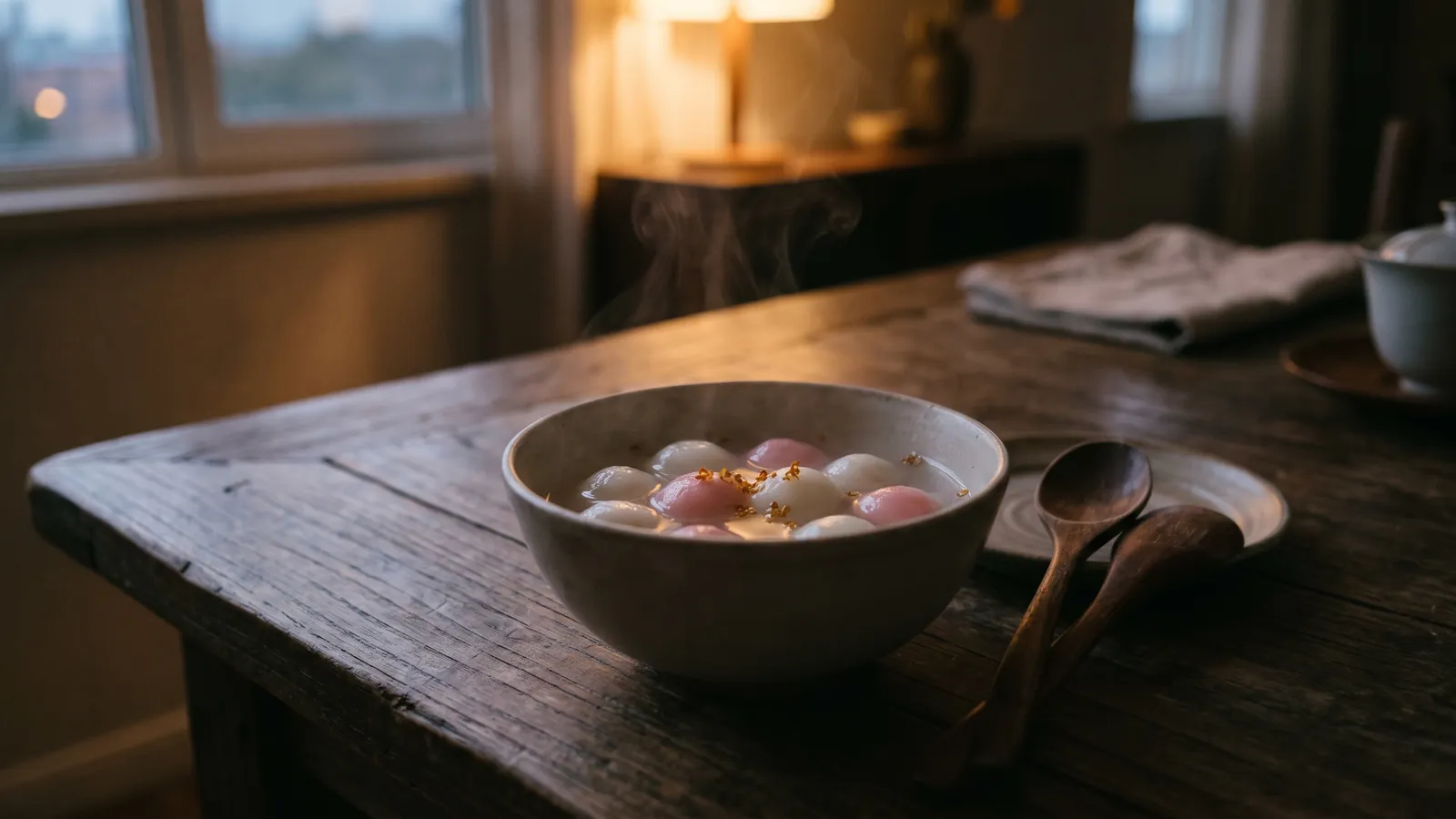
The solstice falls on or about 21 or 22 December. Dates in the lunar calendar shift, but the solstice follows the sun, so it stays close to those two days each year. Check a calendar for the exact day and hour in the year you are reading.
Why the solstice mattered
Start with the idea, because the customs follow from it. In the Chinese reading of the year, daylight is yang and darkness is yin. In the northern half of the world, where this tradition began, the days shorten until the solstice and then begin to lengthen. So Dongzhi is the point where yin has reached its fullest and yang starts to come back.
Two things are commonly misunderstood here. First, Dongzhi is not the coldest day. In the old calendar the cold keeps deepening for weeks afterwards, and the term that follows, Minor Cold (Xiaohan), is named for exactly that. Second, the day is not a Taoist invention. It is one of the twenty-four solar terms, a farming and court calendar shared by everyone (see our page on the twenty-four solar terms). Taoism, like other traditions, built meaning on top of it. In the ordering of the terms, Dongzhi is the twenty-second, between Major Snow and Minor Cold, and our own page for it is Winter Solstice.
Something to notice: Singapore sits about one degree north of the equator, so the length of the day barely changes through the year. You will not see the light return on 22 December the way a person in Beijing would. The observance here is carried by the calendar and by memory, and it helps to know that when someone asks why you are celebrating a "short day" under a bright sky.
Hexagram 24, Fu: one line returns
The Book of Changes (Yijing, 易经) gives the clearest picture of the idea. Hexagram 24 is called Fu (复), usually translated "Return". It is drawn with five broken (yin) lines stacked above one unbroken (yang) line at the bottom. Read from the bottom up, as hexagrams always are, a single yang line has just come back underneath a field of yin.
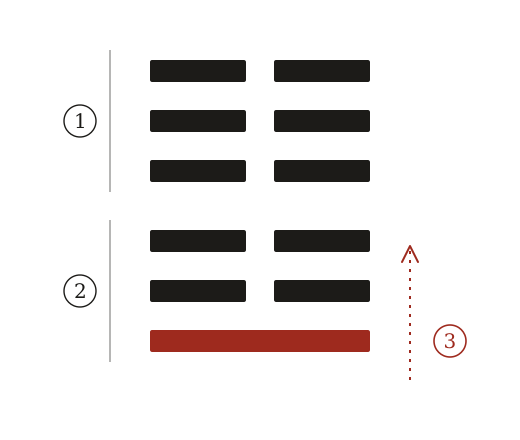
Hexagram 24, Fu 复 (Return), read from the bottom up.
- Upper trigram: Kun 坤, Earth
- Lower trigram: Zhen 震, Thunder
- The one yang line, returning at the bottom
The classic's own commentary says the same thing in few words. The Image commentary (Xiang zhuan) on Fu reads "雷在地中,复": thunder within the earth. It adds that the former kings, on the solstice day (至日), closed the passes, so that merchants did not travel and the ruler did not tour the regions. The Judgment commentary (Tuan zhuan) asks whether in Return one may see "the heart of Heaven and Earth" (天地之心). The original hexagram text also speaks of the return coming "in seven days", which later commentators read in several ways, so treat any single explanation with some caution.
Later Han-dynasty Yijing scholars arranged twelve hexagrams around the year, one for each month, in a scheme usually linked to Meng Xi and Jing Fang. Fu stands for the eleventh month, the one that holds the solstice. This is why Chinese sayings pair the solstice with "one yang is born" (冬至一阳生). Readers have long heard the same note in the Tao Te Ching (Dao De Jing), chapter 16, where the sage watches the myriad things "return" (吾以观复, "I watch their return") to their root in stillness.
This is the reading to hold: the change is small and it comes from underneath. One line is not summer. Fu tells you to treat a beginning as something fragile, to be protected and not pushed. For more on how the hexagrams work, see our pages on the Yijing, the Book of Changes hub and hexagram 24 itself.
What people do: three layers, kept apart
It helps to sort what you see into three layers, because they are easy to mix up.
Wider Chinese custom. The solstice was important enough that the Ming and Qing emperors held a sacrifice to Heaven at the Temple of Heaven in Beijing on this day. Among ordinary people, the saying "Dongzhi is as big as the New Year" (冬至大如年) survives in many families. Customs differ by region: in much of the north, dumplings are the usual dish; in much of the south, rice balls. One old story, recorded in the Jingchu suishiji (荆楚岁时记), a sixth-century record of seasonal customs, says people cooked red bean porridge on this day to keep away a plague spirit. Tradition holds this as the origin of the custom, and nobody can prove it, so enjoy it as a story.
Family habit, as commonly kept in Singapore. Many Chinese families here make or buy tangyuan, often small white and pink balls in a sweet ginger or sugar soup, and eat them together. A common saying is that eating them makes you a year older, a custom often heard in Southern Chinese families. Some families set the meal on the table for the ancestors first, and some do not. Treat all of this as habit, not rule: if your family does it differently, yours is not wrong. The round shape is usually explained as a wish for togetherness and completeness (团圆), which is a meaning people gave the food rather than something fixed in a text.
What Taoist tradition marks. Here we keep to what is general. Many Taoist calendars treat the solstices as days of heightened ritual in temples, even when no deity is being celebrated, as described on our page on the Taoist festivals and rituals. Some calendars also place the birthday of Yuanshi Tianzun (元始天尊), the Celestial Worthy of the Primordial Beginning, around the winter solstice. Sources and temples differ on this, so if you want to take part, ask the temple you plan to visit what it does that day. Do not assume a local temple keeps the same programme as one on a mountain in China. For another day in the Taoist year, a few weeks later, see the Jade Emperor's birthday.
Something to try: before the meal, ask an older relative what their family did on Dongzhi when they were young. Write the answer down. Family habit is the layer that is lost fastest, and it is the only one nobody else can record for you.
A quiet thing to do that evening
The Fu hexagram suggests an evening practice, and it needs no special skill. This is a reflective exercise, not a medical one.
- Dusk (a few minutes). Before the meal, sit by a window for a few minutes with the lights low. Notice the light fading and the sounds of the home. You are only marking the turn of the year.
- The small beginning. Choose one very small thing you would like to begin, such as a short walk each morning or ten minutes of quiet each night. Fu says the line returns under the pressure of yin, so make the start modest.
- Write it down. Put it on one line of paper and keep it somewhere you will see it.
- Eat slowly. Have the tangyuan without hurry. That is the whole practice.
If sitting still feels uncomfortable, stop and get up. This is a custom of attention, not an exercise for the body, and it makes no health claim. If you are troubled in mind and it does not ease, speak to a doctor or someone you trust.
Where to go next
- Hexagram 24, Fu: the full hexagram page.
- Winter Solstice (Dongzhi) and Minor Cold: the seasonal pages.
- Taoist festivals and rituals: how the ritual calendar is put together.
Read next: the season continues with Lunar New Year through a Taoist lens.


