
TAOIST PHILOSOPHY · 道家哲学

The Wooden Rooster (Muji) in the Zhuangzi: Ji Shengzi and the Four Stages of Complete Inner Virtue 《庄子·达生》纪渻子养斗鸡解:从虚憍恃气到“望之似木鸡,其德全矣”

Examine the parable of Ji Shengzi training the rooster in Zhuangzi Chapter 19 (Dasheng) — shedding vain arrogance, reactivity to sound and shadow, and aggressive glare until it stands like a wooden rooster (Wang Zhi Si Muji) whose inner potency (De) is whole.


A quiet Taoist study room: a black guqin on a low wooden console beside a pink lily arrangement and tea set, and a dark-glass study table set with white lotus-shaped cups, an incense holder and a floral branch, with straw cushions and a grey curtain.

1. Textual Foundation: Ji Shengzi Training the Gamecock in Zhuangzi Chapter 19

In modern everyday Chinese, the idiom dai ruo muji (呆若木鸡 — "dumbstruck as a wooden chicken") is often used casually to describe someone frozen in shock. Yet in its original source — Chapter 19 of the Zhuangzi (Dasheng 达生, "Mastering Life") — looking like a wooden rooster (muji 木鸡) is the highest compliment in Taoist cultivation, denoting a practitioner whose spirit and inner potency (De 德, explored in De: Virtue and Inner Potency) have become completely whole and unperturbable.

The text recounts that Master Ji Shengzi (纪渻子) was training a gamecock for the King (纪渻子为王养斗鸡). After ten days, the King asked if the bird was ready. Ji Shengzi replied: "Not yet; it is still vainly arrogant and relies on its impulsive temper" (未也,方虚憍而恃气). After another ten days, the King asked again. Ji Shengzi said: "Not yet; it still reacts to the sound and shadow of other birds" (未也,犹应响景). After another ten days, the King asked a third time. Ji Shengzi said: "Not yet; it still glares fiercely and bristles with aggressive vigor" (未也,犹疾视而盛气). After a fourth ten-day period — forty days in all — Ji Shengzi finally said: "Almost! Even if another rooster crows, it shows no change at all. Looking at it from afar, it seems like a rooster carved of wood; its inner virtue is completely whole. Other roosters dare not face it, but turn and run at the sight of it" (几矣!鸡虽有鸣者,已无变矣,望之似木鸡矣,其德全矣,异鸡无敢应者,反走矣).

2. The First Three Stages: Shedding Bluster, Reactivity, and Combative Glare

Why does Ji Shengzi refuse to let the rooster enter the ring during the first thirty days, even when it looks fierce and eager? Because in Taoist philosophy and internal martial arts, outward ferocity is a symptom of inner vulnerability. At Day 10 (fang xujiao er shi qi 方虚憍而恃气), the bird is puffed up with hollow pride (xujiao 虚憍) and relies on emotional adrenaline (shi qi 恃气); anyone who relies on emotional surges is easily provoked and quickly exhausted. At Day 20 (you ying xiang jing 犹应响景), the outward boasting has quieted, but the nervous system is still jumpy: the moment it hears a rival crow (xiang 响) or sees a fleeting shadow (jing 景), it tenses up to counter-attack. In martial terms, a practitioner at this stage falls for every feint because their mind is tethered to external stimuli.

Even at Day 30 (you jishi er sheng qi 犹疾视而盛气), when the bird no longer jumps at shadows, its eyes still shoot daggers (jishi 疾视) and its vital breath is still puffed up to dominate (sheng qi 盛气). As long as you feel the need to project intimidation, you are still locked in a relationship of rivalry with your opponent.

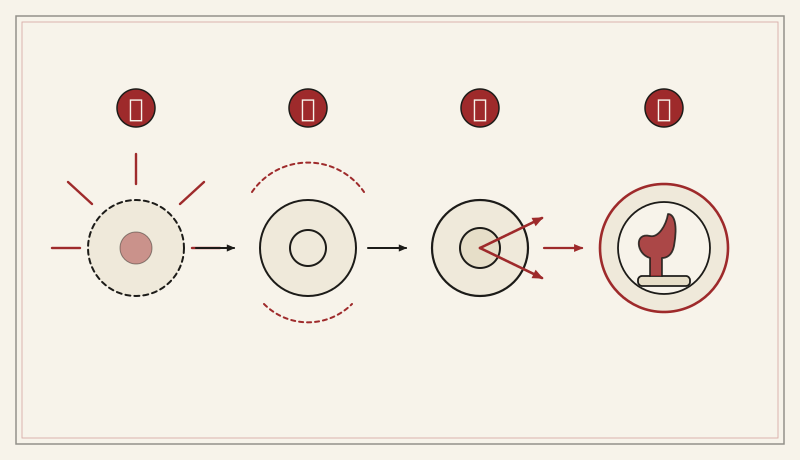
Classical ink-and-cinnabar diagram with four numbered markers (①–④) illustrating the four ten-day stages of Ji Shengzi's rooster training in Zhuangzi Chapter 19, from flaring arrogance to the serene wooden rooster.

Figure 1: The Four Ten-Day Stages of the Wooden Rooster (Zhuangzi Chapter 19, Dasheng) — ① Day 10: Vain arrogance and relying on temper (Fang Xujiao Er Shi Qi); ② Day 20: Reacting to external sound and shadow (You Ying Xiang Jing); ③ Day 30: Fierce glare and bristling aggressive vigor (You Jishi Er Sheng Qi); ④ Day 40: Looking like a rooster carved of wood with inner potency completely whole (Wang Zhi Si Muji, Qi De Quan Yi).

  1. ① Day 10 — Vain Arrogance & Relying on Temper (Fang Xujiao Er Shi Qi 方虚憍而恃气): Outward bluster and hollow pride that exhaust vital breath before contact even begins.
  2. ② Day 20 — Reacting to Sound and Shadow (You Ying Xiang Jing 犹应响景): Being pulled off center by every external noise, feint, or passing movement.
  3. ③ Day 30 — Fierce Glare & Bristling Vigor (You Jishi Er Sheng Qi 犹疾视而盛气): Subtle internal combativeness still leaking out through the eyes and breathing.
  4. ④ Day 40 — The Wooden Rooster of Complete Virtue (Wang Zhi Si Muji, Qi De Quan Yi 望之似木鸡 · 其德全矣): Unshakeable composure that dissolves contention without a fight.

3. Day Forty: "Looking Like a Wooden Rooster, Its Virtue Whole" and the Tao Te Ching

By Day 40, the rooster has shed every trace of performance, anxiety, and hostility. When another bird crows or rushes toward it, its breathing, gaze, and posture undergo zero agitation (yi wu bian yi 已无变矣). It stands as calm and self-contained as unpainted camphor wood (wang zhi si muji 望之似木鸡), recalling the Body Like Seasoned Wood and Heart Like Cooled Ashes of Nanguo Ziqi and the Mirror-Like Mind of Chapter 7 of the Zhuangzi.

Why do rival roosters turn and flee from a bird that makes no threat? Because an aggressive fighter feeds on the opponent's counter-aggression, fear, or opening. Encountering a presence that has no fear, no anger, and no gap (wu jian 无间), the rival's own bluster collapses into emptiness. This is the exact principle of Chapter 68 of the Tao Te Ching (Dao De Jing) in the Taoist Classics: "One who excels as a warrior is not wrathful; one who excels in prevailing over an adversary does not contend... This is called the Virtue of Non-Contention" (善为士者不武,善战者不怒,善胜敌者不与……是谓不争之德).

4. Wudang Martial and Contemplative Practice: Cultivating the Unmoved Center

In the courtyard training of Wudang Mountain and our Singapore classes, Ji Shengzi's forty-day curriculum serves as a mirror for both Push Hands (Tuishou) and solo postures demanding absolute composure such as Golden Rooster Stands on One Leg and Separation of Feet and Heel Kick. Beginners often pass through the same three thresholds: first using stiff muscular force (shi qi), then flinching at every touch or feint (ying xiang jing), and then staring intensely at the partner's hands (jishi). Only when the breath sinks to the lower dantian and the gaze becomes soft and panoramic does the practitioner attain the calm of the wooden rooster.

Try this four-breath check during Standing Post (Zhan Zhuang) or before a challenging meeting today: 1) First breath — release any need to prove yourself (xujiao); 2) Second breath — let background noises pass through your ears without chasing them (ying xiang jing); 3) Third breath — soften the muscles around your eyes and brow (jishi); 4) Fourth breath — stand quietly like seasoned wood, whole and unhurried. Traditional Wudang philosophy and Daoyin cultivate emotional equanimity and physical balance and never replace professional medical care.

Seeker’s Q&A · Frequently Asked Questions

What is the core takeaway of The Wooden Rooster (Muji) in the Zhuangzi?

Examine the parable of Ji Shengzi training the rooster in Zhuangzi Chapter 19 (Dasheng) — shedding vain arrogance, reactivity to sound and shadow, and aggressive glare until it stands like a wooden rooster (Wang Zhi Si Muji) whose inner potency (De) is whole.
