WUDANG TAIJIQUAN · 武当太极拳

Wudang Push Hands (Tuishou) Fundamentals: Peng, Lu, Ji, An and Cooperative Partner Sensitivity 武当太极推手入门:掤捋挤按四正劲、沾连粘随与双人喂劲规矩

How two-person circular drills test the alignment of your solo form—and why classical Tuishou is a laboratory for yielding and balance rather than a shoving match.

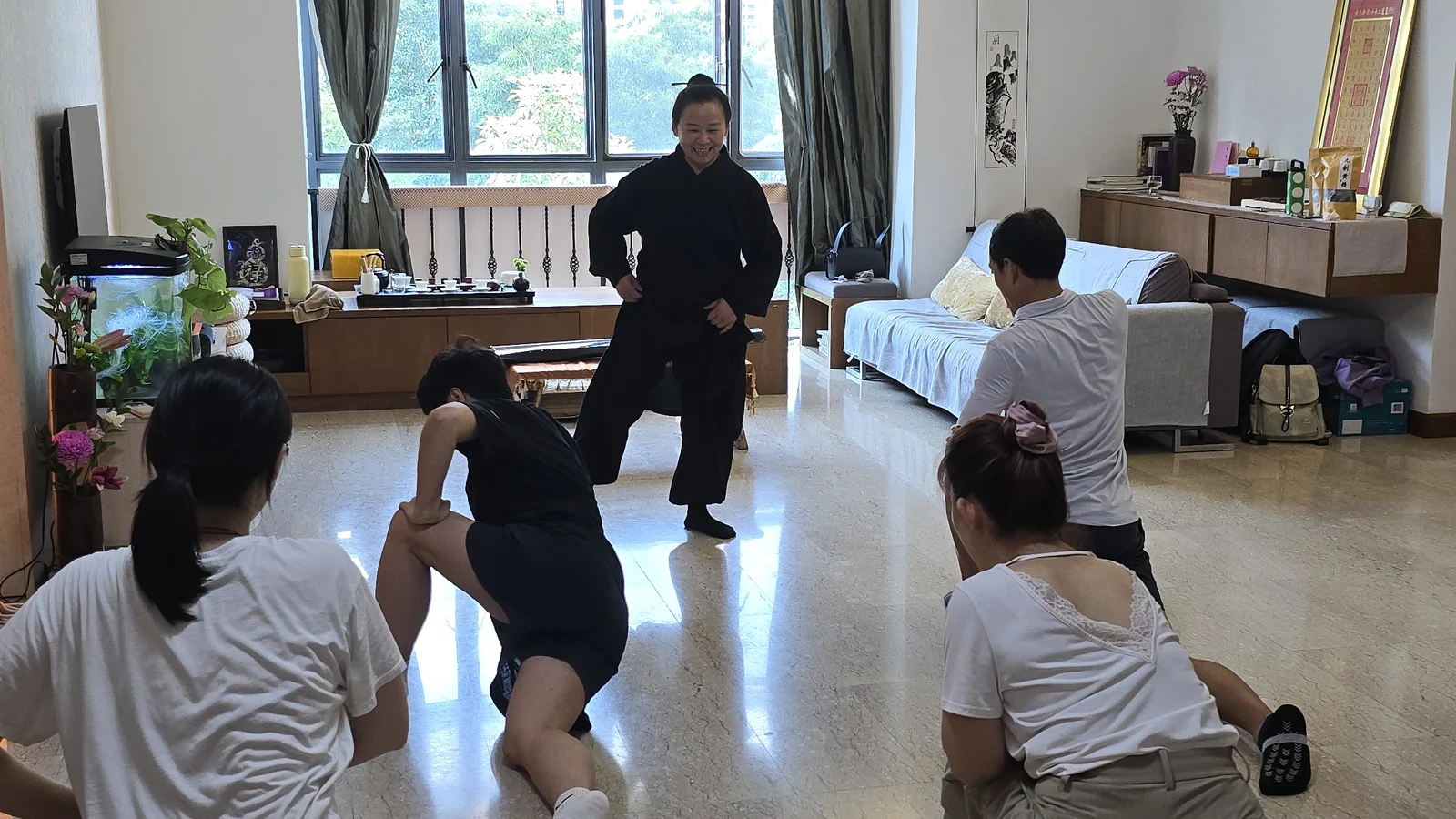
A Wudang taijiquan lesson in a sunlit room: students seen from behind kneel into deep lunges to open the hips while a teacher in black Taoist-style clothing stands in a wide stance, smiling, with an ink-painting scroll on the wall behind.

When you practise solo Wudang Taijiquan by yourself in a quiet room, it is easy to feel perfectly balanced and relaxed. Yet the moment a classmate lightly places a wrist against yours and shifts weight forward, hidden habits appear: your shoulders rise, your breath catches, and your knees lock. That is why classical pedagogy pairs solo form (“the skill of knowing yourself,” 知己功夫) with Push Hands (推手, Tuishou, historically called “Playing Hands,” 打手)—a cooperative two-person laboratory for testing alignment, rooting, and Tingjin (listening energy) under gentle contact.

1. The Classical Blueprint: The Song of Playing Hands (《打手歌》)

One of the most concise texts in the entire Tai Chi canon is the six-line Song of Playing Hands (《打手歌》), preserved alongside Wang Zongyue’s Taijiquan Treatise:

“Ward-off (Peng 掤), Roll-back (Lu 捋), Press (Ji 挤), and Push (An 按) must be practised with genuine care;
When upper and lower coordinate smoothly, the other person finds it hard to enter.
Let them strike with great force if they wish—
Four ounces deflect a thousand pounds (四两拨千斤).
Drawing them in to land on emptiness (引进落空), borrow their force to issue cleanly;
Adhering, connecting, sticking, and following (沾连粘随), neither lose contact nor resist head-on.”

Notice how directly this verse translates the philosophy of Chapter 43 and Chapter 78 of the Tao Te Ching (Dao De Jing) into movement: a small, well-timed deflection at the tangent of a circle redirects a heavy linear push that would overpower you if met chest-to-chest.

2. How the Four Primary Energies (四正手 · 掤捋挤按) Form One Continuous Circle

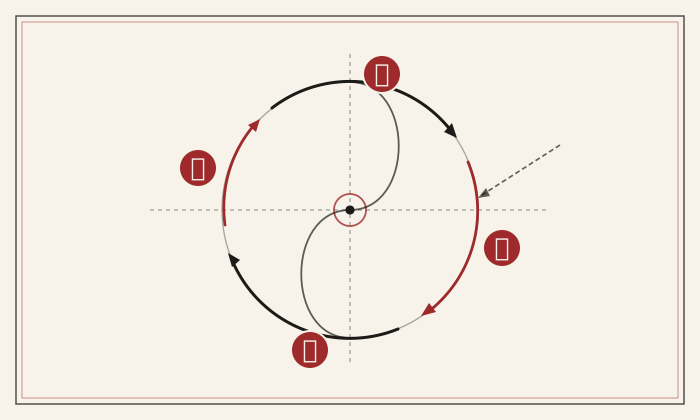
Beginners often mistake Peng, Lu, Ji, and An for four separate hand tricks. In authentic Wudang training, they are four phases of a single continuous wheel governed by the waist and rooted legs (Song and Rooting Jin):

Classical ink-and-cinnabar diagram of Wudang Taijiquan Push Hands showing the continuous circular cycle of Peng, Lu, Ji, and An around a stable central equilibrium axis

The Four Primary Energies (四正劲) in Wudang Tuishou revolving around Central Equilibrium (中定).

  1. Peng (掤 · Buoyant Ward-Off): elastic, rounded structural expansion—like wood floating on water—that supports contact without stiff muscular locking
  2. Lu (捋 · Yielding Roll-Back): rotating the waist and folding the hip crease (kua) to guide an incoming linear push softly past your centre along the tangent (引进落空)
  3. Ji (挤 · Focused Convergence): bringing the rear palm to support the lead forearm as the back leg transfers weight forward into a unified arc
  4. An (按 · Rooted Settling & Release): sinking the wrists and shoulders slightly downward before releasing forward like an ocean wave, returning smoothly into the next cycle

3. How Beginners Start: Single-Hand Circle Before Two-Hand Patterns

In a well-run class, you never begin by trying to throw your partner across the floor. Instead, you build sensitivity across three calm progressions (see also our broader overview on Push Hands):

  • Step 1 — Fixed-Step Single-Hand Horizontal & Vertical Circles (定步单推手): Standing in a comfortable bow stance with your front feet parallel, touch the back of one wrist lightly to your partner’s wrist. One partner shifts weight forward to 70/30 while turning the waist; the other folds the hip joint (kua) and guides the arm past the shoulder without leaning backward, then returns the arc.
  • Step 2 — Checking Your Own “Double-Weightedness” (双重之病): Whenever the circle jams or grates, pause and check where both partners stiffened at the same time—the classical fault called “double-weightedness” (双重则滞) in the Taijiquan Treatise.
  • Step 3 — Two-Hand Four-Primary Pattern (四正推手): Once single-hand contact stays light as a feather through fifty continuous circles, add the second hand to cycle smoothly through Peng → Lu → Ji → An.
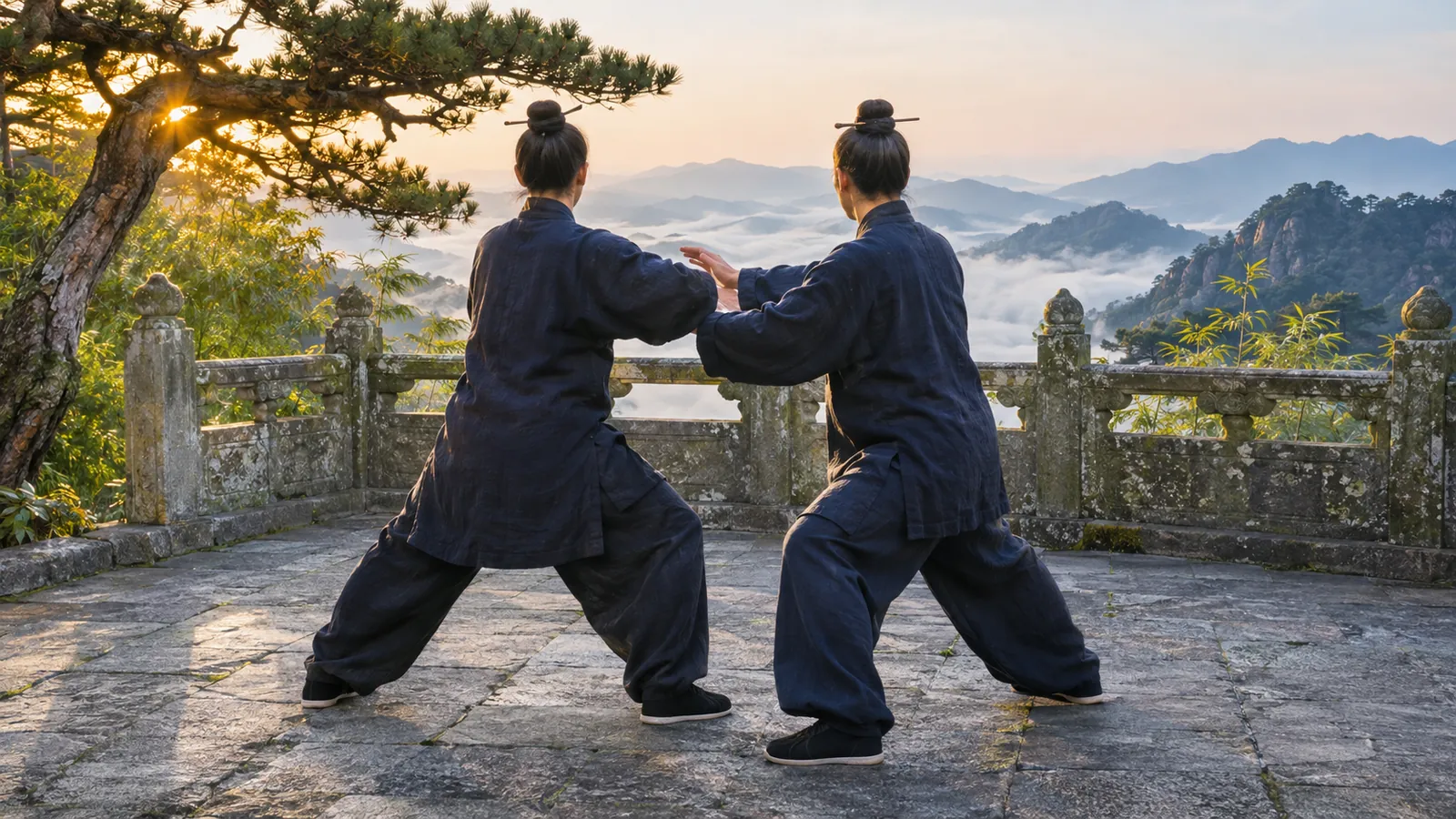
Two practitioners in dark indigo Taoist robes seen from behind on a grey stone mountain terrace above morning clouds, wrists lightly connected in cooperative Wudang Tai Chi Push Hands (Tuishou) practice.

Cooperative Push Hands (Tuishou) at dawn: light forearm contact tests rooting, waist rotation, and listening sensitivity without stiff resistance.

4. Partner Etiquette (Wude 武德) Between Wudang Mountain and Singapore

Traditional Wudang training calls cooperative partner drills “feeding energy” (喂劲, weijin): a senior student offers a clear, steady vector of force at a speed the newer student can actually feel and neutralize, practicing the quiet integrity (De) taught in the classics. Between Wudang Mountain’s UNESCO World Heritage ancient Taoist temples and our regular classes in Singapore, beginners first establish solo alignment in Zhan Zhuang and Wudang Tai Chi for Beginners, then experience supervised partner drills at the Tai Chi Retreat Camp in Singapore (or map a full study path on Start Here).

Safety note: Keep knees aligned strictly with the toes during all weight transfers, never jerk a partner’s wrist or elbow joint, and remember that internal martial arts are a cultural movement practice rather than medical therapy.

Seeker’s Q&A · Frequently Asked Questions

What are the Four Primary Energies (Si Zheng Jin 四正劲) in Tai Chi Push Hands?

They are Peng (掤, buoyant structural ward-off), Lu (捋, yielding roll-back that guides incoming force along the tangent), Ji (挤, focused two-arm convergence toward the centreline), and An (按, rooted downward settling followed by wave-like forward release).


Is Tai Chi Push Hands a wrestling or shoving competition?

No. In traditional Wudang training, Push Hands is a cooperative sensitivity laboratory (“feeding energy,” 喂劲) designed to expose hidden stiffness (“double-weightedness,” 双重) and train tactile listening (Tingjin) and balance.

When is a beginner ready to start Fixed-Step Single-Hand Push Hands?

Once you can stand comfortably in Zhan Zhuang for five to ten minutes with unlocked knees and sunk shoulders, and can shift weight 70/30 smoothly in basic solo stepping without leaning your torso, you are ready to begin cooperative Fixed-Step Single-Hand Push Hands.
