WUDANG TAIJIQUAN · 武当太极拳

Grasp the Sparrow’s Tail (Lanquewei) in Wudang Taijiquan: Step-by-Step Guide to Peng, Lu, Ji, An in Solo Form 武当太极拳“揽雀尾”详解:掤、捋、挤、按四正手身法拆解与慢练心法

Why traditional masters call Grasp the Sparrow’s Tail the “mother sequence” of Taijiquan—and how to link Ward-Off, Roll-Back, Press, and Push into one unbroken waist-driven loop.

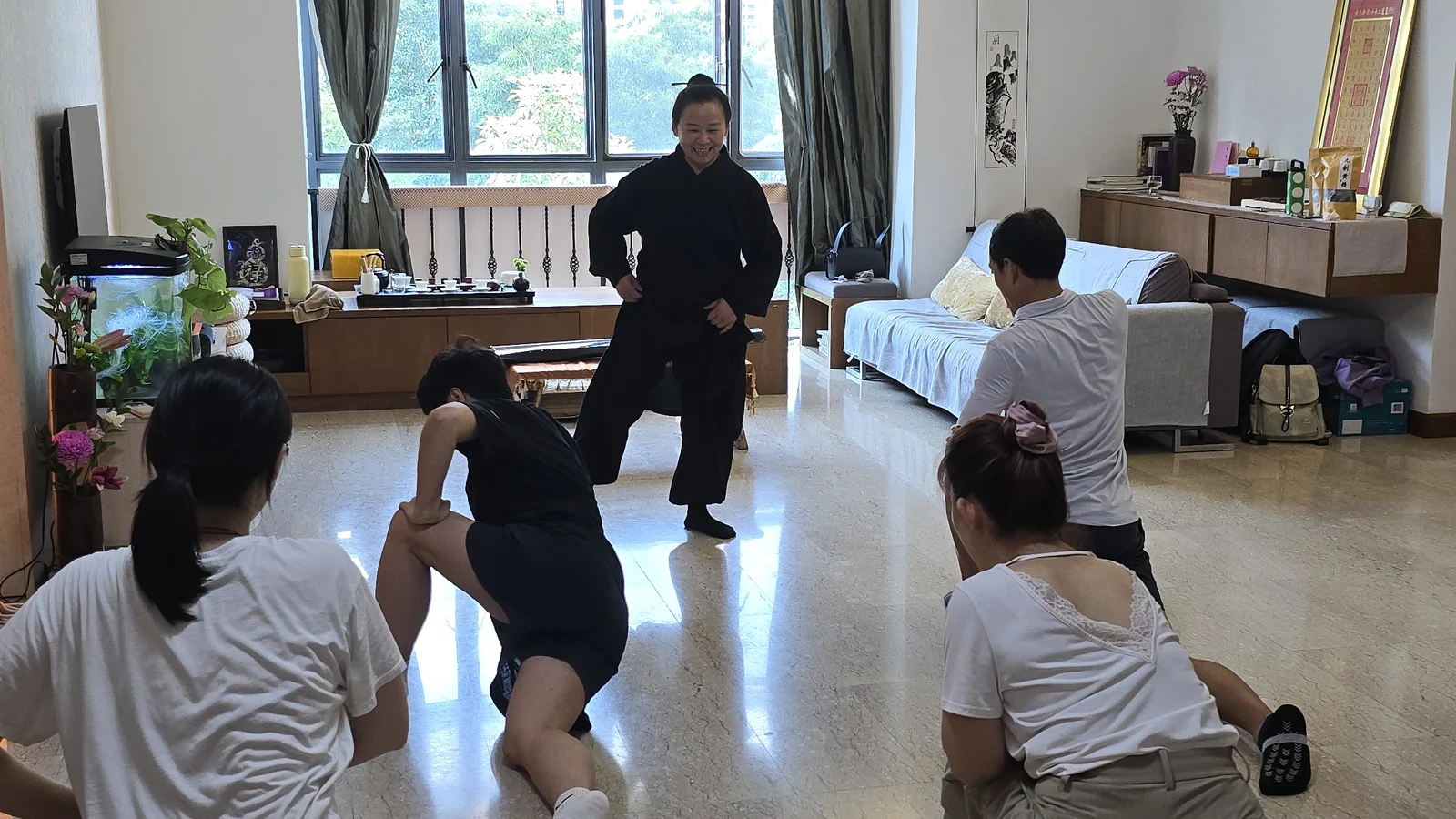
A Wudang taijiquan lesson in a sunlit room: students seen from behind kneel into deep lunges to open the hips while a teacher in black Taoist-style clothing stands in a wide stance, smiling, with an ink-painting scroll on the wall behind.

Ask any veteran teacher of Wudang Taijiquan which single sequence contains the DNA of the entire art, and the answer is almost always “Grasp the Sparrow’s Tail” (揽雀尾, Lanquewei). A classic saying in internal martial arts circles observes: “All of Taijiquan is the unfolding of Grasp the Sparrow’s Tail; Grasp the Sparrow’s Tail is the condensation of all Taijiquan.”

While our companion guides on Wudang Push Hands (Tuishou) and The Thirteen Postures (Shisanshi) introduce the Four Primary Energies in partner sensitivity and trigram cosmology, this step-by-step guide focuses on how to perform Grasp the Sparrow’s Tail cleanly in your solo form—so your arms never collapse against your chest or over-reach past your toes.

1. Why Is It Called “Grasp the Sparrow’s Tail” (揽雀尾)?

Two complementary images from traditional teaching explain this poetic name:

  • Cradling a Live Sparrow Without Crushing It or Letting It Fly: When a small bird perches on your forearm, if you squeeze tightly with stiff force, you injure it; if your arm goes limp and slack, it flies away immediately; and as soon as its feet push down to take off, a sensitive forearm yields a fraction of an inch (Tingjin) so the bird has nothing solid to push against.
  • The Rounded Tail-Fan Frame Before the Chest: Throughout the four phases of Lanquewei, your two forearms maintain a buoyant hemispherical arc in front of your torso—“rising no higher than the eyebrows, sinking no lower than the navel, drawing no closer than a fist-width from the chest, and extending no further than the front toes”—opening and closing smoothly like a sparrow’s tail feathers steering in the wind.

2. Step-by-Step Anatomy of the Four Phases: Peng, Lu, Ji, An

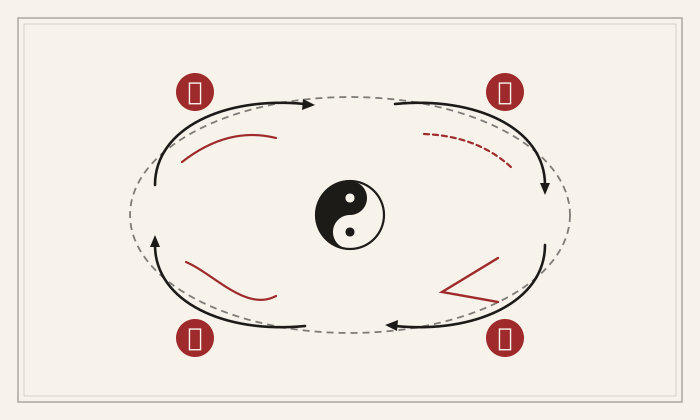
In solo practice, the four phases of Grasp the Sparrow’s Tail flow in one continuous figure-eight loop driven by the waist and hip creases (kua):

Classical ink-and-cinnabar diagram of Wudang Taijiquan Grasp the Sparrow's Tail (Lanquewei) showing the four phases of Peng (Ward-Off), Lu (Roll-Back), Ji (Press), and An (Push) unified into one continuous waist-driven loop

The four-phase cycle of Grasp the Sparrow’s Tail (揽雀尾 · 掤捋挤按四正循环) in solo Wudang Taijiquan.

  1. Phase 1 — Peng (掤 · Ward-Off, Expanding Forward & Upward): weight transfers into the front bow stance (60–70% front) while the leading forearm rises in a rounded horizontal arc at chest height, buoyant like driftwood on water
  2. Phase 2 — Lu (捋 · Roll-Back, Sitting Back & Turning the Waist): both palms turn softly in Silk-Reeling spirals as you fold the rear hip crease (kua) and rotate the waist 45 degrees, guiding incoming force diagonally past your hip without collapsing the elbows against the ribs
  3. Phase 3 — Ji (挤 · Press, Uniting Both Forearms at the Centreline): as weight shifts forward again, the rear palm meets the inner wrist or forearm of the lead arm to form a rounded wedge expanding from the rear heel through the spine (Six Harmonies)
  4. Phase 4 — An (按 · Push, Withdrawing Over the Curve & Settling Forward): both hands separate to shoulder width, draw back slightly while sitting into the rear hip as if wiping over a floating ball, then sink the wrists and press forward-and-downward from the soles

3. Three Common Solo Mistakes—and How to Fix Them

  • Mistake 1 — “Clamping the Armpits” During Roll-Back (Lu): Beginners often pull their hands back with their biceps while staying facing straight ahead, pinning their elbows against their ribs. Fix: Leave a fist’s space in both armpits; let the backward-and-sideways travel of your hands come 80% from sitting into the rear hip crease and turning the waist.
  • Mistake 2 — Leaning the Nose Past the Front Knee During Press (Ji) and Push (An): Reaching for extra distance tips the torso forward and breaks your central pivot. Fix: Keep the tailbone plumb and the crown suspended; stop the forward weight shift the instant your front knee aligns over the ball of the foot.
  • Mistake 3 — Dropping Peng Buoyancy Between Phases: Treating the four movements as four separate stop-and-start postures. Fix: As Chapter 40 of the Tao Te Ching (Dao De Jing) notes, “Returning is the movement of the Tao” (反者道之动)—the final millimetre of Peng already contains the turning seed of Lu, and the end of Lu already coils the spring for Ji.
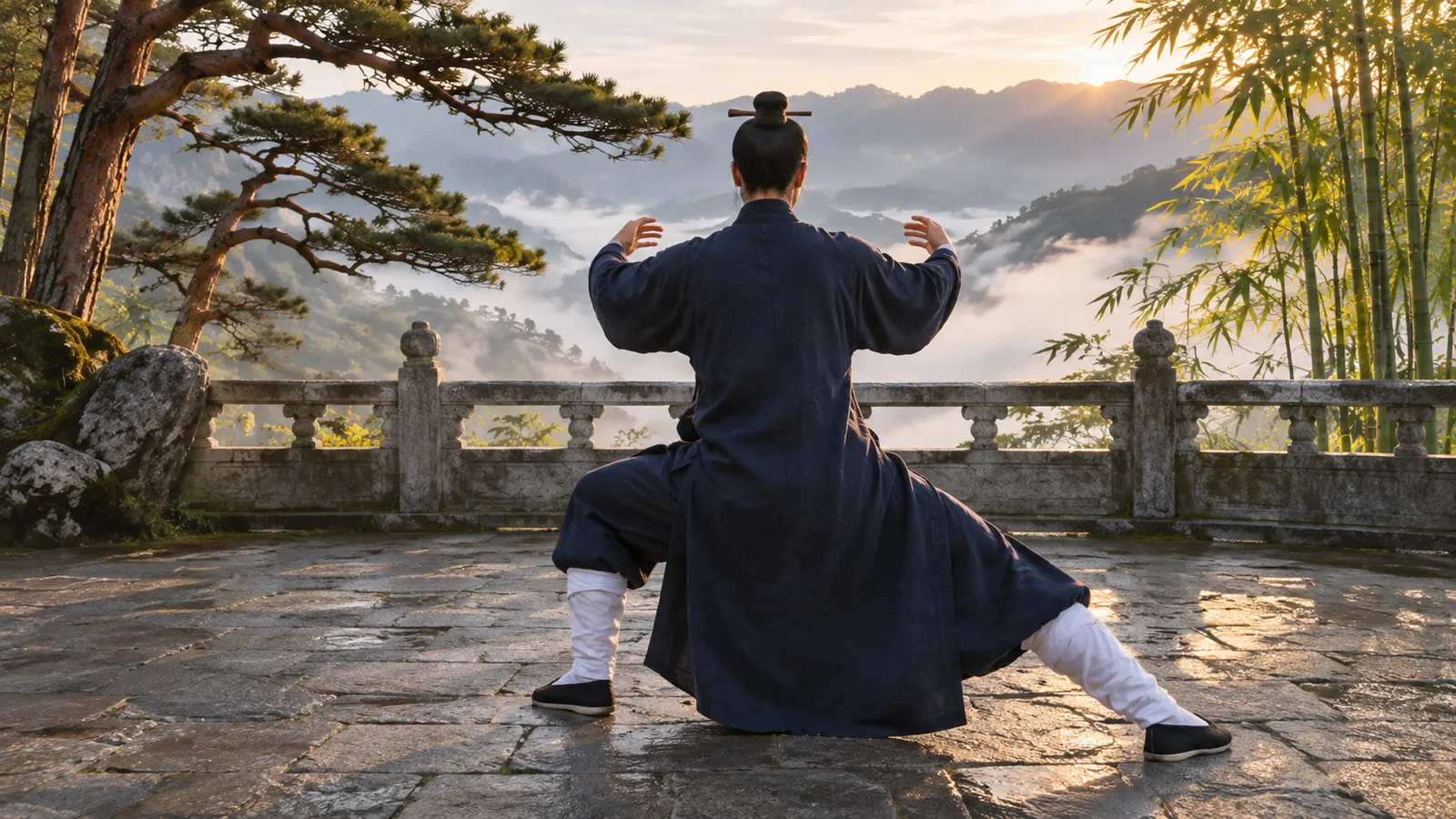
A practitioner in dark indigo Taoist robes and white cotton leg wraps seen from behind holding a rounded Wudang Taijiquan Grasp the Sparrow’s Tail (Lanquewei) Ward-Off stance on a misty mountain courtyard at dawn.

Grasp the Sparrow’s Tail (Lanquewei) at dawn: the rounded Ward-Off frame stays buoyant between eyebrows and navel, neither stiff nor collapsed.

4. Practising Lanquewei Between Wudang Mountain and Singapore

Connecting the living martial lineage near Wudang Mountain’s UNESCO World Heritage ancient Taoist temples with our regular classes in Singapore, Wudang.Org helps students link solo Lanquewei seamlessly into Single Whip and Cloud Hands. Begin with Wudang Tai Chi for Beginners, map your curriculum on Start Here, or join our Singapore Tai Chi Retreat Camp.

Safety note: Keep the front knee aligned with the toes and never past the tips of the toes during the forward bow stance, and breathe naturally through the nose (Natural Abdominal Breathing); traditional martial training complements but does not replace medical care.

Seeker’s Q&A · Frequently Asked Questions

Why is “Grasp the Sparrow’s Tail” (Lanquewei 揽雀尾) considered the core sequence of Taijiquan?

Because it unites all Four Primary Energies—Peng (Ward-Off), Lu (Roll-Back), Ji (Press), and An (Push)—along with forward-and-backward weight transfer, waist rotation, and spiral arm coordination into one continuous loop.


How far should the arms extend during Peng, Ji, and An in Grasp the Sparrow’s Tail?

Follow the traditional rule: “rising no higher than the eyebrows, sinking no lower than the navel, drawing no closer than a fist-width from the chest, and extending no further than the front toes,” keeping the elbows softly bent and heavy.

What is the difference between Ji (Press) and An (Push) in Lanquewei?

Ji (Press) unites both forearms at the centreline like a focused wedge expanding straight forward from the rear heel; An (Push) separates the hands to shoulder width, withdraws slightly over a curve to neutralize incoming force, and settles forward-and-downward like a broad wave.
