Chinese Tea Ware: Clay, Porcelain, Glaze and the Uses of Form
中国茶器:胎土、瓷釉、造型与使用
Chinese tea ware is often introduced as equipment: one vessel holds water, another steeps leaves, and another receives the finished infusion. Yet a bowl, gaiwan or teapot is also a made object. Clay or porcelain body, glaze, firing, wall thickness, foot, lid, handle, inscriptions, repairs and traces of use can reveal different parts of its history.
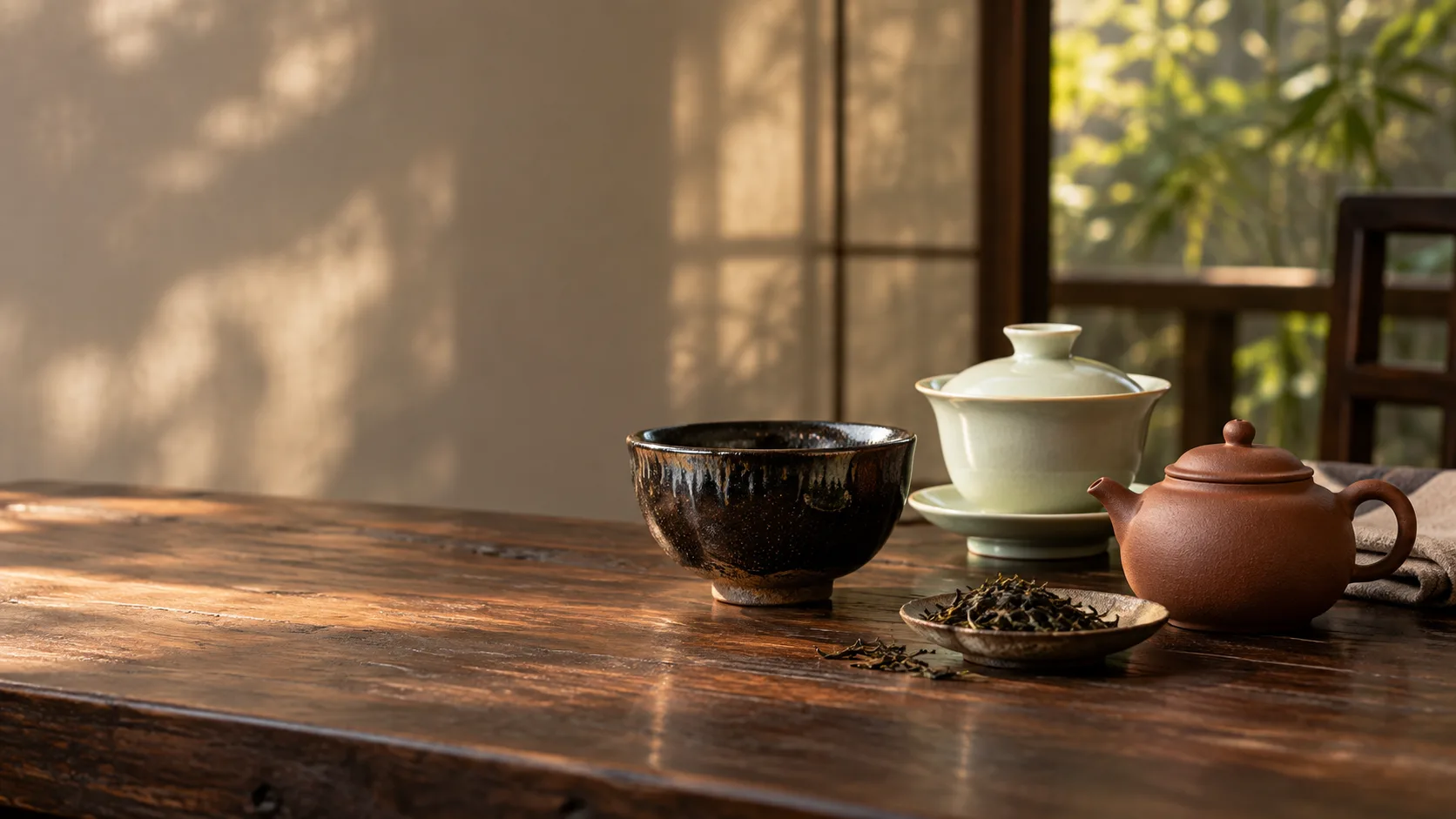
This guide complements the site’s practical gongfu tea method. It does not rank materials, promise that one clay improves every tea, or teach authentication from photographs. Instead, it offers a way to look carefully, connect form with documented practice and keep later collecting stories separate from what the object itself can support.
Begin with body, glaze and firing
Name the ceramic body before the colour
“Clay,” “stoneware” and “porcelain” are not interchangeable colour words. Ceramic bodies differ in raw materials, refinement, forming and firing. A reddish unglazed body may suggest one family of stoneware, while a pale translucent body may suggest porcelain, but visual appearance alone does not securely identify a kiln, recipe or date. Start with the museum’s stated medium, then compare colour, texture, weight and translucency as observations rather than verdicts.
Read glaze as a fired surface
Glaze can pool, thin, streak, crawl, spot or change colour where heat and atmosphere varied. The Metropolitan Museum of Art’s eleventh- to twelfth-century Jian tea bowl has an iron-rich “hare’s-fur” glaze. The Met relates its dark surface to whisked tea and notes that it heightened the colour of the pale green liquor. This is a documented relationship for a particular bowl tradition, not a rule that dark cups improve all tea.
The foot and underside preserve another view
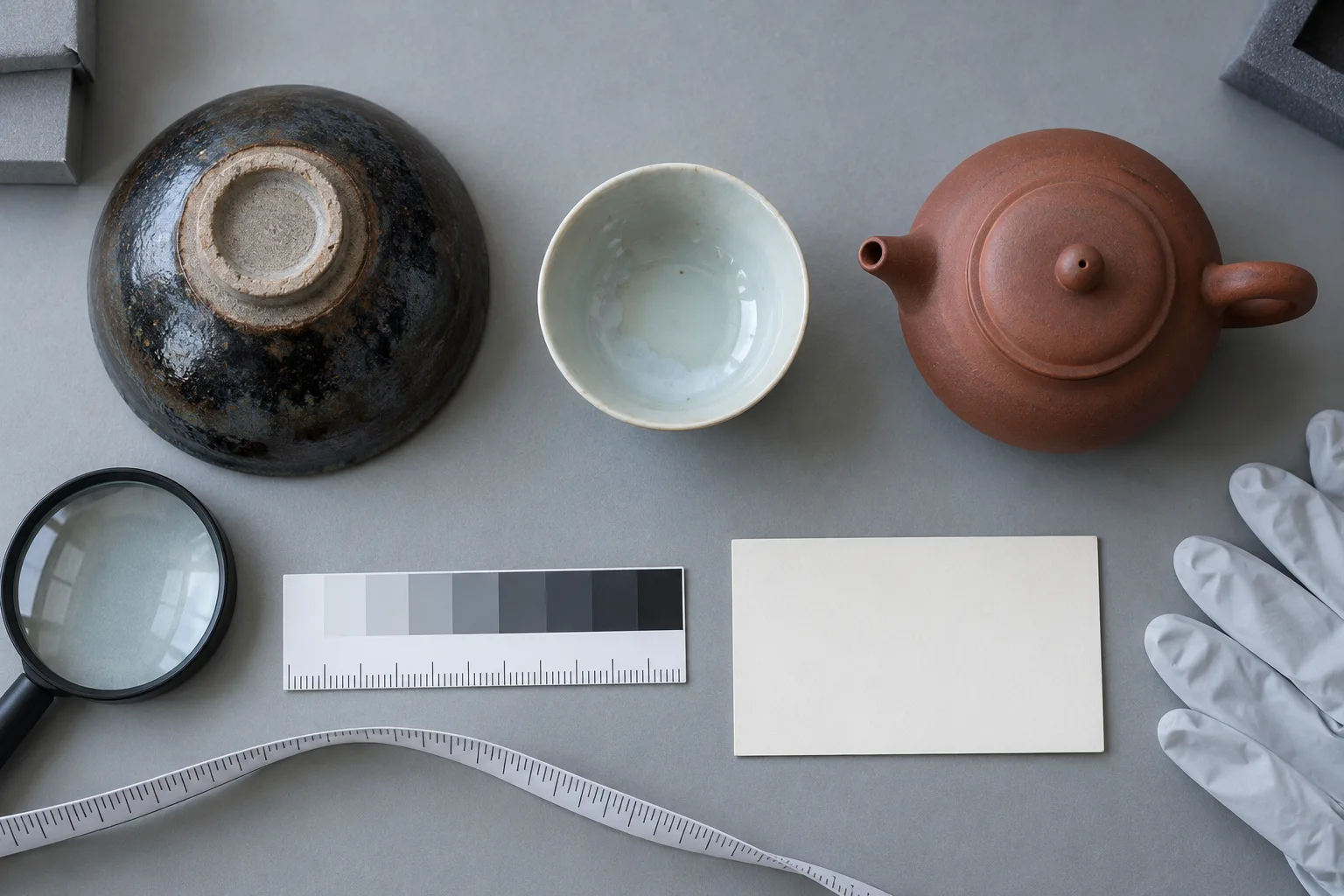
The foot ring can expose the ceramic body, trimming marks, kiln grit, glaze runs, later labels or repairs. The underside of a lid may carry a separate impressed mark. Museum photography does not always show every angle, so record what is absent from the view instead of filling it with assumptions. A complete reading needs the mouth, wall, base, foot, lid and joining points—not only the most photogenic profile.
Connect form with changing tea practices
A bowl belongs to a way of preparing tea
The Jian bowl makes most sense beside the powdered and whisked tea described in its catalogue record. A deep wall, stable foot and dark glaze participated in that act of serving and seeing. Other bowls supported other habits. Form can make a practice easier, but it does not prove who used an object, in which room, or on what exact occasion.
Teapots answer steeped-leaf brewing
The Met’s teapot in the shape of a plum blossom, attributed to Shi Dabin and dated to the seventeenth century, is Yixing stoneware. The museum cautiously explains that potters are thought to have adapted wine-ewer forms for tea drinkers using steeped leaves rather than powdered tea. The useful point is a changing relationship between preparation and vessel design—not a single inventor story.
Capacity, balance and pour are related, not absolute
A small pot may support repeated short infusions; a wider opening can make leaves easier to place and remove; a handle changes how heat and weight reach the hand. But capacity must be measured, not guessed from a photograph, and a celebrated shape may pour poorly if lid, spout and balance do not work together. For actual brewing choices, return to the six tea families, the role of water and your own controlled comparison.
Read surface, marks and later additions
Decoration may be modelled, carved, painted or added
Relief, incised lines, enamel, slip, glaze and applied metal belong to different working stages. The British Museum records a Yixing stoneware teapot encased in pewter with jade handle, spout and lid knob. Its appearance cannot be explained by clay alone. Describe every material and ask whether each part was made together, added during manufacture or fitted later.
Inscriptions and seals are evidence, not automatic proof
A pot may carry a maker’s seal, studio name, poem, owner’s mark or later attribution. Location and technique matter: impressed beneath a lid, carved into a body and painted over a glaze are not equivalent. The Hong Kong Museum of Art’s tea-ware collection shows how inscriptions could move from the base onto the visible body. Use the site’s guide to Chinese seals to separate matrix, impression and attribution, and verify a name against catalogue and provenance rather than prestige.
Repairs and collecting history are part of the object
A replaced lid, metal rim, lacquer repair or fitted case may belong to a later life. The National Palace Museum’s exhibition on Yixing ware and its later transformations places clay bodies beside painted enamels and cross-material decoration. Such additions can show taste, circulation or care. They should neither be erased as impurity nor mistaken for the vessel’s first state.
Build an evidence-led object reading
Use one dated object at a time
A museum label joins material, date, place, dimensions, acquisition and sometimes a maker, but each field has its own certainty. Compare a Song bowl, a Ming or Qing pot and a modern Yixing work as individual records before building a long history. The Met’s twentieth-century Yixing teapot is useful precisely because “Yixing ware” did not end with the imperial period.
Question attractive material myths
Claims that a named clay always sweetens tea, permanently remembers one leaf type or proves authenticity should be tested rather than repeated. A recent Oxford doctoral study of zisha technology and meaning specifically questions simple links between porosity and flavour. Material science, craft history and use history can inform one another without turning a complex vessel into a magical device.
A six-pass reading method
- Name. Record object type, stated ware, ceramic body, glaze and other materials.
- Map. Follow rim, wall, foot, lid, handle, spout and every join.
- Surface. Separate glaze effects, tool marks, decoration, wear, residue and repair.
- Measure. Use documented dimensions and capacity; do not infer scale from an isolated image.
- Trace. Distinguish maker’s marks, later inscriptions, labels, ownership and museum acquisition.
- Compare. Test one feature against securely dated objects, then state what remains uncertain.
Good object reading moves between looking and documentation. It lets a tea bowl remain a bowl, a teapot remain a working vessel, and each later mark remain a historical layer. Return to Chinese Tea Culture for the wider reading path, then handle modern usable ware according to the maker’s care instructions rather than treating museum objects as brewing manuals.
Research note: This guide draws on object records and curatorial material from the Metropolitan Museum of Art, British Museum, Hong Kong Museum of Art and National Palace Museum, together with recent Oxford research on zisha technology. The examples demonstrate methods of observation, not a universal ranking of tea ware or an authentication checklist.