Twenty Words You Will Meet on This Site
二十个你会在本站遇到的词
Sooner or later every reader of this site meets a word that will not stay still: qi, dantian, wu wei, ziran. The same words turn up in the Tao Te Ching (Dao De Jing), in a qigong class and on the walls of a temple, and almost nobody stops to explain them. This page is for the moment you wish someone would.
Why these words are hard to translate
Most of them are older than the languages we translate them into. A single English word such as “energy”, “nature” or “virtue” usually fits one part of the meaning and misleads about the rest. So this site keeps the pinyin (the standard spelling of Chinese sounds in Roman letters) once a word’s sense has been explained, and it is worth getting used to the sound of each one.
How to use this list
You do not need to learn all twenty. Read the headings, look at one or two entries, and come back when a word stops you on another page. Every entry has the same four parts: the word with its Chinese characters, a plain line on what it means, a line on what it is often mistaken for, and a link to the page on this site that explains it best. Where the tradition describes a practice, these entries report what the tradition says; they are not instructions, and they do not promise any effect.
The big ideas
Tao (dào) 道
The Way: the course along which things come to be and change. The classical texts rarely define it directly; they point at it with images such as water, a valley and an empty vessel.
Often mistaken for a creator god, or a fixed set of rules. The texts treat it as beyond any single method.
De (dé) 德
Usually “virtue” or “inner potency”: the Tao taking living shape in a person’s character and conduct. The Tao Te Ching (Dao De Jing) takes its name from the two words Tao and De.
Often mistaken for politeness or rule-following. In Classical Chinese the word is wider than that.
Yin (yīn) 阴
Originally the shaded side of a hill or the south bank of a river. By extension, the quieter, darker, receptive side of any pair.
Often mistaken for a label stuck on things (dark, female, weak). It describes how two sides relate to each other, not what a thing is.
Yang (yáng) 阳
The sunlit side of a hill, and by extension the brighter, more active, rising side of any pair. Yang only makes sense next to yin.
Often mistaken for the “good” half that ought to win. The two are not opponents; each is described by the other.
Wu wei (wúwéi) 无为
Literally “non-action”: acting without forcing, so that nothing needful is left undone.
Often mistaken for doing nothing, or giving up. The classical texts pair it with “nothing left undone”.
Ziran (zìrán) 自然
Literally “so of itself”: things unfolding by their own nature, without being pushed from outside.
Often mistaken for “nature” in the modern sense of forests and mountains, or a fourth power standing above the Tao.
The body and practice
Qi (qì) 气
In Chinese the old word for breath, vapour and the lively stuff of things. In Taoist practice it is an organising idea that the tradition describes rather than measures.
Often mistaken for a physical force or fluid, like electricity. The usual English word “energy” is the part that misleads.
Dantian (dāntián) 丹田
“Cinnabar field” or “elixir field”. In the texts, a region of the body, traditionally three (upper, middle, lower), on which attention is placed in practice.
Often mistaken for an organ, or one exact spot you could find on an anatomy chart. The texts place the fields in the body, but describe them by their role in practice, not as anatomy.
Jing–qi–shen (jīng qì shén) 精气神
The “Three Treasures”: essence, breath and spirit. The tradition uses them to describe a person from the densest level (jing) to the finest (shen). Do not confuse them with Laozi’s three ethical treasures in chapter 67.
Often mistaken for three separate substances. The tradition treats them as linked, and inner alchemy describes refining one into the next.
Neidan (nèidān) 内丹
“Inner alchemy”: the Taoist tradition that borrows the language of the alchemist’s furnace and elixir as a symbolic map of inner cultivation. Its oldest ancestor on our site is the Cantong Qi.
Often mistaken for a set of exercises you can pick up from a book. Its texts are written in symbols, and it is traditionally taught step by step by a teacher.
Daoyin (dǎoyǐn) 导引
“Guiding and pulling”: movement and stretching exercises done with the breath. A painted chart of them was found in a Western Han tomb at Mawangdui, from the second century BCE.
Often mistaken for just another name for qigong. Daoyin is the older word; “qigong” became the common name only in the twentieth century.
Yangsheng (yǎngshēng) 养生
“Nourishing life”: a broad field of habits (food, sleep, movement, mood, season) aimed at looking after life over a long course.
Often mistaken for a treatment, or a promise of long life. It is not one technique, one lineage or a medical therapy.
Jingzuo (jìngzuò) 静坐
“Quiet sitting”: a name Taoists (and also Neo-Confucians) use for sitting still, upright and unhurried, and letting body, breath and mind settle.
Often mistaken for a trance, or just a posture. The posture is shared with many traditions; what makes it Taoist is the texts and communities behind it.
Neigong (nèigōng) 内功
“Internal work” or “internal training”. In different schools it can mean standing, slow movement, breathing, focused attention or a mix of these.
Often mistaken for one secret exercise, or a source of hidden power. The useful question is what a particular teacher asks you to practise.
The cosmos and the Book of Changes
Taiji (tàijí) 太极
The “supreme pivot” or “supreme limit”: the point from which yin and yang are said to arise. It is also the first half of the name Taijiquan.
Often mistaken for only the name of a martial art. The word is far older: a sentence in the Xici commentary to the Book of Changes, 易有太极 (“in the Changes there is the taiji”), made it central.
Wuji (wújí) 无极
The “limitless” or undivided: the stillness before yin and yang are told apart. Teachers say a Taijiquan session begins from it, in the opening stillness.
Often mistaken for an empty nothing. The tradition uses it for an undivided condition, before distinctions arise.
Gua (guà) 卦
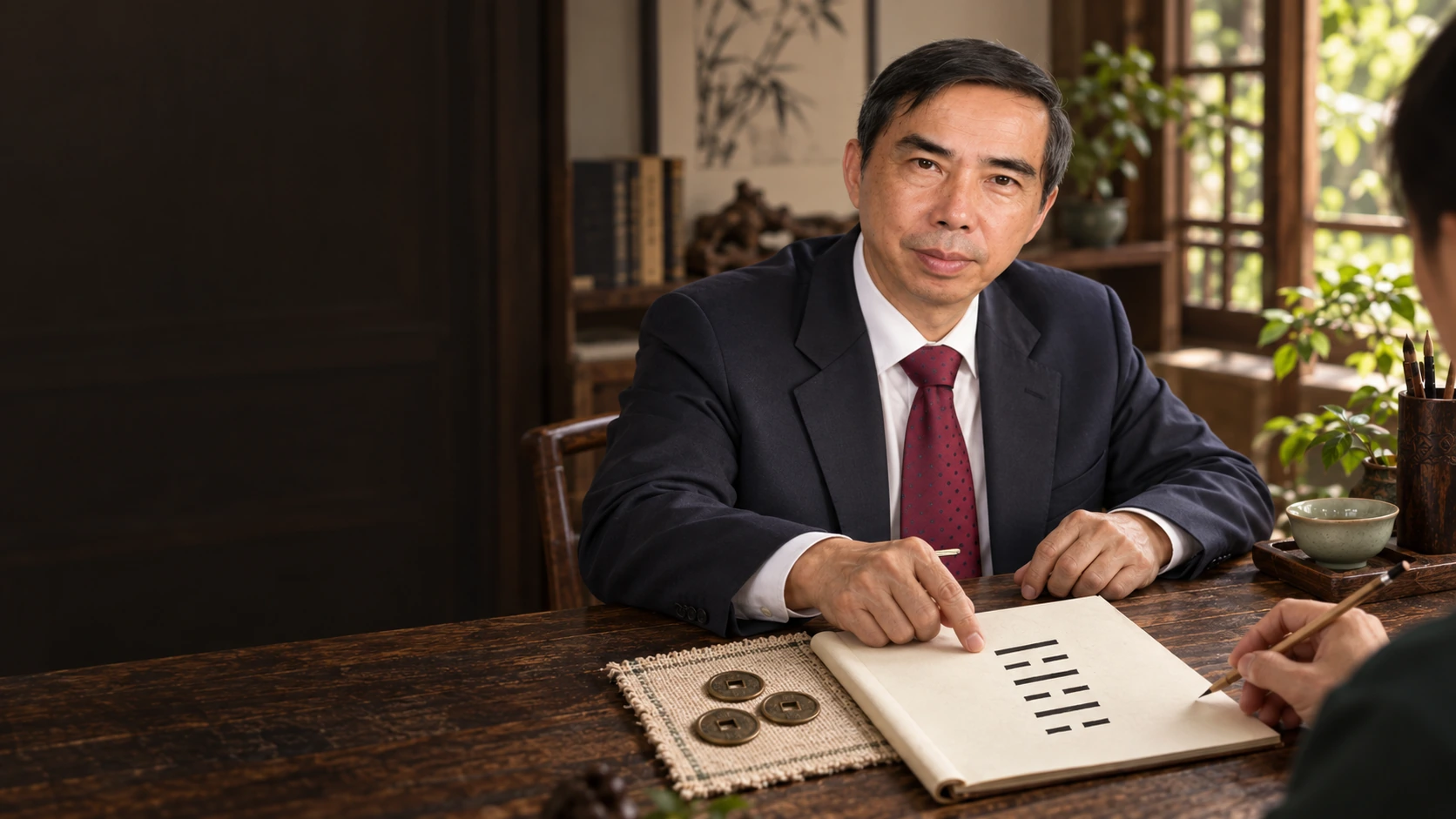
A figure from the Book of Changes made of broken and unbroken lines: three lines make a trigram (eight of them), six make a hexagram (sixty-four).
Often mistaken for mere decoration, or a lucky charm. The eight trigrams are the building blocks of all sixty-four hexagrams.
Wuxing (wǔxíng) 五行
The “five phases”: Wood, Fire, Earth, Metal and Water, five ways in which things move and change.
Often mistaken for “five elements” in the Greek or chemical sense. Phases are processes, not materials.
The Taoist tradition at Wudang
Quanzhen (quánzhēn) 全真
“Complete Perfection”: the monastic branch of Taoism, from the twelfth century, with communal life under written rules. Most of the Taoists who live in Wudang’s temples today belong to it.
Often mistaken for the whole of Taoism, or its oldest form. The Celestial Masters tradition is much older.
Zhenwu (zhēnwǔ) 真武
The “Perfected Warrior”: the deity at the heart of Wudang Mountain. He is often shown in dark robes with a sword, with a tortoise and a snake, commonly at his feet.
Often mistaken for a martial-arts founder or a historical master. Much of the mountain’s temple life centres on him as a deity.
Something to try
Choose one word from the list that you have already met somewhere and not quite understood. Open its page, read only the first paragraph, and then write one sentence in your own words saying what the word is not. Putting the mistake into words is often the quickest way to see what the word is.
If a page leads you to try a practice, stop if you feel pain, dizziness or unusual breathlessness, and see a doctor if it does not settle. Call 995 at once for chest pain, severe difficulty breathing or fainting. Seek advice first if you are pregnant, have a medical condition or a fresh injury. For a wider map of where these words belong, read Core Ideas: Wu Wei, Yin-Yang and Ziran.