
TAOIST PHILOSOPHY · 道家哲学

From Wuji to Taiji: How Taoist Cosmology Links the Nameless Origin to the Living Pivot of Yin and Yang 从无极而太极:读懂《道德经》“道生一”与动静互根的宇宙观

Reading Tao Te Ching Chapters 14, 25, 28, and 42 alongside the Diagram of the Supreme Ultimate (Taijitu Shuo) and the opening of the Taijiquan Treatise.

Forested rocky peaks rising above a sea of clouds at dawn.

Every time a student steps onto a training floor to practise Wudang Taijiquan or Qigong, the session begins before the hands ever move. You stand quietly with feet shoulder-width apart, shoulders settled, and breath unhurried. Traditional teachers call this opening stillness Wuji (无极, the Limitless or Undivided); the moment intention stirs and weight distinguishes substantial from insubstantial, they say Taiji (太极, the Supreme Pivot) has been born. Why do two cosmological terms from classical Chinese philosophy govern the first ten seconds of every practice?

1. Where the Words Come From: Wuji in the Tao Te Ching and Taiji in the Book of Changes

In early classical texts, the two terms arose in complementary streams that later converged in Wudang cultivation:

  • Wuji (无极, “without ridgepole or limit”): Appears first in Chapter 28 of the Tao Te Ching (Dao De Jing): “Know the white, yet keep to the black, and be a valley for the world; being a valley for the world, constant virtue (De) suffices, and one returns to the Limitless (复归于无极).” In Chapter 14 and Chapter 25, Laozi describes this state prior to heaven and earth as undifferentiated wholeness (有物混成,先天地生)—silent, boundless, yet pregnant with all possibilities.
  • Taiji (太极, “the Great Ridgepole or Supreme Pivot”): Appears in the Zhuangzi (Chapter 6, Dazongshi) and in the Great Treatise (《系辞上传》) of the Yi Jing (Book of Changes): “In Change there is the Supreme Pivot (易有太极), which generates the Two Modes (Yin and Yang); the Two Modes generate the Four Images, and the Four Images generate the Eight Trigrams.”

2. “The Tao Generates One… and Harmonizing Qi Makes Peace” (冲气以为和)

How does the nameless, undivided source unfold into the living world without losing its unity? Chapter 42 of the Tao Te Ching gives the most famous four-step formula in Taoist philosophy:

“The Tao generates One; One generates Two; Two generates Three; Three generates the ten thousand things. The ten thousand things carry Yin on their backs and embrace Yang in their arms, and through the blending of vital breath they achieve harmony (万物负阴而抱阳,冲气以为和).”

Notice that Laozi does not stop at “Two” (the opposition of Yin and Yang). If Yin and Yang merely pulled against each other like two rigid teams in a tug-of-war, nothing could live. A third reality—Chongqi (冲气, the receptive, blending breath in the open middle, related to empty space)—allows stillness and motion, inhalation and exhalation, firmness and yielding to interpenetrate.

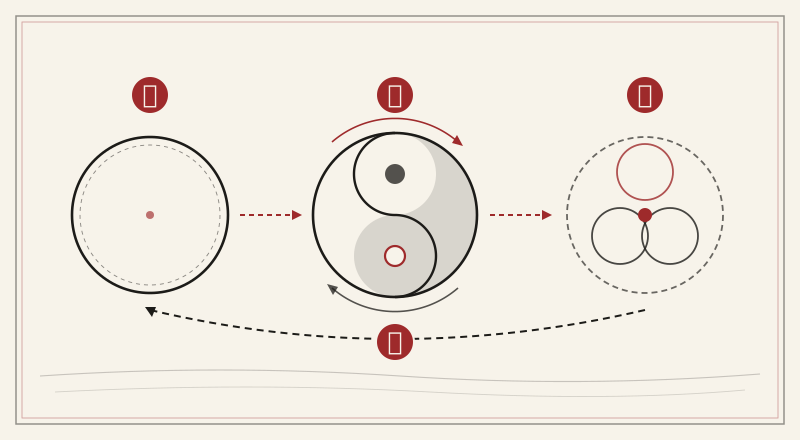
Classical ink-and-cinnabar diagram showing the progression from the undivided circle of Wuji to the Yin-Yang pivot of Taiji, the harmonizing triad of Chongqi, and the return arc to stillness

From Wuji to Taiji and back to stillness (Fugui): cosmological unfolding and contemplative return.

  1. Wuji (无极之圆 · Undivided Stillness): serene wholeness before intention splits into “this” and “that”
  2. Taiji (太极动静 · Mutual Rooting of Yin and Yang): movement gives birth to Yang; at its limit it settles into Yin—each holding the seed of the other
  3. Harmonizing Breath (冲气以为和 · Three Generates the Myriad Things): the open centre where Yin and Yang blend to sustain living vitality
  4. Return to the Root (静之则合 · 复归于无极): gathering scattered movement back into quiet equilibrium at the close of practice

3. Movement and Stillness as Each Other’s Root (一动一静,互为其根)

In the eleventh century, the diagram tradition associated with the Taoist lineage of Chen Tuan (陈抟) and articulated in Zhou Dunyi’s Explanation of the Diagram of the Supreme Ultimate (《太极图说》) linked Wuji and Taiji in a single sentence: “Limitless, and yet the Supreme Pivot!” (无极而太极). It is not that Wuji is a dead vacuum that disappears once Taiji starts moving; rather, stillness is the very root that keeps movement balanced:

“Through movement, the Supreme Pivot generates Yang; when movement reaches its limit, it becomes still. Through stillness, it generates Yin; when stillness reaches its limit, it moves again. One movement, one stillness—each is the root of the other (一动一静,互为其根).”

Centuries later, Wang Zongyue opened the classical Taijiquan Treatise (《太极拳论》) with the exact same principle: “Taiji is born from Wuji; it is the pivot of movement and stillness, and the mother of Yin and Yang. When it moves, it divides; when it rests, it reunites (动之则分,静之则合).”

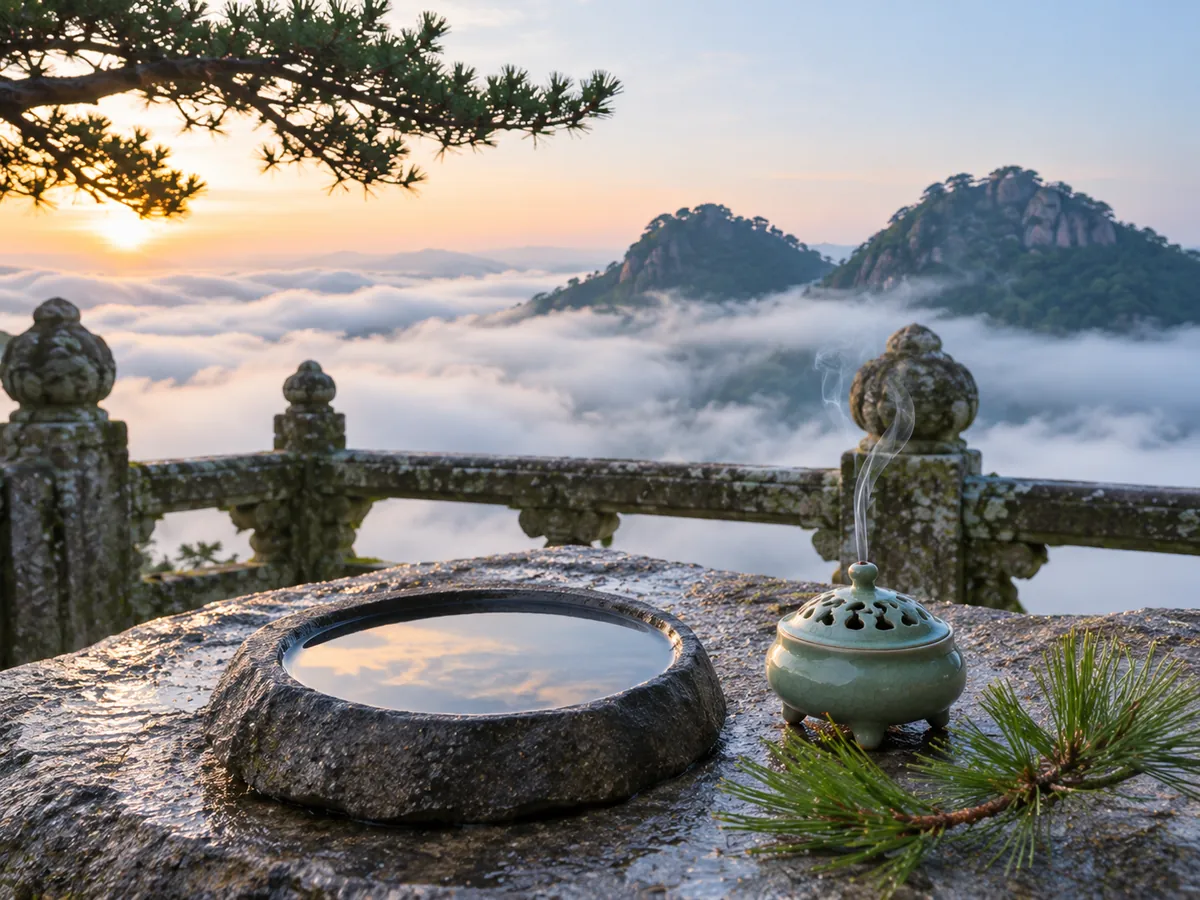
A round dark stone basin holding clear still mountain water beside a celadon incense burner and pine needles on a grey stone parapet overlooking twin forested peaks rising from morning clouds.

From Wuji to Taiji: the round mirror of still water evokes undivided Wuji, while peaks emerging from moving clouds reflect the living interplay of Yin and Yang.

4. Experiencing Wuji and Taiji on the Training Floor

Between Wudang Mountain’s UNESCO World Heritage ancient Taoist temples and our classes in Singapore, you do not have to memorize cosmological charts to feel Wuji and Taiji:

  • At the start of practice (Wuji Standing Post): Pause for sixty seconds before your first movement. Let the day’s mental chatter settle (Qingjing Jing) and let your breath sink naturally (Natural Abdominal Breathing) until neither side of the body feels braced.
  • During movement (Wudang Tai Chi for Beginners & Push Hands): Keep a quiet centre inside every weight shift (“stillness within movement,” 动中求静) so your six body segments move as one (The Six Harmonies).
  • At the close of practice (收势 · Returning to Wuji): Never walk away abruptly after the final posture; stand quietly for three breaths over the lower Dantian to gather the energy back to its root (Start Here).

Seeker’s Q&A · Frequently Asked Questions

What is the difference between Wuji (无极) and Taiji (太极) in Taoist philosophy?

Wuji (the Limitless) describes the quiet, undifferentiated wholeness prior to any division into opposites (Tao Te Ching Chapter 28), whereas Taiji (the Supreme Pivot) describes the dynamic pivot through which Yin and Yang, stillness and movement, alternate and give birth to one another. As the Taijitu Shuo states, they are not two separate places: Taiji is Wuji in living motion.


What does “carrying Yin and embracing Yang, blending Qi for harmony” (万物负阴而抱阳,冲气以为和) mean in Chapter 42?

It means every living thing holds both receptive stillness (Yin) and active expression (Yang), and sustains its life not by letting one side crush the other, but through Chongqi—the open, unforced middle breath that blends both sides into dynamic balance.

Why do Wudang Tai Chi and Qigong forms always begin and end with standing in Wuji?

Standing quietly in Wuji before moving clears habitual tension and mental haste so movement arises from a balanced centre (“Taiji born from Wuji”); standing quietly at the close gathers circulating breath and attention back to the lower Dantian (“when still, it reunites,” 静之则合).
