TAOIST PHILOSOPHY · 道家哲学

Guarding the Three Dantian and Rinsing the Jade Pond (黄庭经 Huangting Jing): The Yellow Court, Lute-Heart Harmony (Qinxin Sandie), and Nourishing the Root in Wudang Practice 《黄庭经》“琴心三叠、守三丹田与玉池清水灌灵根”精解:由内景黄庭中宫通向武当咽津导引与太极三田一线

How the classical poetic manual of the body's inner landscape harmonizes the Upper, Middle, and Lower Dantian like a seven-stringed zither and nourishes vitality with the Jade Pond's clear spring.

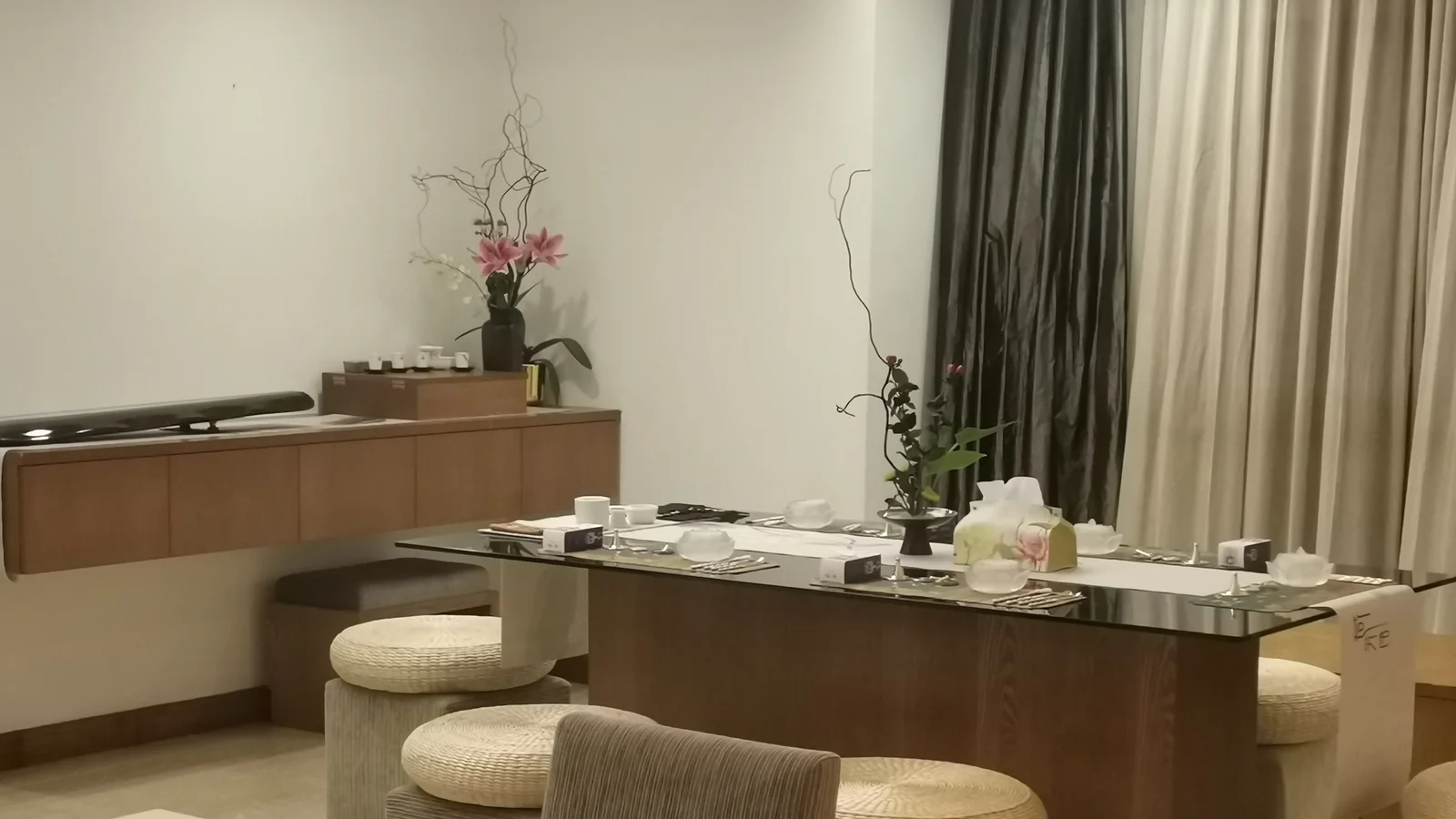
A quiet Taoist study room: a black guqin on a low wooden console beside a pink lily arrangement and tea set, and a dark-glass study table set with white lotus-shaped cups, an incense holder and a floral branch, with straw cushions and a grey curtain.

1. What Is the "Yellow Court" (Huangting 黄庭)? Textual History and the Inner Landscape of the Body

Within the classical Taoist library studied on Wudang Mountain, if the Tao Te Ching establishes the philosophy of returning to the root, the Qingjing Jing teaches how to settle discursive thought, and the Yinfu Jing reveals the timing of Heaven and Earth, then the Huangting Jing (黄庭经, Scripture of the Yellow Court) is the foundational poetic atlas of the human body's internal landscape (Neijing 内景). Composed in rhythmic seven-character verse during the late Han to Wei-Jin period (3rd–4th centuries CE), the scripture circulates in two complementary texts: the Huangting Waijing Jing (黄庭外景经, Outer Landscape Scripture, famously copied in small regular script by the Jin calligrapher Wang Xizhi 王羲之 in 356 CE) and the longer Huangting Neijing Jing (黄庭内景经, Inner Landscape Scripture, historically associated with the female Taoist adept Wei Huacun 魏华存, 252–334 CE). Major commentaries by the Tang scholar Bai Lüzhong (白履忠, styled Liangqiuzi 梁丘子, fl. 722 CE) and the Song internal-alchemy master Bai Yuchan (白玉蟾, 1194–1229) bridged its early meditation imagery directly into Song-Ming Neidan (Cantong Qi and Wuzhen Pian).

What do the two characters Huang Ting (黄庭, "Yellow Court") signify? In the opening chapter of the Neijing Jing, Liangqiuzi and Bai Yuchan offer a remarkably clear explanation:

  1. Why "Yellow" (Huang 黄)? In the Five Phases (Wu Xing 五行), Green/Blue belongs to East-Wood (Liver), Red to South-Fire (Heart), White to West-Metal (Lungs), Black to North-Water (Kidneys), and Yellow (Huang) is the color of Central Earth (Zhongyang Tuse 中央土色), which harmonizes and supports the other four directions without taking sides.
  2. Why "Court" (Ting 庭)? In traditional Chinese courtyard architecture, the Ting is the open, sunlit central courtyard surrounded on all four sides by halls and chambers. Because the central courtyard is empty and unobstructed (Xukong Wuai 虚空无碍), light, fresh air, and footsteps can communicate freely among every room of the house. In the human torso, the "Yellow Court" refers to the luminous, uncramped central pivot between the solar plexus (Zhongwan CV-12), the diaphragm, and the navel (Shenque CV-8)—and by extension, the quiet central awareness at the core of each of the Three Cinnabar Fields (San Dantian 三丹田).
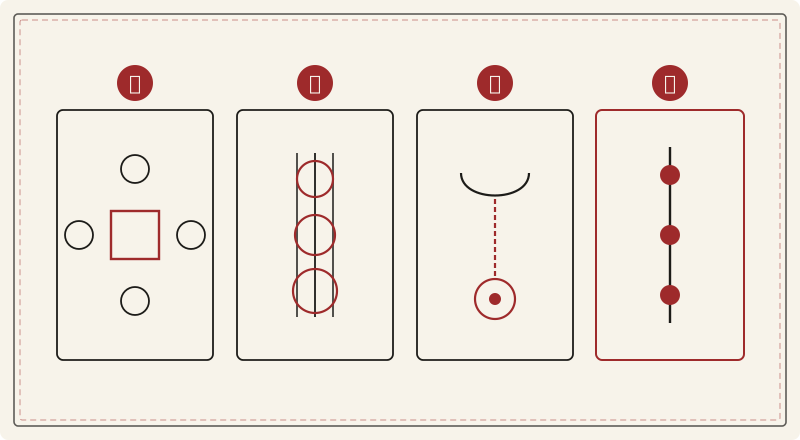
Classical four-panel Wudang diagram for the Huangting Jing illustrating the central Yellow Court surrounded by Four Directions, the Three Dantian Lute-Heart Resonance, Rinsing the Jade Pond to irrigate the lower root, and vertical standing alignment
Figure 1 — Internal Architecture of the Huangting Jing (黄庭经): ① Huangting Zhonggong (黄庭中宫 — The Yellow Court): the open central courtyard of Earth harmonizing North-Water, South-Fire, East-Wood, and West-Metal; ② Qinxin Sandie (琴心三叠 — Lute-Heart of Three Refoldings): harmonic resonance across the Upper (Niwan), Middle (Jiangong), and Lower (Qihai–Guanyuan) Dantian; ③ Yuchi Qingshui Guan Linggen (玉池清水灌灵根): gathering the Jade Fluid in the mouth and descending along the Conception Vessel to nourish the lower root; ④ Three-field vertical plumb line in Wudang standing and Taijiquan.

2. "The Lute-Heart of Three Refoldings" (Qinxin Sandie 琴心三叠) and the Three Cinnabar Fields

In Chapter 1 of the Huangting Neijing Jing (Shangqing Zhang 上清章) appears one of the most celebrated couplets in Chinese literary and contemplative history—a verse later echoed by poets from Li Bai to Su Shi:

琴心三叠舞胎仙,九气映明出霄间。

"The Lute-Heart in three refoldings (qinxin sandie 琴心三叠) dances the embryonic immortal (wu taixian 舞胎仙); the ninefold breaths shine brightly across the inner sky."

Why does the scripture compare the meditative heart-mind to a seven-stringed zither (Qin 琴, the guqin) played in "three refoldings" (Sandie 三叠)? Bai Yuchan's commentary points out that Qin (琴) is a classical homophone and symbol for He (和, "harmony and tuned resonance"). If the strings of a guqin are tuned too tightly, they snap; if tuned too loosely, they produce no clear tone. Only when every string is tuned in proportional harmony does a single pluck awaken sympathetic resonance (Gongming 共鸣) along the entire hollowed paulownia-wood soundboard.

In the human body, the "Three Refoldings" (Sandie 三叠) correspond to the tuned alignment of the Three Cinnabar Fields (San Dantian 三丹田) along the central axis:

  1. Upper Dantian (Shang Dantian 上丹田 — Niwan Gong 泥丸宫, "Mud-Pill Palace"): Centered behind the midpoint between the eyebrows (Yintang), housing the clarity of Spirit (Shen 神). When the eyes are softly curtained (Ji Zai Mu in the Yinfu Jing), the Upper Dantian remains cool and lucid.
  2. Middle Dantian (Zhong Dantian 中丹田 — Jiangong 绛宫, "Crimson Palace" & Huangting): Centered between the chest (Tanzhong CV-17) and Zhongwan (CV-12), governing the smooth rising and descending of Breath (Qi 气).
  3. Lower Dantian (Xia Dantian 下丹田 — Mingmen / Qihai–Guanyuan): Centered in the lower abdomen between the navel, Qihai (CV-6), Guanyuan (CV-4), and the lumbar Mingmen (GV-4), storing Vital Essence (Jing 精). When Spirit, Breath, and Essence resonate together without tension across these three fields, the body's innate vitality (Taixian 胎仙, the "embryonic breath" of rejuvenation) moves as effortlessly as a dancer.
Huangting Jing VerseClassical Neijing MeaningWudang Daoyin, Meditation & Taijiquan Practice
黄者中央色,庭者四方中 (Huang zhe zhongyang se, ting zhe sifang zhong)Yellow is the color of Central Earth; the Court is the open center connecting all four directionsKeeping the midsection (Zhongwan to Kua) spacious and uncramped so all four limbs connect through the waist
琴心三叠舞胎仙 (Qinxin sandie wu taixian)Harmonizing Upper, Middle, and Lower Dantian like a tuned zither awakens natural embryonic breathingAligning head (Xuling Dingjin), chest (Hanxiong), and lower abdomen (Chen Qi Dantian) on one vertical plumb line
口为玉池太和官 (Kou wei yuchi taihe guan)The mouth is the "Jade Pond" and Palace of Supreme HarmonyRelaxing the jaw and resting the tongue tip lightly against the upper palate (Daeqiao 搭鹊桥)
玉池清水灌灵根,审能修之可长存 (Yuchi qingshui guan linggen)Clear saliva from the Jade Pond irrigates the root of the tongue and lower DantianPracticing Kouchi Yanjin (tapping the teeth and swallowing the sweet Jade Fluid in three portions) after standing or form work
恬淡无欲养华根 (Tiandan wuyu yang huagen)Quiet contentment without grasping desire nourishes the root of lifeEchoing Tao Te Ching Chapter 80 (An Qi Ju) and the Qingjing Jing

3. "Clear Water From the Jade Pond Irrigates the Numinous Root" (Yuchi Qingshui Guan Linggen)

Among all the practical self-cultivation methods preserved in the Huangting Jing, none is more universally practiced in Wudang morning and evening routines than the Jade Pond Method (Yuchi Fa 玉池法), described in Chapters 3 and 22 of the Neijing Jing and throughout the Waijing Jing:

口为玉池太和官,漱咽灵液灾不干。
玉池清水灌灵根,审能修之可长存。

"The mouth is the Jade Pond (yuchi 玉池), the official of Supreme Harmony; rinsing and swallowing the numinous fluid keeps disharmony away.
Clear water from the Jade Pond irrigates the Numinous Root (linggen 灵根, the tongue and lower Dantian); whoever practices this diligently endures long."

In classical Taoist physiology, thin, frothy saliva produced when talking excitedly or eating hastily is called Tuo (唾, surface spittle), whereas the clear, slightly sweet, warm fluid that wells up naturally beneath the tongue (from the sublingual Jinjin 金津 and Yuye 玉液 ducts) during quiet abdominal breathing is treasured as Jade Fluid (Yuye / Jinye 玉液/津液), directly linked to Kidney Water. Instead of spitting it out or letting the mouth go dry through mouth-breathing, Wudang practitioners touch the tip of the tongue gently to the roof of the mouth behind the upper front teeth throughout standing post Zhan Zhuang, Wudang Taijiquan, and straight-sword (Jianfa) practice. At the close of practice (Shougong 收功), when the mouth is filled with clear fluid, one gently taps the upper and lower teeth together 36 times (Kouchi 叩齿), swirls the fluid around the gums with the tongue (Chihai 赤龙搅海), and swallows it calmly in three soft gulps, guiding the warmth down the midline through Zhongwan into Qihai and Guanyuan.

4. Living Transmission on Wudang Mountain and in Singapore

Across the quiet temple halls of the UNESCO World Heritage ancient Taoist complex on Wudang Mountain (No. 72 Jianhe 2nd Road, Wudangshan, Hubei, China; UNESCO World Heritage guide) and daily classes at Lee Wudang International Pte. Ltd. (58A Smith Street (2nd Floor), Singapore 058962; beginner guide), the Huangting Jing reminds students that internal cultivation is never harsh or dry. When your wrists and chest are softened through Inner and Outer Pass (Neiguan PC-6 and Waiguan TE-5) Daoyin, your Three Dantian stack vertically like a tuned guqin, and clear Jade Fluid moistens the mouth, you have direct somatic confirmation that your practice is unforced and harmonious.

Practice Reflection for Students

At the end of your practice today, stand or sit quietly for two minutes with lips gently closed and the tip of your tongue resting behind your upper front teeth. Circle your tongue slowly nine times clockwise and nine times counterclockwise outside and inside the teeth, allow the clear saliva (Yuchi Qingshui) to gather naturally, and swallow it in three calm breaths down to your lower abdomen.

Seeker’s Q&A · Frequently Asked Questions

What is the “Yellow Court” in the Huangting Jing, and how is it practiced?

The Huangting Jing (Scripture of the Yellow Court) is a verse scripture of the late Han to Wei-Jin period that maps the inner landscape of the body. Yellow is the color of Central Earth and a court is the open courtyard at the center of a house, so the Yellow Court is the open, uncramped center of the torso, between Zhongwan (CV-12), the diaphragm and the navel. Its line on the “lute-heart in three refoldings” (琴心三叠) is read as the upper, middle and lower Dantian tuned in line like the strings of a guqin. In practice you keep head, chest and lower abdomen on one plumb line, rest the tip of the tongue behind the upper teeth, and swallow the gathered saliva, the “clear water of the Jade Pond”, down to the lower abdomen.

How can I apply this in practice?

At the end of your practice today, stand or sit quietly for two minutes with lips gently closed and the tip of your tongue resting behind your upper front teeth. Circle your tongue slowly nine times clockwise and nine times counterclockwise outside and inside the teeth, allow the clear saliva (Yuchi Qingshui) to gather naturally, and swallow it in three calm breaths down to your lower abdomen.
