
WUDANG TAIJIQUAN · 武当太极拳

The Four Corner Energies (Cai, Lie, Zhou, Kao) in Wudang Taijiquan: Plucking, Splitting, Elbow-Guard, and Body-Frame Alignment Explained 武当太极拳四隅手“采、挒、肘、靠”详解:秤锤之采、飞轮之挒与中根二节护防

Complete your study of the Eight Methods (Bafa) of Wudang Taijiquan with a biomechanical guide to the Four Corner Energies (Si Yu): Pluck (Cai), Split (Lie), Elbow (Zhou), and Shoulder/Hip Frame (Kao).


An empty timber hall with dark wooden pillars and a plank floor, its lattice doors standing open onto a green courtyard.

1. From the Four Cardinal Directions (Si Zheng) to the Four Corners (Si Yu)

In our foundational guides to The Thirteen Postures (Shisanshi): Eight Methods and Five Steps and Grasp the Sparrow's Tail (Lanquewei), we explored the Four Cardinal Energies (Si Zheng 四正): Peng (Ward-Off), Lu (Roll-Back), Ji (Press), and An (Push). When both partners maintain their central equilibrium along the cardinal lines, those four methods suffice. Yet when an exchange slips off the main axis into oblique angles or close-range tangles, the Taijiquan classics introduce the Four Corner Energies (Si Yu 四隅): Cai (采, Pluck), Lie (挒, Split), Zhou (肘, Elbow), and Kao (靠, Shoulder/Body-Stroke).

As the classical Song of the Thirteen Postures (Shisanshi Ge 十三势歌) states: 'Ward-Off, Roll-Back, Press, and Push must be practiced earnestly... Pluck, Split, Elbow, and Body-Stroke are even more merveilleux; when enacted naturally, they require no strained deliberation.' In the eight-trigram (Bagua) map of Taijiquan, these four corner methods correspond to the four corner trigrams: Xun (Wind), Zhen (Thunder), Dui (Lake), and Gen (Mountain).

2. Cai (Plucking) and Lie (Splitting): The Steelyard Weight and the Spinning Wheel

Cai (采劲, 'Plucking'—literally picking a leaf or fruit from a branch) and Lie (挒劲, 'Splitting' or 'Rotating Shear') are the distal corner pair expressed through the hands and forearms. Classical manuals compare Cai to a sliding weight on a traditional Chinese steelyard balance (Chengchui 秤锤): just as a small weight near the end of a balance beam can tip a heavy load, when a partner leans forward or stiffens their arm, Cai applies a brief, downward-diagonal pluck via sinking the hip crease (Kua) and sitting the wrist—uprooting their heels without a tug-of-war.

Lie is compared in the classics to a rapidly spinning potter's wheel or whirlpool (Xuanzhuan Ruo Feilun 旋转若飞轮): anything that touches its rim is spun off on a tangent. We already saw Lie in action in postures such as Parting the Wild Horse's Mane (Yema Fenzong) and Diagonal Flying (Xiefeishi), where one arm spirals forward-upward while the other spirals downward-back around the turning waist axle.

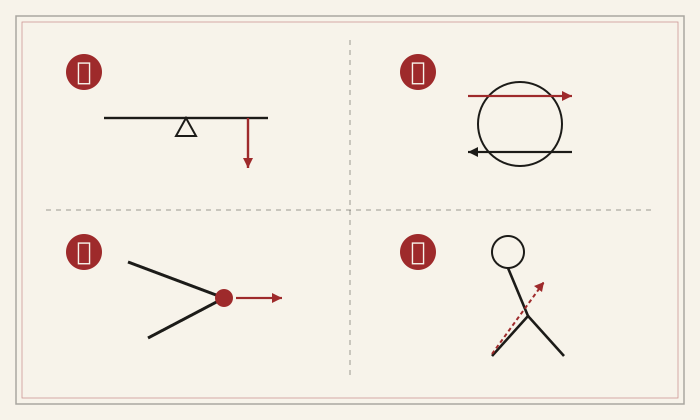
Four-panel classical diagram of Wudang Taijiquan's Four Corner Energies: Cai steelyard lever, Lie spinning-wheel shear, Zhou folded elbow guard, and Kao rooted body-frame alignment

The Four Corner Energies (Si Yu) of Wudang Taijiquan: ① Cai (Plucking), ② Lie (Splitting), ③ Zhou (Elbow-Method), and ④ Kao (Body-Frame Alignment).

  1. ① Cai (Plucking / Steelyard Weight): A crisp downward-diagonal lever that uproots an opponent's over-committed forward weight.
  2. ② Lie (Splitting / Spinning Wheel): Rotational shear in two opposing directions driven by a sudden turn of the waist.
  3. ③ Zhou (Elbow-Method / Middle Gate): Using the heavy, folded elbow arc to guard the ribs and transmit whole-body waist torque.
  4. ④ Kao (Shoulder & Hip Frame / Proximal Root): Uniting foot, knee, hip, and shoulder when close-range contact breaches the hands.

3. Zhou (Elbow) and Kao (Shoulder/Hip Frame): Guarding the Middle and Proximal Gates

In Wudang martial anatomy, the arm is divided into three sections (Sanjie 三节): the hand is the tip (Shaojie), the elbow is the middle section (Zhongjie), and the shoulder/hip is the root section (Genjie). When an incoming force passes your hands, you do not panic or pull your arms back blindly; instead, you fold and guard with the middle section (Zhou 肘) and the root section (Kao 靠).

In Zhou (Elbow-Method)—seen in solo postures like Fist Under Elbow (Zhoudi Kanchui) and Turn Body and Chop with Fist—the elbow stays heavy and connected to the ribcage and waist, never flying out in isolation. In Kao (Shoulder, Back, or Hip Frame), the practitioner steps into the partner's base while uniting foot, knee, hip, and shoulder into a single stable mountain frame (Gen trigram), re-establishing space without leaning the head.

4. Solo & Cooperative Study Guidelines and Safety Notes

To feel all four corner energies in solo practice, perform a slow four-posture link: begin with Needle at Sea Bottom (Haidizhen) to feel the downward-diagonal pluck of Cai; transition into Diagonal Flying (Xiefeishi) to feel the two-way waist shear of Lie and the proximal shoulder-hip alignment of Kao; then fold into Zhoudi Kanchui to feel the protective middle-gate Zhou.

Safety note: in cooperative Push Hands (Tuishou), Cai, Lie, Zhou, and Kao are studied strictly as slow, controlled structural alignments and balance-listening exercises—never yank a partner's wrist or joint in Cai/Lie, and never ram with the elbow or shoulder in Zhou/Kao. Practice with mutual care and respect.

Seeker’s Q&A · Frequently Asked Questions

What is the core takeaway of The Four Corner Energies (Cai, Lie, Zhou, Kao) in Wudang Taijiquan?

Complete your study of the Eight Methods (Bafa) of Wudang Taijiquan with a biomechanical guide to the Four Corner Energies (Si Yu): Pluck (Cai), Split (Lie), Elbow (Zhou), and Shoulder/Hip Frame (Kao).
