
WUDANG TAIJIQUAN · 武当太极拳

Fair Lady Works at Shuttles (Yunü Chuansuo) in Wudang Taijiquan: Four-Corner Stepping, Upward-Spiralling Ward-Off and Simultaneous Forward Push 武当太极拳“玉女穿梭”详解:四隅角步法、滚臂上掤与前推掌身法

How this classic four-direction sequence trains 360-degree spatial orientation, threading the forearm like a weaver’s shuttle, and uniting overhead protection with centered forward power.

The seven stars of the Northern Dipper above dark misty ridges at night, with a bronze tripod incense burner on a stone platform in the foreground.

Most postures in the opening half of Wudang Taijiquan—such as Grasp the Sparrow’s Tail, Single Whip, and Brush Knee—travel along the four cardinal directions (North, South, East, West, called Sizheng 四正 in The Thirteen Postures). Then suddenly the form gathers at the center and launches into four crisp diagonal turns toward the four corners of the courtyard: “Fair Lady Works at Shuttles” (玉女穿梭, Yunü Chuansuo).

Why is this four-corner sequence named after a traditional weaver passing a wooden shuttle through the warp threads on a loom? Because in each turn, your leading hand threads smoothly through the space inside your other arm like a shuttle gliding through silk threads before rolling upward to guard the forehead while the opposite palm presses forward.

1. Four-Corner Spatial Geometry and Shuttle Mechanics

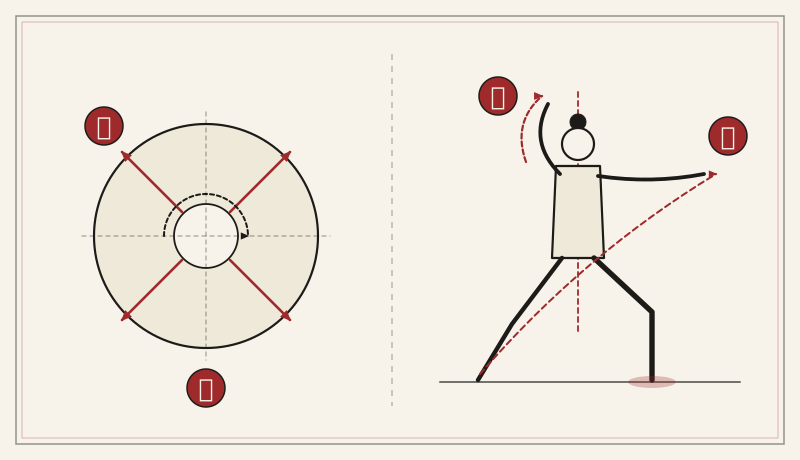
Classical ink-and-cinnabar diagram of Wudang Taijiquan Fair Lady Works at Shuttles (Yunü Chuansuo) showing the Four-Corner diagonal Bagua floor compass on the left, the central waist-and-foot pivot, the upward-spiralling forearm guard above the forehead on the right, and the simultaneous forward push palm

Spatial compass and structural alignment of Fair Lady Works at Shuttles (玉女穿梭 · 四隅斜角与撑架推掌).

  1. The Four Diagonal Corners (四隅方位 · 乾坤艮巽): stepping successively toward the four 45-degree corners of the room trains 360-degree orientation (“supporting all eight directions,” 支撑八面)
  2. Unloaded Foot Pivot & Threading the Shuttle (坐胯扣撇 · 穿掌如梭): by shifting weight into the supporting hip first (Empty and Full), you turn on the heel toward the new corner while threading the forearm upward along the centerline
  3. Upward-Spiralling Forearm Guard (滚臂上架 · 护额掤化): the lead forearm rotates outward (Ni Chan) to form a rounded canopy slightly above and in front of the temple—never collapsing onto the head or shrugging the shoulder (Chenjian Zhuizhou)
  4. Simultaneous Bow-Stance Forward Push (弓步推掌 · 上下相随): as the front foot settles into a diagonal bow stance, the rear palm presses forward at chest height—uniting overhead deflection and forward issue in a single breath (Six Harmonies)

2. Why “Rolling the Forearm” (滚臂上架) Protects Without Stiff Force

Echoing Chapter 73 of the Tao Te Ching (Dao De Jing)—“The net of Heaven is vast; though its meshes are wide, nothing slips through” (天网恢恢,疏而不失)—the upper arm in Yunü Chuansuo does not block overhead force like a rigid wooden beam. If you push straight up with a stiff shoulder, a heavy downward force will crush your structure. Instead, by threading the hand up along the inside and rolling the forearm like a revolving cylinder as you step into the corner, any downward force glances off the spiral curve harmlessly while your other palm travels straight into the opening.

3. Three Keys to Turning Cleanly Across All Four Corners

  • Keep the armpit of the raised arm open: Even though the guarding forearm rests above forehead height, the shoulder blade settles downward and the elbow points slightly forward-and-downward rather than flaring out to the side.
  • Step on two parallel diagonal tracks: When turning 90 or 180 degrees from one corner to the next, pause a beat to gather the empty foot beside the standing ankle (just as in Holding the Ball) before stepping out onto a shoulder-width diagonal track.
  • Coordinate eyes, waist, and breath: Inhale as you pivot and thread the shuttle hand; exhale as the bow stance settles, the upper forearm rolls into place, and the forward palm issues (Natural Abdominal Breathing).
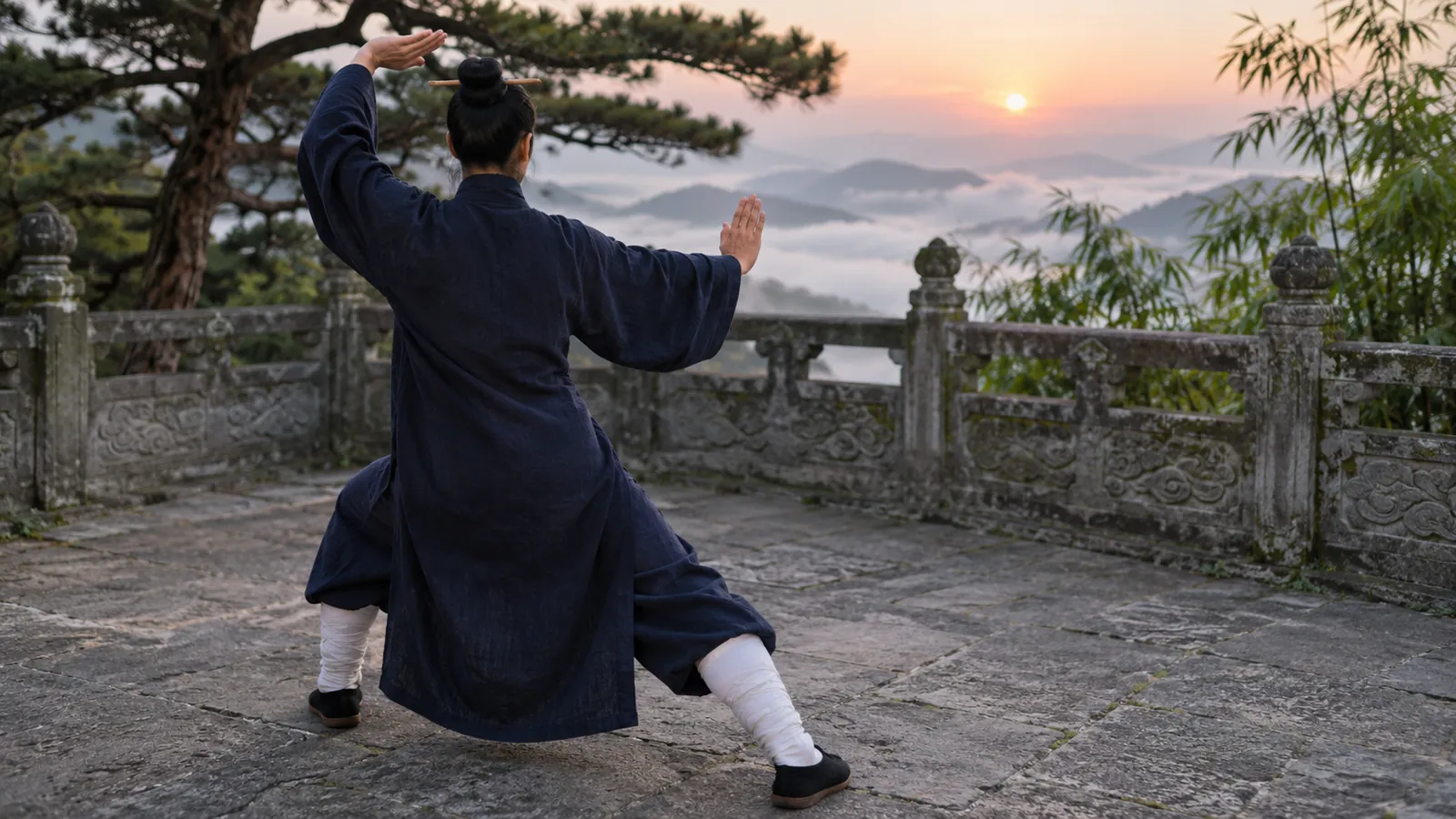
A practitioner in dark indigo Taoist robes and white cotton leg wraps seen from behind in a diagonal bow stance of Wudang Taijiquan’s Fair Lady Works at Shuttles (Yunü Chuansuo), one forearm arched overhead, on a stone mountain terrace above morning clouds.

Fair Lady Works at Shuttles (Yunü Chuansuo) at dawn: one forearm arcs overhead while the other palm presses forward, the body turning toward a diagonal corner.

4. Training Four-Corner Poise Between Wudang Mountain and Singapore

Connecting the living martial heritage near Wudang Mountain’s UNESCO World Heritage ancient Taoist temples with our regular classes in Singapore, Wudang.Org guides students through the complete traditional form. Begin with Wudang Tai Chi for Beginners, visit Start Here, or join our Singapore Tai Chi Retreat Camp.

Safety note: Always shift weight onto the supporting leg before turning the pivoting foot across large 90-to-180-degree corner transitions so your knees never twist under load; traditional martial training does not replace medical care.

Seeker’s Q&A · Frequently Asked Questions

What are the “Four Corners” (Siyu 四隅) in Fair Lady Works at Shuttles (Yunü Chuansuo)?

While Sizheng (四正) refers to the four cardinal directions (North, South, East, West), Siyu (四隅) refers to the four 45-degree diagonal corners (Northwest/Qian, Southwest/Kun, Northeast/Gen, Southeast/Xun). Yunü Chuansuo steps into all four corners in turn.


Why is the posture called “Fair Lady Works at Shuttles” (玉女穿梭)?

Because as you turn toward each corner, the hand that will guard your forehead threads upward through the inside space of your other arm—just like a weaver passing a wooden shuttle smoothly through the warp threads on a loom.

How do I keep my shoulder from shrugging when raising the forearm above forehead height in Yunü Chuansuo?

Keep the elbow softly bent and pointing slightly downward-and-forward, allow the shoulder blade to sink down your back, and position the forearm a fist-and-a-half in front of the temple rather than directly over the top of your head.
