Visiting a Taoist Temple in Singapore: What You Will See and How to Behave
走进新加坡的道教庙宇:你会看到什么,该怎样举止
You may have walked past a Chinese temple in Singapore for years: the roof ridge, the smoke, the red doors standing open. This page is written for the reader who stays outside for fear of doing something wrong. The short version is that temples are generally open to visitors, almost nothing you do by mistake causes lasting offence, and a quiet, observant first visit is a perfectly good one. What follows is general. Every temple has its own habits, and what the temple asks of you, by sign or by a person, comes before anything written here.
1. What kind of temple is it?
Start with the idea, because it removes a lot of worry. Many Chinese temples mix Taoist, Buddhist and folk practice. One hall may hold a Taoist deity beside a figure that families have honoured for generations, and the people praying may not draw any line between them. So you do not need to be sure what kind of temple you are in. You can only tell roughly, and that is enough.
- Deities. The Three Pure Ones and the Jade Emperor point to Taoism. Popular figures such as Guan Yu or Mazu (see this page) are honoured in temples of several kinds.
- The people who serve. Taoist ritual specialists wear robes and, in some traditions, gather their hair up. Our page on Taoist clergy explains that the two main branches differ, and that you cannot always tell who is a priest by dress alone. Temple staff and volunteers are often in ordinary clothes.
- Scriptures and notices. Texts such as the Tao Te Ching (Dao De Jing) are Taoist. Buddhist temples will show their own sutras and statues.
What beginners get wrong: treating this as a test. If you want an answer, ask (see section 7).
2. The layout you will usually meet
Why does layout matter? Because most of the etiquette comes from the building: it has a line of use running from the door to the altar, and your task is to stay out of the way of it. Our page on entering a hall explains this in detail. In outline, you will commonly meet:
- The entrance and threshold. Often a raised timber or stone threshold. Step over it rather than on it, and do not stop in the doorway: step through, then stop. If there are three doors, the side ones are the ordinary choice for visitors.
- The courtyard and the incense burner. The burner commonly stands in the open air in front of the main hall. People light incense and place it there before going in, or without going in.
- The main hall. The principal figure or figures sit at the far end, facing the door. Worshippers stand or kneel on the central line, so visitors usually stand to one side.
- Side halls. Smaller halls for other deities, which may be what local families come for. A Singapore temple may be smaller or arranged differently from the classical plan on our temple architecture page.
If a kneeling cushion is in front of an altar, do not sit on it. It is one of the most common visitor mistakes.
3. Incense and offerings
You do not need to offer anything. Standing still and looking is a complete visit, and nobody will notice that you did not light incense.
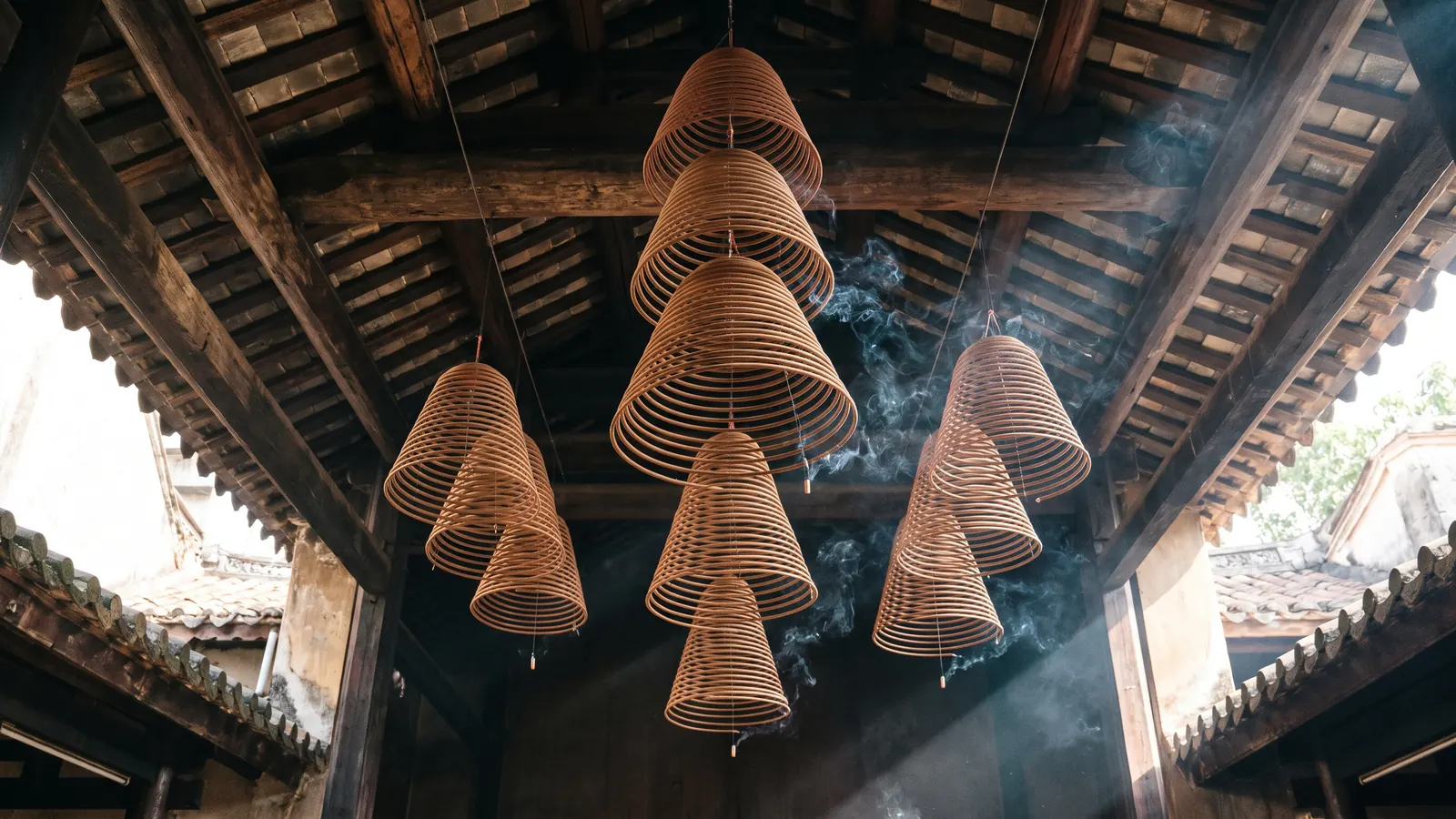
If you do want to take part, our page on incense and bowing describes the usual procedure on Wudang Mountain, and the page on worship, temples and offerings gives the reasoning: you are approaching an office respectfully and in the proper form. In outline:
- Light the sticks, and put out any flame by waving the sticks, not by blowing.
- Hold them in front of your chest with both hands, face the image, and bow slightly.
- Place them in the burner, and only in the burner.
The number of sticks, who uses which hand, and whether people bow toward each deity or only the main one differ between temples. Singapore temples may follow different habits from those described for Wudang. So the best guidance is the one that applies to every first visit: watch what the regulars do, and follow any sign. If a temple sells incense at a counter, the price is usually posted. If anyone approaches you first and puts something in your hand before a price is mentioned, you are allowed to hand it back politely; our page on donations and fees explains the pattern.
4. Who is on the altar?
You do not need to memorise names. The Taoist pantheon works like an administration, with ranks and offices, so the figures make more sense once you know the structure; the pantheon page is the place to start. In general terms, the most senior figures, such as the Three Pure Ones, often sit at the centre of the main hall, though many temples centre on their own patron deity, such as Mazu. Other halls may honour a deity of the locality, a protector, or a historical figure later honoured as a god. Some deities are honoured as people who once lived; for others, such as Mazu, the human life comes down through tradition, as the Guan Yu and Mazu page explains. If you want a name, there is often a board or plaque with the deity’s name in Chinese; you can take a photograph of that, where photography is allowed, and look it up afterwards.
5. How to behave
- Dress. Aim to be unremarkable: neat clothes, shoulders and knees covered. Our page on dress, timing and what to bring says Wudang has no formal dress code; a Singapore temple may post its own.
- Voice. Halls carry sound. Use fewer words rather than quieter ones, and set your phone to silent before you go in.
- Photographs. Allowed in some places and not in others. Look for a sign; if you cannot find one and nobody else is photographing, assume not inside a hall. Do not photograph people at prayer without asking them, and do not use flash.
- The threshold and the centre line. Step over the threshold and keep off the centre line in front of the altar.
- Ritual objects. Do not touch or move offerings, lamps, cushions or anything on the altar table, even to improve a photograph.
- Donations. Donation boxes usually take whatever you choose, including nothing. Giving is optional.
Our page on common mistakes sorts errors by how much they matter, and the answer is reassuring: most of them matter very little. The fuller guide on temple etiquette and the page on pilgrimage etiquette cover the same ground in more depth.
6. When are temples busiest?
If you want a quiet first visit, choose an ordinary weekday, and avoid the days listed here. Temples tend to be busiest around festival days, on the first and fifteenth of the lunar month (a widespread custom for visiting temples), and above all at Lunar New Year, when queues for incense can be long. See Lunar New Year through a Taoist lens, the festivals hub, and pages such as the Jade Emperor’s birthday, Laozi’s birthday and the Zhongyuan (Ghost) Festival. On a crowded day, let those who came to worship go first. The dates move each year, so check the lunar calendar.
7. How to ask a question politely
Choose a quiet moment, not a service and not a queue. Greet the person with an ordinary greeting and a small nod. If you know the word, daozhang (道长) is a respectful way to address a Taoist priest, but in a temple of mixed practice you may be talking to a caretaker or volunteer, and an ordinary greeting is fine. Then ask something small and concrete: “May I ask what this hall is for?” or “Is photography allowed here?” Do not ask for a prediction or a reading of your future. A brief answer is normal: people are often busy.
Something to try on your first visit
Go on an ordinary morning, and give yourself ten minutes. Do not light incense and do not take photographs. Stand in the courtyard and watch, in this order: how people approach the burner, which door they use, whether they pause on the threshold, and where they stand in the hall. Afterwards, write down three things you noticed and one question to ask next time. Then read the pages above and see which of your observations they explain.