TRADITIONAL WEAPONS · 传统器械

Wudang Horsetail Whisk Fundamentals (Taiji Fuchen & Xuanwu Fuchen): Soft-Hard Dual Mechanics of Coiling (Chan), Sweeping (Sao), and Shaking-Issuance (Dou) 武当拂尘(太极拂尘与玄武拂尘)基础指南:软硬兼施、缠拦扫抖与剑指配伍

An authentic technical guide to the Wudang horsetail whisk (Fuchen)—covering its historical transition from a monastic ritual implement to a flexible-and-rigid Wudang weapon, two-part anatomy (Chenba handle and Chensi strands), and the six foundational methods of Chan, Lan, Sao, Dou, Pi, and Dian.


A plain graphic of two blank ruled pages laid side by side like an open thread-bound book, on a cream background.

1. From Monastic Implement to Wudang Flexible-Rigid Weapon: Two-Part Anatomy of the Fuchen

Among traditional Chinese weapons, the horsetail whisk (拂尘, Fuchen, literally 'whisking away dust') is uniquely emblematic of Taoist cultivation on Wudang Mountain. Originally carried in daily monastic life both to gently brush away insects without harming life and as a visual reminder to sweep dust from the heart-mind (拂去尘缘), the Fuchen evolved within the Wudang internal martial tradition into an ingenious 'soft-and-hard dual weapon' (软硬兼施之器). Structurally, it consists of two contrasting halves: the rigid wooden handle (尘把, Chenba, traditionally turned from dense jujube or hardwood, roughly 50–60 cm in length) and the flexible plume of horsehair or hemp strands (尘丝 / 尘拂, Chensi). In combat and solo form practice—taught across the heritage courtyards of Wudang Mountain's UNESCO World Heritage ancient Taoist temples and at Lee Wudang International Pte. Ltd.—the wooden handle functions like a short baton or sword hilt for close-range dotting, hooking, and parrying, while the flowing strands extend the practitioner's reach like a soft whip.

2. Silk-Reeling Figure-Eight Loops (Wu Hua) and Sword-Fingers Coordination

Because the horsehair plume has no rigid spine of its own, it will tangle around the practitioner's arm or collapse limply if swung with stiff shoulder force. The foundational prerequisite of both Wudang Taiji Fuchen (太极拂尘) and Xuanwu Fuchen (玄武拂尘) is continuous figure-eight coiling—known as 'Waving Flowers' (舞花, Wu Hua) or Vertical-and-Horizontal Cloud Loops (云花)—driven by waist rotation and a supple, unlocked wrist. Just as in Wudang straight sword (Jian), the empty lead hand forms 'Sword-Fingers' (剑指, Jianzhi), counter-balancing the whisk hand, lightly stroking the horsehair plume during gathering transitions (捋尘, Lu Chen), and leading footwork shifts through Bagua-style mud-wading arcs and Taiji bow steps.

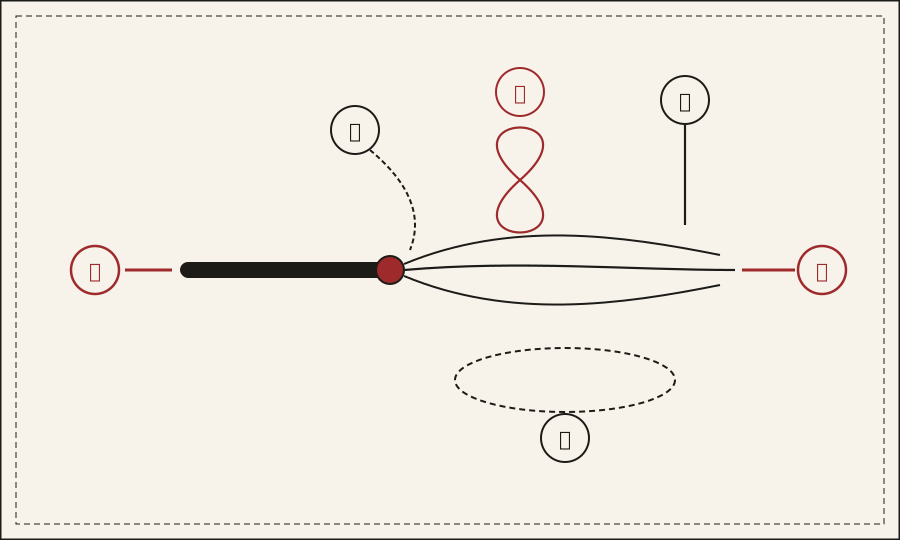
Numbers-only classical Wudang ink-and-cinnabar diagram of the Wudang Horsetail Whisk (Fuchen) anatomy and six core techniques (①–⑥).

Classical Wudang diagram of the Horsetail Whisk (Fuchen, numbers-only SVG key)

  1. ① Chan (Spiral Coiling & Wrapping of the Plume)
  2. ② Lan (Protective Arcuate Interception)
  3. ③ Sao (Waist-Led Horizontal Sweeping)
  4. ④ Dou (Linear Shaking/Snapping Issuance at the Plume Tip)
  5. ⑤ Pi (Sagittal Downward Splitting)
  6. ⑥ Dian (Close-Range Dotting with the Wooden Handle Butt — Chenba).

3. The Six Core Fuchen Techniques: Chan (Coil-Bind), Lan (Intercept), Sao (Sweep), Dou (Snap-Shake), Pi (Split), and Dian (Handle-Dot)

Wudang Fuchen routines weave six primary techniques into seamless spirals: (1) Chan (缠, Coiling/Wrapping) spirals the horsehair plume around an incoming wrist or weapon shaft to obscure vision and entangle leverage; (2) Lan (拦, Outward/Inward Interception) arcs the handle and plume across the centerline to brush aside linear thrusts; (3) Sao (扫, Horizontal Sweeping) turns the waist to sweep the plume horizontally across the high, middle, or low gates like wind parting mountain mist; (4) Dou (抖, Shaking/Snapping Issuance) halts a circular arc with a crisp wrist-and-kua pulse so the very tips of the strands snap outward in a straight line; (5) Pi (劈, Downward Splitting) brings the plume and handle cleanly down the sagittal plane from overhead; and (6) Dian (点 / 戳, Handle-End Dotting/Thrusting) reverses the grip or slides the hand along the shaft to tap vital targets with the rounded butt of the wooden handle.

4. Solo Practice Progression, Safety Notes, and Wudang Curriculum Bridges

Safety note: When practicing indoor figure-eight loops (Wu Hua) and shaking issuance (Dou), verify clear overhead and lateral space and keep the grip relaxed between thumb, index, and little fingers so the wrist never strains. To connect Fuchen mechanics with related weapons and classical texts, explore our Wudang Martial Arts Overview, compare three-section blade control in Wudang Straight Sword Eight Mother Techniques (Ba Mu Jian), study non-coercive responsiveness in The World Is a Sacred Vessel (Tao Te Ching Chapter 29), and pair weapon training with Beating the Heavenly Drum (Ming Tiangu) Daoyin Guide.

Seeker’s Q&A · Frequently Asked Questions

What is the core takeaway of Wudang Horsetail Whisk Fundamentals (Taiji Fuchen & Xuanwu Fuchen)?

An authentic technical guide to the Wudang horsetail whisk (Fuchen)—covering its historical transition from a monastic ritual implement to a flexible-and-rigid Wudang weapon, two-part anatomy (Chenba handle and Chensi strands), and the six foundational methods of Chan, Lan, Sao, Dou, Pi, and Dian.
