TRADITIONAL WEAPONS · 传统器械

Wudang Taiji Jian Wrist & Tip Techniques: Pointing (Dian), Tilting (Beng), Slicing (Xiao), and Pressing (Ya) Explained 武当太极剑腕法与剑锋四技详解:点剑、崩剑、削剑与压剑的活把枢机

Learn how Wudang Taiji Jian (Straight Sword) uses subtle wrist leverage and finger-fulcrum shifts to execute Pointing (Dian), Tilting (Beng), Slicing (Xiao), and Pressing (Ya) with precision rather than brute chopping.


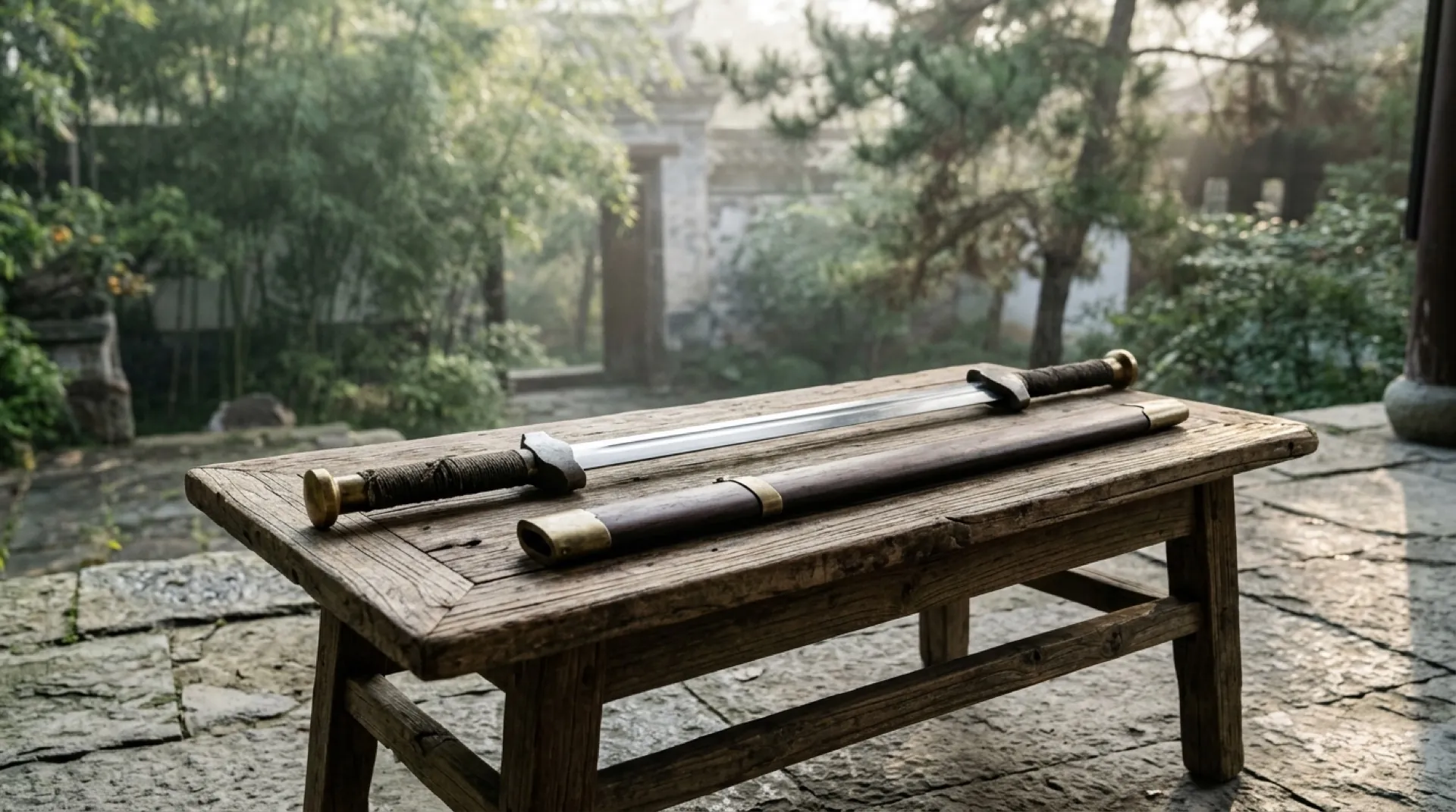
A Chinese straight sword (jian) lying drawn beside its scabbard on a weathered wooden table in a stone-paved courtyard, with pines and a gateway in the mist behind.

1. Why the Straight Sword Relies on the Wrist and the Last Three Inches of the Blade

In Chinese weapon manuals, a classic maxim contrasts the single-edged saber (Dao) with the double-edged straight sword (Jian): 'The saber is like a fierce tiger; the straight sword is like a flying phoenix or swimming dragon.' Because a traditional Wudang straight sword is double-edged, slender, and balanced near the guard, using it like a heavy cleaver exposes the blade to damage and leaves the wielder's centerline open.

Building upon our earlier guides to Wudang Taiji Jian fundamentals, the 活把 (supple grip) and basic cuts Ci, Pi, Dian, Liao, and circular deflections Gua, Yun, Mo, Dai, this guide examines four refined techniques—Dian (点), Beng (崩), Xiao (削), and Ya (压)—that transmit whole-body energy through supple wrist and finger spirals into the front section (Jianfeng 剑锋) of the blade.

2. Dian (Pointing) and Beng (Tilting Upward): The Vertical Yin-Yang Pair of the Sword Tip

Dian (点剑, 'Pointing' or 'Tapping') and Beng (崩剑, 'Tilting' or 'Flicking Upward') are vertical complements that work with the very tip of the vertical blade (Lijian 立剑). In Dian—often compared in Wudang lore to 'a dragonfly touching water' (qingting dianshui 蜻蜓点水)—the shoulder and elbow first sink as the wrist gently arches upward, and then the wrist flexes downward while the index and middle fingers guide the tip to tap a precise target (such as an incoming wrist) and immediately rebound.

Beng reverses that lever: with the blade vertical and the arm already extended or coiled low, the thumb and index finger act as a pivot near the guard while the ring and little fingers squeeze the lower handle slightly into the palm. This tiny finger-fulcrum shift causes the sword tip to flick crisply upward from underneath—delivering short, surprising power without lifting the shoulder.

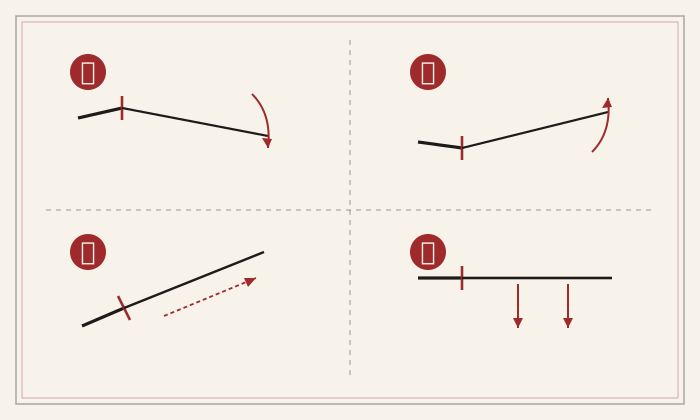
Four-panel classical diagram of Wudang Taiji Jian wrist and tip techniques showing Dian downward pointing, Beng upward flicking, Xiao 45-degree slicing, and Ya downward blade pressing

The four refined blade-tip and edge techniques of Wudang Taiji Jian: Dian (Pointing), Beng (Tilting Upward), Xiao (Diagonal Slicing), and Ya (Pressing).

  1. ① Dian (Pointing / Dragonfly Touches Water): Lifting the wrist slightly before dropping the sword tip crisply downward onto a small target.
  2. ② Beng (Tilting / Flicking Upward): Engaging the ring and little fingers against the pommel end to snap the sword tip sharply upward from below.
  3. ③ Xiao (Diagonal Slicing): Gliding the double-edged blade forward-upward or backward at a 45-degree bevel driven by the waist.
  4. ④ Ya (Pressing / Sealing Downward): Settling the flat or oblique blade face downward with An energy to control an opposing weapon.

3. Xiao (Diagonal Slicing) and Ya (Pressing): Controlling Angles with the Flat and Bevel

Whereas Dian and Beng focus energy at the tip, Xiao (削剑, 'Slicing' or 'Paring') and Ya (压剑, 'Pressing') utilize the front third of the cutting edge and the flat of the blade (Pingjian 平剑 / Xiejian 斜剑). In Xiao, the blade is angled at roughly 45 degrees and glides diagonally upward or downward across the centerline as the waist turns—slicing along a tangent rather than hacking straight down.

In Ya (Pressing), the blade turns flat or slightly oblique with the palm facing downward (or outward-downward), and the practitioner settles the knees and elbows to press the flat of the sword down onto an opposing line of force—translating Taijiquan's An (Push/Press-Down) energy directly into the steel while the left sword-fingers (Jianzhi) extend or guard the temple to maintain spinal equilibrium.

4. Safe Solo Practice Drill: Ten Slow Repetitions with a Wooden Jian

Using a balanced wooden practice sword in a clear space, stand in a right bow stance with the left sword-fingers poised behind you. Practice ten slow pairs of Dian and Beng: inhale as the rear hip folds and the wrist gathers slightly; exhale as the tip drops into Dian, pause for a breath to check that your right shoulder is sunk, then use the lower two fingers to lift the tip into Beng without locking the elbow. Follow with six slow diagonal Xiao slices and Ya presses while stepping in cat-walk transitions.

Safety note: always inspect your practice area for adequate ceiling and wall clearance before swinging or extending a practice sword, use unsharpened wooden or blunt training blades, and avoid forceful wrist snapping if you have wrist tendonitis. This guide is for educational martial arts study.

Seeker’s Q&A · Frequently Asked Questions

What is the core takeaway of Wudang Taiji Jian Wrist & Tip Techniques?

Learn how Wudang Taiji Jian (Straight Sword) uses subtle wrist leverage and finger-fulcrum shifts to execute Pointing (Dian), Tilting (Beng), Slicing (Xiao), and Pressing (Ya) with precision rather than brute chopping.
