TRADITIONAL WEAPONS · 传统器械

Wudang Taiji Jian Circular Deflections: Hanging (Gua), Cloud-Sweeping (Yun), Wiping (Mo), and Leading (Dai) 武当太极剑圆弧走化四剑法详解:挂剑、云剑、抹剑与带剑要领

Master the four circular and adhesive deflection methods of Wudang Taiji Jian — Left and Right Hanging (Gua Jian), Overhead Cloud-Sweeping (Yun Jian), Horizontal Wiping (Mo Jian), and Diagonal Leading (Dai Jian) — to redirect incoming force with four ounces deflecting a thousand pounds.


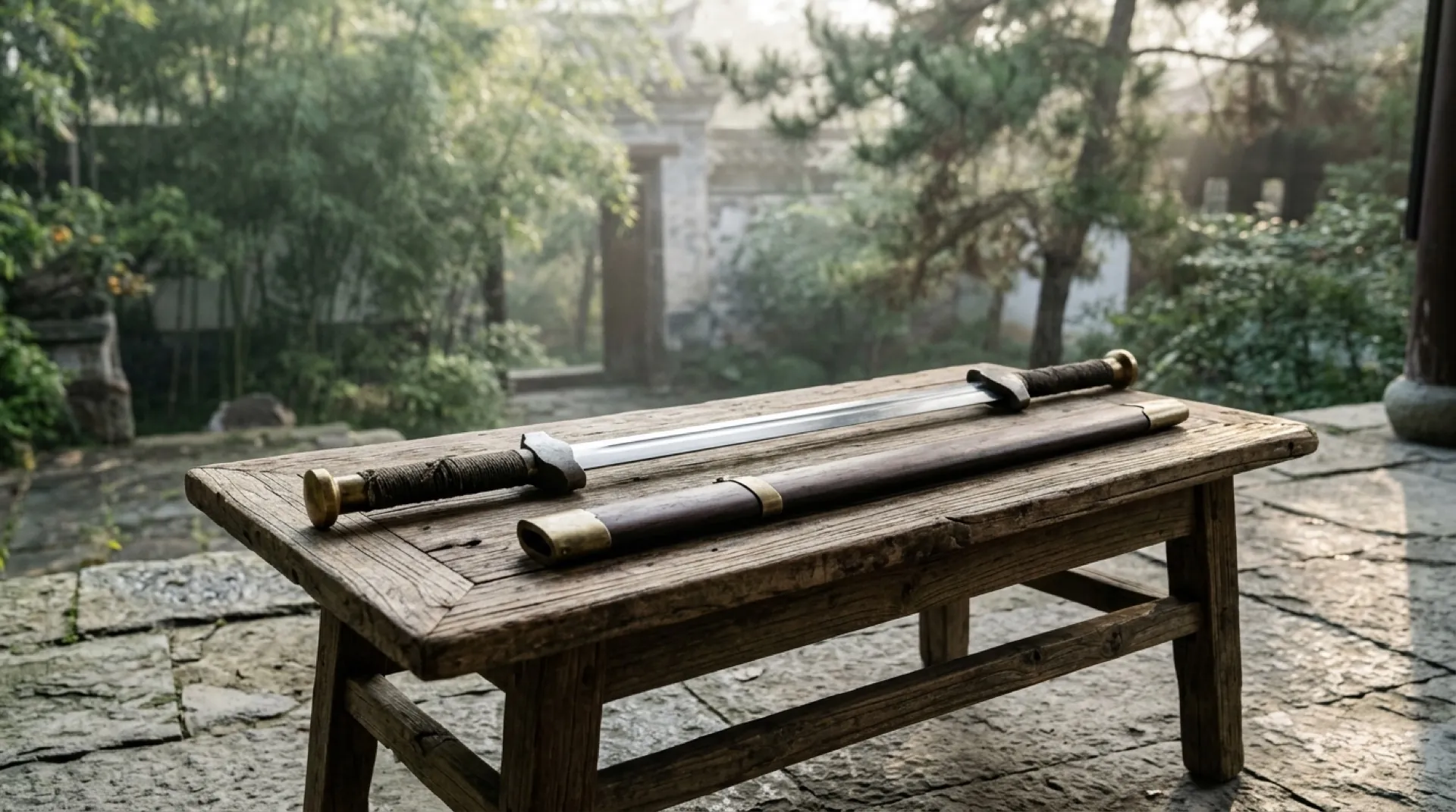
A Chinese straight sword (jian) lying drawn beside its scabbard on a weathered wooden table in a stone-paved courtyard, with pines and a gateway in the mist behind.

1. Why a Double-Edged Jian Never Blocks Edge-Against-Edge

In our first training guide on Wudang Taiji Jian Living Grip (Huo Ba) and Basic Cuts (Ci, Pi, Dian, Liao), we saw how the straight double-edged sword extends along the centerline. Yet if an opponent attacks with a heavy saber (dao), staff (gun), or spear (qiang), meeting their weapon with a rigid perpendicular block would notch the thin jian blade and jar the wielder's wrist. Classical Wudang Taiji Jian Fundamentals solve this through the exact same principle taught in Push Hands (Tuishou): adhering, yielding, and redirecting along a tangent circle (zhannian lianxun 粘黏连随).

Four techniques from the Thirteen Sword Methods (Shisan Jianfa 十三剑法) specialize in this circular redirection: Gua (挂 — Hanging), Yun (云 — Cloud-Sweeping), Mo (抹 — Wiping/Slicing), and Dai (带 — Leading/Drawing Back). Together they weave an unbroken spherical shield around the practitioner's vertical axis.

2. Gua Jian (Hanging) and Yun Jian (Cloud-Sweeping): Vertical Flank Wheels and Overhead Canopies

Gua Jian (挂剑 — Left and Right Hanging Sword): With the blade in the vertical plane (lijian 立剑), allow the sword tip to dip forward and downward, then sweep the front half of the blade rearward along the outside of your left or right leg in a smooth vertical circle — like a waterwheel turning beside your flank. In Left Hanging (Zuo Gua), the forearm pronates slightly as the blade brushes past the left hip; in Right Hanging (You Gua), the forearm supinates slightly as the blade brushes past the right hip, while the left Sword-Fingers (Jianzhi 剑指) arc above the forehead or guard the inner wrist. As the hanging circle completes its rearward sweep, it flows naturally into an upward Liao (撩) or forward Ci (刺).

Yun Jian (云剑 — Overhead Cloud-Sweeping Sword): Named after mountain clouds revolving above the peaks, Yun Jian turns a flat or slightly bevelled blade (pingjian 平剑) in a horizontal circle above the forehead and crown. Initiated by a supple figure-eight of the waist and a relaxed Living Grip (huoba), the sword tip sweeps from front to left, back over the crown (with the head gently looking up under the wrist), and out to the right — wrapping away high strikes before descending into a split (Pi 劈) or point (Dian 点).

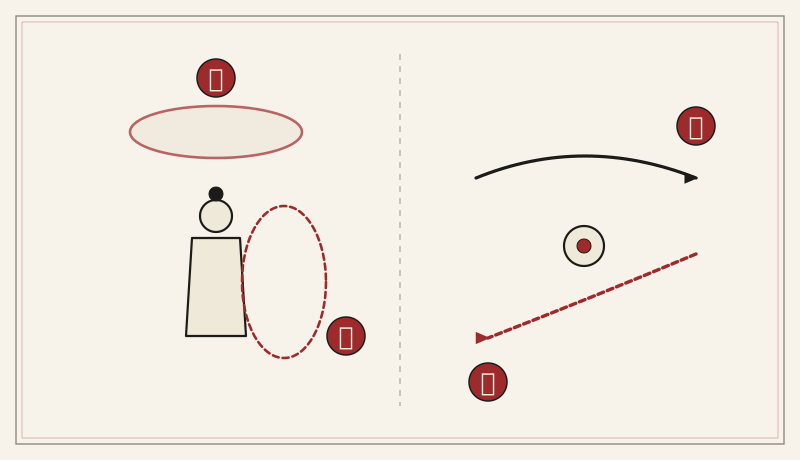
Classical ink-and-cinnabar diagram of Wudang Taiji Jian circular deflections (Gua, Yun, Mo, Dai) with four numbered markers (①–④).

Figure 1: Wudang Taiji Jian Circular Deflections — ① Left and Right Hanging Circles along the vertical flank plane (Zuo You Gua Jian); ② Overhead Horizontal Cloud-Sweeping Canopy (Yun Jian); ③ Flat Horizontal Slicing Wipe across the chest (Mo Jian); ④ Diagonal Waist-Led Adhering Draw (Dai Jian).

  1. ① Hanging Sword (Gua Jian 挂剑): A vertical circular wheel brushing downward and rearward along the left or right flank to deflect incoming thrusts.
  2. ② Cloud-Sweeping Sword (Yun Jian 云剑): A horizontal or slightly tilted circular canopy above the head and forehead that wraps and redirects high attacks.
  3. ③ Wiping Sword (Mo Jian 抹剑): A flat-blade horizontal arc drawn smoothly across from left to right or right to left at chest height.
  4. ④ Leading Sword (Dai Jian 带剑): Adhering to an incoming weapon with the flat or edge of the blade and drawing it diagonally into emptiness by rotating the waist.

3. Mo Jian (Wiping) and Dai Jian (Leading): Horizontal Slicing and Diagonal Emptying

Whereas Gua and Yun operate in the vertical-lateral and overhead planes, Mo and Dai govern the horizontal and diagonal waist planes:

  • Mo Jian (抹剑 — Horizontal Wiping Slice): Holding the blade flat (pingjian 平剑) at chest or throat level, turn the waist smoothly from left to right (or right to left) so the front cutting edge draws across in a level horizontal arc — like wiping a table with a silk cloth. Because the movement is driven by the waist and Empty and Full Stepping rather than stiff arms, Mo Jian slices and redirects simultaneously.
  • Dai Jian (带剑 — Diagonal Leading / Drawing Back): Directly analogous to Lü (捋 — Roll-Back) in Grasp the Sparrow's Tail (Lanquewei). As you shift weight to the rear leg and fold the rear kua, let the flat or bevelled edge of the sword adhere to the incoming line and draw diagonally backward and outward toward your rear hip, guiding the opponent's force into emptiness while the sword tip stays pointed toward their centerline.

4. Continuous Figure-Eight Flow Drill and Practice Precautions

In the temple courtyards of Wudang Mountain and in our Singapore classes, we train the transition between these four deflections using a slow Left-and-Right Hanging Figure-Eight Drill (Zuoyou Guajian Huaxing 左右挂剑化行): 1) Stand in a relaxed Bow or Walking Stance holding a wooden jian with a supple Living Grip; 2) Turn the waist left to trace a Left Gua vertical circle beside the left leg, then let the tip rise across the centerline and turn the waist right into a Right Gua circle beside the right leg, tracing a continuous sideways figure-eight (∞); 3) After six figure-eights, lift the circle overhead into a smooth Yun Jian cloud sweep, settle into a horizontal Mo Jian wipe, and shift back into a diagonal Dai Jian draw.

When practicing Yun Jian overhead, keep the elbow softly bent and tilt the sword handle slightly down in front of the forehead so the flat of the blade passes safely above the hairknot without straining the shoulder rotator cuff. Traditional Wudang swordsmanship cultivates whole-body coordination, wrist mobility, and calm focus and never replaces professional medical care.

Seeker’s Q&A · Frequently Asked Questions

What is the core takeaway of Wudang Taiji Jian Circular Deflections?

Master the four circular and adhesive deflection methods of Wudang Taiji Jian — Left and Right Hanging (Gua Jian), Overhead Cloud-Sweeping (Yun Jian), Horizontal Wiping (Mo Jian), and Diagonal Leading (Dai Jian) — to redirect incoming force with four ounces deflecting a thousand pounds.
