TRADITIONAL WEAPONS · 传统器械

Wudang Taiji Jian Opening Salute, Receiving the Sword & Closing Return (Qishi, Jiejian, Huanjian, Shoushi): Full Form Etiquette & Mechanics 武当太极剑“起势、接剑、交剑、收势”全解:反手背剑藏锋与引气归元的礼法枢机

Master the complete ritual and biomechanical frame of Wudang Taiji Jian—Reverse-Hand Back-Sword Preparation (beijian), Opening Salute, Receiving the Sword (Jiejian), Returning the Sword to the Left Hand (Huanjian), and Closing Return to Origin (Shoushi).


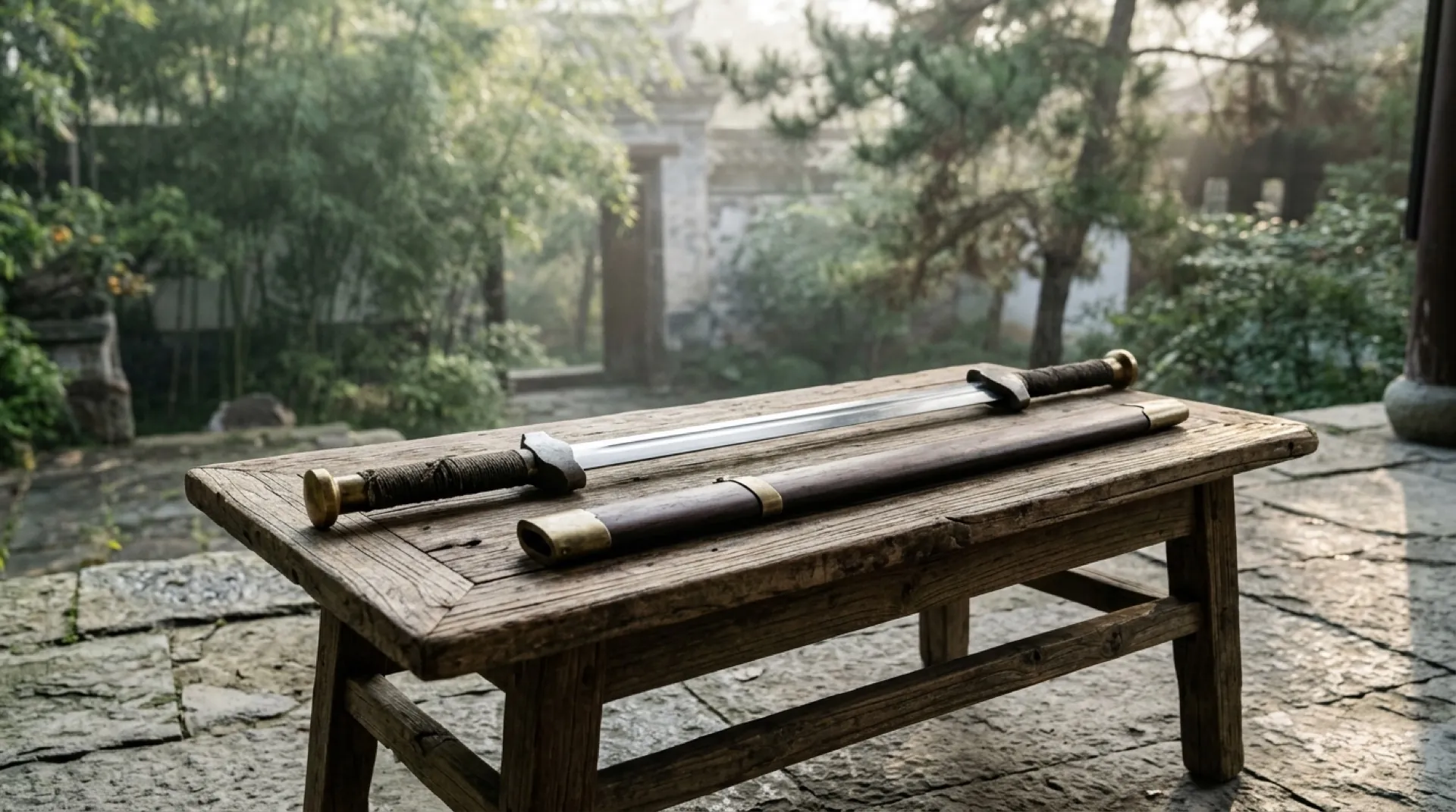
A Chinese straight sword (jian) lying drawn beside its scabbard on a weathered wooden table in a stone-paved courtyard, with pines and a gateway in the mist behind.

1. Framing the Thirteen Sword Methods: Why the Form Begins with the Sword in the Left Hand

Having explored Wudang Taiji Jian Fundamentals, Basic Cuts (Ci, Pi, Dian, Liao), Circular Deflections (Gua, Yun, Mo), Wrist Techniques (Dian, Beng, Xiao, Ya), Drawing & Lifting Blades (Chou, Dai, Ti, Ge), Intercepting & Coiling Blades (Jie, Jiao, Tuo, Chan), and Left-Hand Sword-Fingers (Jianjue), we now examine the bookends that open and close every traditional Wudang Taiji Jian set: Qishi (起势, Opening Posture), Jiejian (接剑, Receiving the Sword), Huanjian (还剑 / 交剑, Returning the Sword), and Shoushi (收势, Closing Posture).

First-time observers often ask why a right-handed sword form begins and ends with the sword held vertically behind the left forearm. In classical Chinese martial etiquette (wuli 武礼), concealing the blade behind the left arm with the tip pointing straight up shows peaceful restraint (cang feng 藏锋, hiding the sharp point)—embodying Tao Te Ching Chapter 4's precept to blunt the sharpness and soften the glare.

2. Opening Posture (Qishi) and 'Pointing the Immortal's Way' to Receive the Hilt (Jiejian)

Just as bare-hand Taijiquan begins in Wuji Stillness and Opening Posture (Qishi), the sword form begins standing upright with feet together or at shoulder width. The left hand holds the sword guard (jiantan) in a reverse grip—thumb and index finger wrapping the lower guard, middle/ring/little fingers curled over the hilt—so the unsharpened flat rests quietly behind the left forearm.

On the opening breath, both arms float up to shoulder height and sink softly as the knees bend. The practitioner then steps into a bow or T-stance with the right hand forming Sword-Fingers (Jianjue) to perform postures such as 'Pointing the Immortal's Way' (Xianren Zhilu 仙人指路) or 'Three Rings Around the Moon' (Sanhuan Taoyue 三环套月). Only after the waist and breathing are fully settled does the right hand open its Sword-Fingers to receive the hilt (Jiejian 接剑) from the left hand while the left hand simultaneously forms Jianjue.

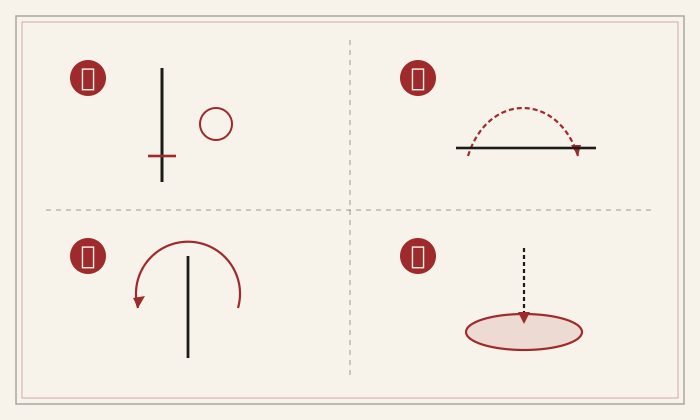
Classical four-stage diagram of Wudang Taiji Jian opening and closing mechanics showing Left Reverse-Hand Back-Sword Preparation, Right Sword-Fingers Arc to Receive the Hilt (Jiejian), Circular Return of the Blade to the Left Hand (Huanjian), and Closing Qi Return to Dantian (Shoushi)

The ritual and mechanical frame of Wudang Taiji Jian: ① Reverse-Hand Back-Sword Preparation, ② Receiving the Sword (Jiejian), ③ Returning the Sword to the Left Hand (Huanjian), and ④ Closing Return to Origin (Shoushi).

  1. ① Left Reverse-Hand Back-Sword (Zuo Fanshou Chijian): Thumb and index finger hold the guard while the flat of the blade rests vertically behind the left forearm.
  2. ② Receiving the Sword (Jiejian): Right Sword-Fingers lead the opener before transitioning smoothly onto the hilt.
  3. ③ Returning the Sword (Huanjian / Jiaojian): Sweeping the blade in a calm left-ward arc back into the left reverse-hand cradle.
  4. ④ Closing Return to Origin (Shoushi / Yin Qi Gui Yuan): Descending the right palm past the chest to seal qi into the lower dantian.

3. Returning the Blade to the Left Hand (Huanjian) and Closing Return to Origin (Shoushi)

At the conclusion of the sword routine, the practitioner never simply drops their arms and walks away. Mirroring the bare-hand Closing Posture (Shoushi) and Returning Qi to Origin, the right hand guides the sword in a calm horizontal or downward arc across the front of the body toward the left hip.

The left hand—waiting palm-out at the left waist—slides its thumb and index finger under the sword guard to receive the blade back (Huanjian 还剑 / Jiaojian 交剑), tucking the sword vertically behind the left forearm once more. Freed of the weapon, the right hand forms Jianjue, traces a broad arc overhead, and descends slowly down the centerline past the face and chest to the lower dantian (Yin Qi Gui Yuan 引气归元) as the feet come together.

4. Five-Minute Solo Drill: Practicing the Seamless Left-to-Right Hand Handoff

With a wooden training sword, practice the opening and closing handoffs ten times in a row without rushing: (1) stand in left reverse-hand back-sword posture for three breaths; (2) step forward, bring the left hilt and right Jianjue together in front of the chest, and smoothly transfer the hilt into the right live grip (Jiejian) while the left hand extends backward in Jianjue; (3) circle the right sword back across the waist to return it into the left reverse-hand cradle (Huanjian) without looking down at your hands or clattering the guard; (4) lower the right palm down the centerline and stand quietly for three breaths.

Safety note: always ensure the blade flat rests securely behind the forearm during reverse-grip transitions and practice with a rounded wooden sword in a clear space.

Seeker’s Q&A · Frequently Asked Questions

What is the core takeaway of Wudang Taiji Jian Opening Salute, Receiving the Sword & Closing Return (Qishi, Jiejian, Huanjian, Shoushi)?

Master the complete ritual and biomechanical frame of Wudang Taiji Jian—Reverse-Hand Back-Sword Preparation (beijian), Opening Salute, Receiving the Sword (Jiejian), Returning the Sword to the Left Hand (Huanjian), and Closing Return to Origin (Shoushi).
