TRADITIONAL WEAPONS · 传统器械

Wudang Taiji Jian Living Grip (Huo Ba) and Four Foundational Techniques: Thrust (Ci), Split (Pi), Point (Dian), and Sweep (Liao) 武当太极剑“活把握剑”与四母剑法详解:刺剑、劈剑、点剑与撩剑要领

A practical guide to the Living Sword Grip (Huo Ba), Sword-Fingers alignment (Jianzhi), and the first four techniques of the Thirteen Sword Methods in Wudang Taiji Jian — Straight Thrust (Ci), Splitting Cut (Pi), Wrist-Seated Pointing (Dian), and Upward Sweep (Liao).


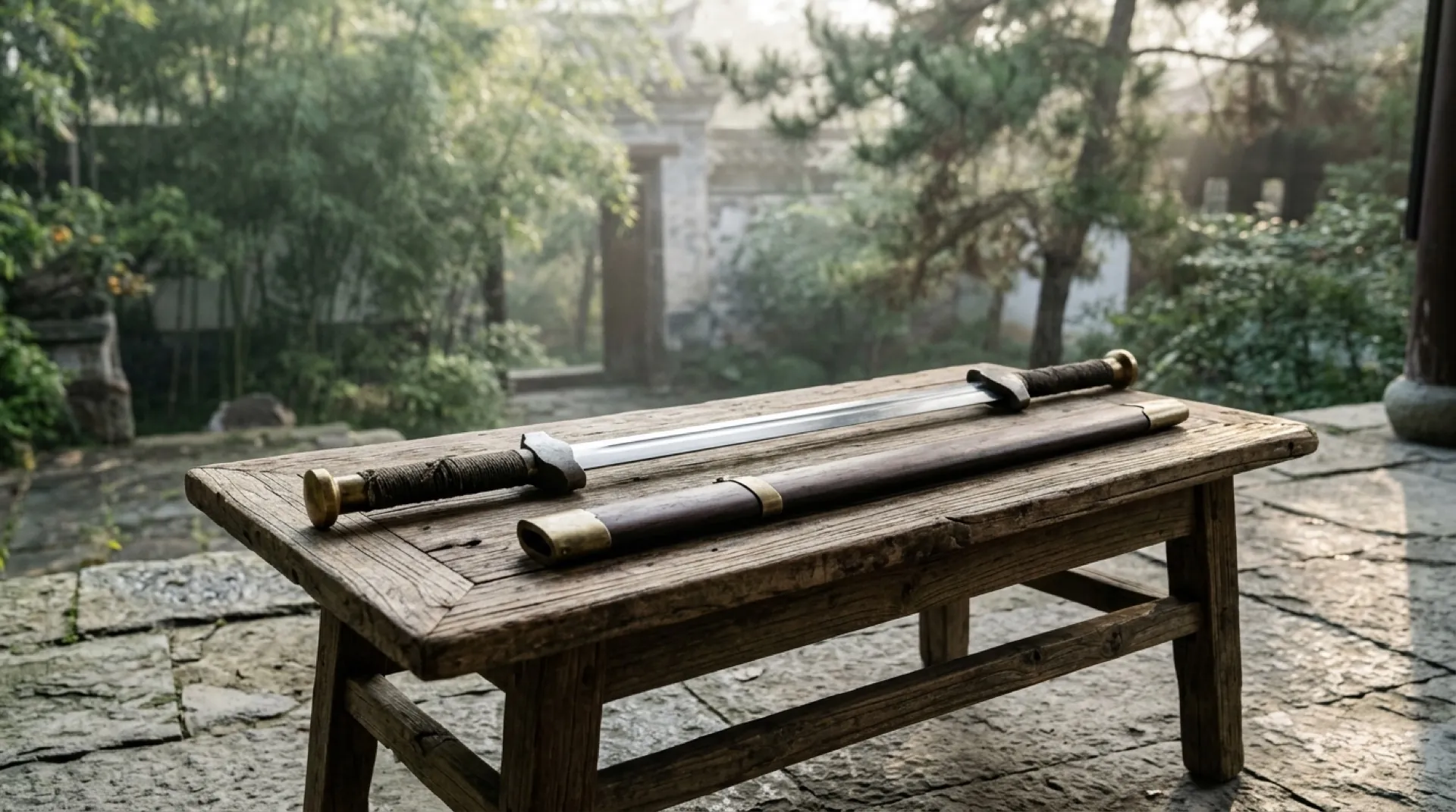
A Chinese straight sword (jian) lying drawn beside its scabbard on a weathered wooden table in a stone-paved courtyard, with pines and a gateway in the mist behind.

1. Why Wudang Taiji Jian Begins with the "Living Grip" (Huo Ba) and Sword-Fingers (Jianzhi)

As introduced in our overview of Wudang Taiji Jian Fundamentals, the straight double-edged sword (jian 剑) is revered in Wudang tradition as the "Gentleman of Weapons" (bing zhong junzi 兵中君子) because it prevails through sensitivity, timing, and spiraling redirection rather than brute chopping force. Yet that sensitivity is impossible if the practitioner clutches the hilt like a hammer — a fault classical teachers call Holding a "Dead Grip" (siba 死把).

Instead, Wudang swordsmanship requires a Living Grip (huoba 活把): the thumb and index finger form a stable yet supple ring (huokou 虎口) about half an inch behind the sword guard (jianhu 剑护), acting as the pivot fulcrum, while the middle, ring, and little fingers wrap lightly around the lower handle like elastic springs. As the blade transitions between flat (pingjian 平剑, horizontal blade plane) and vertical (lijian 立剑, vertical blade plane), the lower three fingers gently gather or release so the sword pivots effortlessly in the palm. Simultaneously, the left hand forms Sword-Fingers (jianzhi 剑指 — index and middle fingers extended together, thumb resting over the bent ring and little fingers) to counterbalance the sword and complete the circuit of internal Qi.

2. Ci (Thrust) and Pi (Split): Extending the Centerline with Waist-Driven Alignment

Among the classical Thirteen Sword Methods (Shisan Jianfa 十三剑法), Ci (刺 — Thrust) and Pi (劈 — Split) establish the primary forward lines of extension:

  • Ci Jian (刺剑 — Straight Thrust): Performed either with the blade flat (Ping Ci 平刺) or vertical (Li Ci 立刺). Starting with the sword hilt near the waist or chest, shift into a rooted Bow Stance (Empty and Full Stepping) and turn the waist so the sword extends straight forward along the centerline until arm and blade form one continuous line (shen jian heyi 身剑合一), while the left Jianzhi either supports the right wrist or extends rearward at shoulder height in opposite counterbalance.
  • Pi Jian (劈剑 — Downward Splitting Cut): Keeping the blade in the vertical plane (lijian 立剑), arc the sword from above the crown forward and downward to shoulder-to-waist height. In Taiji Jian, Pi is never a stiff-shouldered chop; the shoulder drops (chenjian zhuizhou 沉肩坠肘) and the waist settles so the entire upper and lower cutting edge slices through with elastic Silk-Reeling Force (Chansijin).
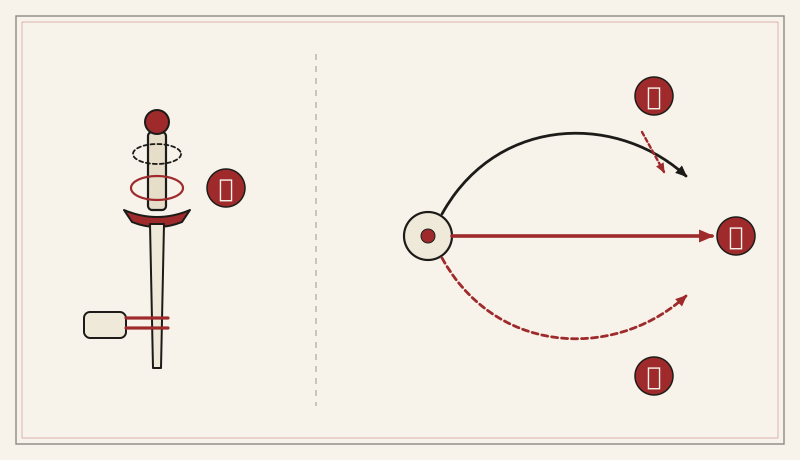
Classical ink-and-cinnabar diagram of the Wudang Taiji Jian Living Sword Grip (Huo Ba), Sword-Fingers (Jianzhi), and four blade vectors (Ci, Pi, Dian, Liao) with four numbered markers (①–④).

Figure 1: Wudang Taiji Jian Living Grip and Four Foundational Blade Vectors — ① Living Sword Grip (Huo Ba) with thumb-index collar fulcrum and supple lower fingers; ② Linear waist-to-tip Thrust (Ping Ci / Li Ci); ③ Downward Splitting Arc (Pi Jian) and Wrist-Seated Tip Point (Dian Jian); ④ Upward Sweeping Arc (Liao Jian) paired with Sword-Fingers counterbalance (Jianzhi).

  1. ① Living Sword Grip (Huo Ba Wo Jian 活把握剑): The thumb and index finger form a responsive fulcrum near the guard while the middle, ring, and little fingers open and close like a lever.
  2. ② Straight Thrust (Ci Jian 刺剑): Extending the blade along a clean line from the rear foot and waist directly out the sword tip.
  3. ③ Downward Split & Tip Point (Pi Jian & Dian Jian 劈剑与点剑): Whole-body downward splitting vs. seating the wrist to drop only the front inch of the tip.
  4. ④ Upward Sweep & Sword-Fingers (Liao Jian & Jianzhi 撩剑与剑指): Sweeping the edge upward along a silk-reeling circle while the left Sword-Fingers counterbalance the axis.

3. Dian (Point) and Liao (Upward Sweep): Subtle Wrist Articulation and Circular Redirection

If Ci and Pi teach whole-body linear extension, Dian (点 — Point/Tap) and Liao (撩 — Upward Sweep) reveal the refined finesse of the jian:

  • Dian Jian (点剑 — Wrist-Seated Tip Pointing): Often compared to a dragonfly touching water (qingting dianshui 蜻蜓点水). With the blade vertical, lift the wrist slightly as you inhale; on the exhalation, seat the wrist upward while allowing the lower three fingers on the hilt to relax slightly so the very tip of the sword (jianfeng 剑锋, the front two inches) drops sharply onto the target (such as an opponent's wrist) and rebounds immediately. The elbow and shoulder remain quiet while the wrist transmits a crisp wave to the tip.
  • Liao Jian (撩剑 — Upward Sweeping Arc): Starting from below the waist or beside the hip, turn the waist and sweep the vertical blade forward and upward along a smooth circular arc (either forehand Zhengliao 正撩 with the palm facing up/inward, or backhand Fanliao 反撩 with the forearm spiraling outward), brushing aside low attacks while slicing upward.

4. Ten-Minute Wooden-Sword Solo Drill and Safety Guidelines

In the temple courtyards of Wudang Mountain and in our Singapore classes, students practice these four foundational cuts with a balanced wooden jian in a slow ten-minute sequence: 1) Check your Living Grip (huoba) — ensure you can wiggle your ring and little fingers on the handle without dropping the sword; 2) Step forward into a right Bow Stance with Ping Ci (level thrust) while extending the left Jianzhi rearward; 3) Shift back to Empty Stance, draw the sword over the crown, and step into Pi Jian (splitting cut) followed by a subtle wrist-seated Dian Jian (tip point); 4) Circle the blade past the left hip into a smooth forehand Liao Jian (upward sweep).

Always verify clear spatial distance around you before practicing with a wooden or blunt training sword, and never lock the elbow joint at the end of a thrust. Traditional Wudang sword training refines posture, wrist suppleness, and calm focus and never replaces professional medical care.

Seeker’s Q&A · Frequently Asked Questions

What is the core takeaway of Wudang Taiji Jian Living Grip (Huo Ba) and Four Foundational Techniques?

A practical guide to the Living Sword Grip (Huo Ba), Sword-Fingers alignment (Jianzhi), and the first four techniques of the Thirteen Sword Methods in Wudang Taiji Jian — Straight Thrust (Ci), Splitting Cut (Pi), Wrist-Seated Pointing (Dian), and Upward Sweep (Liao).
