TRADITIONAL WEAPONS · 传统器械

Wudang Taiji Jian Spiraling Cuts (Jiao, Jie, Zhan, Tuo, Jia), Sword Tassel Mechanics (Jiansui), and Evasive Footwork 武当太极剑“绞截斩托架”五剑法、剑穗劲路检验与游龙闪展步法详解

Complete the Thirteen Sword Methods of Wudang Taiji Jian with Coiling (Jiao), Intercepting (Jie), Slicing (Zhan), Supporting (Tuo), and Framing (Jia) — plus how the traditional sword tassel (Jiansui) mirrors silk-reeling continuity and evasive corner footwork.


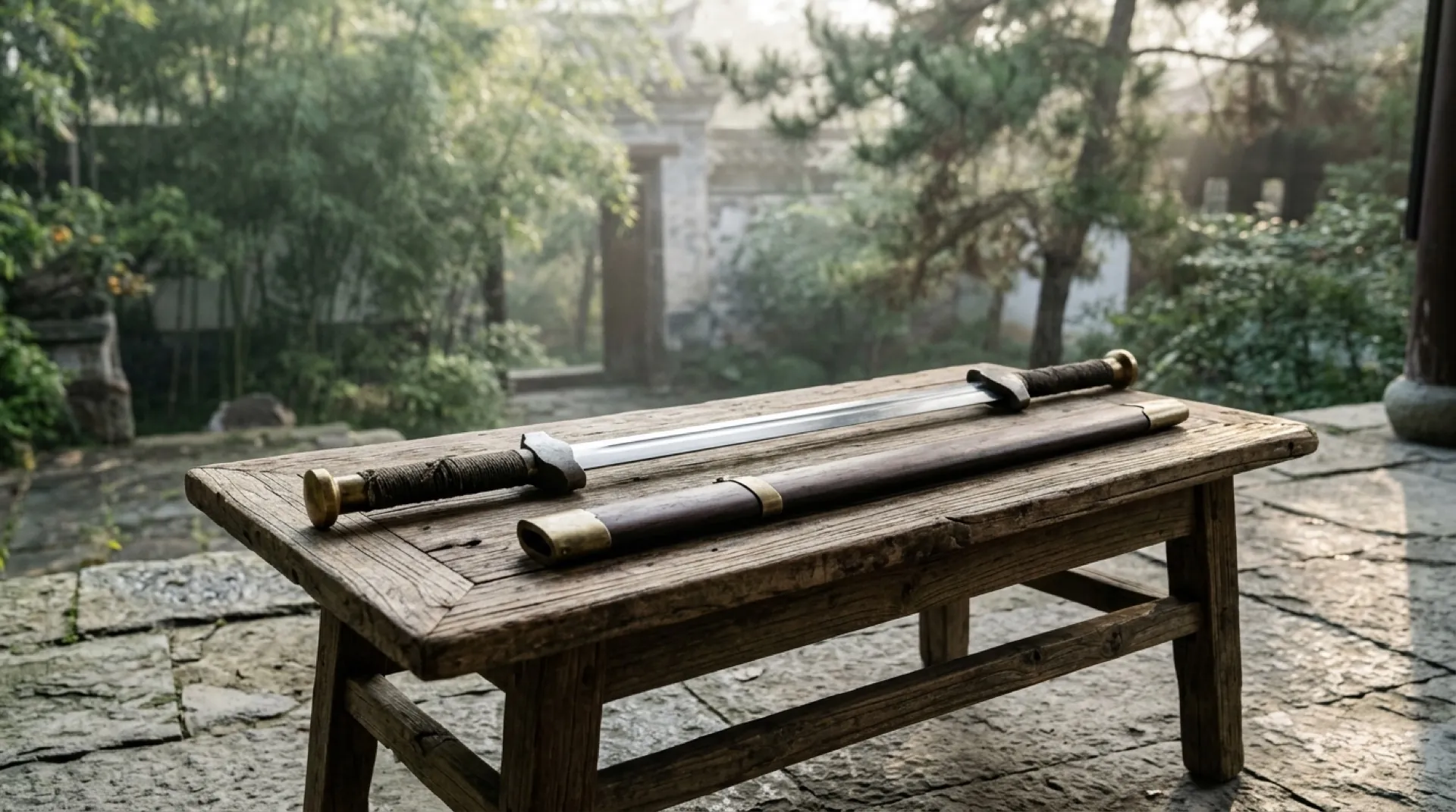
A Chinese straight sword (jian) lying drawn beside its scabbard on a weathered wooden table in a stone-paved courtyard, with pines and a gateway in the mist behind.

1. Completing the Thirteen Sword Methods: Jiao, Jie, Zhan, Tuo, and Jia

Across our foundational guides to Wudang Taiji Jian Fundamentals, Living Grip and Basic Cuts (Ci, Pi, Dian, Liao), and Circular Deflections (Gua, Yun, Mo, Dai), we have examined eight of the classical Thirteen Sword Methods (Shisan Jianfa 十三剑法). Now we complete the curriculum with five techniques that unite spiraling containment, tangent interception, and structural framing:

  • Jiao Jian (绞剑 — Coiling / Spiraling Sword): Extending the sword forward, the waist and supple wrist guide the sword tip in small, continuous conical circles (clockwise or counter-clockwise) while the hilt stays near the centerline, wrapping around an incoming shaft or wrist using Silk-Reeling Force (Chansijin).
  • Jie Jian (截剑 — Tangent Intercepting Cut): Rather than blocking the opponent's weapon, Jie Jian steps slightly off the line and slices diagonally across the opponent's advancing wrist or forearm the instant their attack begins.
  • Zhan Jian (斩剑 — Horizontal/Bevel Decapitating Cut): Whereas Mo Jian wipes softly in a level drawing arc, Zhan Jian delivers a crisp waist-driven horizontal or slightly diagonal cut with the front third of the flat blade at neck-to-shoulder height.
  • Tuo Jian (托剑 — Upward Supporting Blade) & Jia Jian (架剑 — Overhead Framing Block): Using the flat or bevelled edge of the mid-blade angled at forty-five degrees so an incoming downward strike slides harmlessly off the slope while you counter-thrust underneath.

2. The Sword Tassel (Jiansui): An Honest Mirror of Internal Continuity

Observers watching traditional Wudang Taiji Jian often ask whether the flowing silk sword tassel (jiansui 剑穗, attached to the pommel ring) is merely decorative. In classical Wudang pedagogy, the tassel — whether short/medium (duansui 短穗) for brisk martial sets or long (changsui 长穗) for advanced body-flexibility training — serves as a rigorous diagnostic mirror of internal body-work (shenfa 身法).

Because the silk tassel has no stiffness of its own, it obeys pure physics: if your transitions between Gua, Yun, Mo, and Dai are driven by jerky, disconnected arm muscles or sudden stops (duanjin 断劲), the tassel immediately whips back and tangles around your wrist, forearm, or blade. Conversely, when every redirection originates in the feet and waist, passes smoothly through a relaxed shoulder and elbow, and pivots around a supple Living Grip (Huo Ba), the tassel trails behind the pommel in unbroken figure-eight arcs (∞), never wrapping the wrist unless intentionally coiled and released.

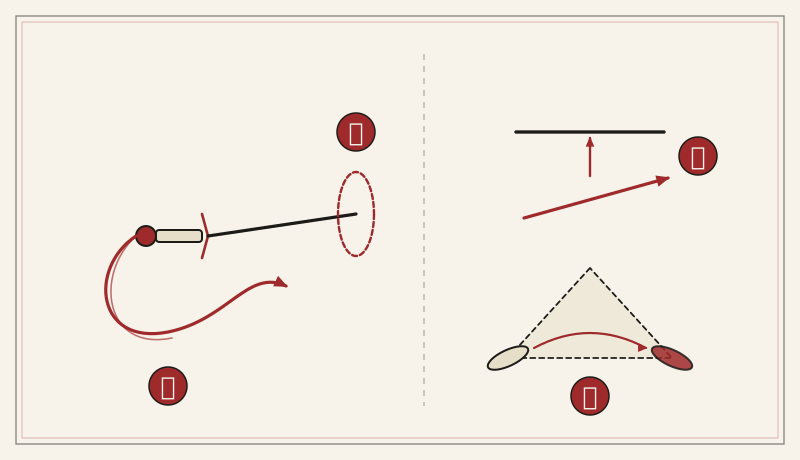
Classical ink-and-cinnabar diagram of Wudang Taiji Jian spiraling blade mechanics (Jiao, Jie, Tuo, Jia), flowing sword tassel (Jiansui), and evasive corner footwork with four numbered markers (①–④).

Figure 1: Wudang Taiji Jian Spiraling Techniques, Tassel Continuity, and Evasive Stepping — ① Conical spiraling blade tip in Coiling Sword (Jiao Jian); ② Tangent Intercepting (Jie) and Overhead Supporting/Framing (Tuo & Jia); ③ Unbroken figure-eight path of the silk sword tassel (Jiansui) trailing the pommel; ④ Evasive corner stepping (Koubu & Baibu) moving off the line of collision.

  1. ① Coiling Sword (Jiao Jian 绞剑): The sword tip traces a tight conical spiral driven by the waist and wrist to wrap and unseat an opponent's weapon.
  2. ② Intercepting, Supporting & Framing (Jie, Tuo & Jia 截·托·架): Cutting across the opponent's wrist line (Jie) or supporting upward along a slanted plane (Tuo/Jia).
  3. ③ Sword Tassel Continuity (Jiansui Sui Jian 剑穗随剑): The pommel tassel flows smoothly without tangling around the wrist only when force is continuous and circular.
  4. ④ Evasive Corner Stepping (Koubu Baibu ShanZhan 扣步摆步闪展): Stepping to the 45-degree diagonal gates so the body never stands directly in front of heavy incoming force.

3. "Walking Like a Cat, Moving Like a Swimming Dragon": Wudang Sword Footwork

Classical Wudang sword proverbs state: "The saber is like a fierce tiger, the sword is like a swimming dragon" (刀如猛虎,剑如游龙), and "In swordsmanship, look first at the body-method and stepping; if you stand dead in the doorway, even a sharp sword is useless." Because the jian is light and double-edged, its power depends on evasive corner footwork (shanzhan bufa 闪展步法) rooted in Empty and Full Stepping (Xu-Shi).

Four stepping patterns appear constantly across Wudang sword forms: 1) Koubu (扣步 — Hook-In Step) and Baibu (摆步 — Swing-Out Step): Turning the lead foot inward or outward from the hip socket to pivot 45, 90, or 180 degrees off the opponent's line of attack while keeping the knees safe; 2) Guibu (跪步 / 偷步 — Coiled Kneeling/Stealing Step): Tucking one knee behind the supporting calf to coil low before springing into an upward Liao or Ci; 3) Xubu (虚步 — Empty Cat Stance) and Duli (独立 — Single-Leg Stance): Allowing the front foot or lifted knee to change direction in an instant while the sword intercepts (Jie) along the tangent.

4. Progressive Coiling Drill: Practicing Without and With a Tassel

In the temple courtyards of Wudang Mountain and in our Singapore classes, we recommend a two-stage approach to mastering Jiao Jian, Jie Jian, and tassel control: 1) First master the bare wooden sword (or short tassel): Stand in a right Bow Stance and practice twelve slow clockwise and twelve counter-clockwise Jiao Jian (coiling) circles about the size of a dinner plate at chest height, ensuring the circle is drawn by the waist and wrist rather than the shoulder; 2) Add a medium silk tassel: Link Left Gua → Right Gua → Step to 45° Corner with Jie Jian (Intercept) → Jiao Jian (Coil) → Ping Ci (Thrust), listening to the quiet swish of the tassel so it never snags on your sleeve.

Always practice in a clear, unobstructed space and keep the standing knee aligned with the toes during all corner pivots. Traditional Wudang sword training cultivates spatial awareness, agile footwork, and calm composure and never replaces professional medical care.

Seeker’s Q&A · Frequently Asked Questions

What is the core takeaway of Wudang Taiji Jian Spiraling Cuts (Jiao, Jie, Zhan, Tuo, Jia), Sword Tassel Mechanics (Jiansui), and Evasive Footwork?

Complete the Thirteen Sword Methods of Wudang Taiji Jian with Coiling (Jiao), Intercepting (Jie), Slicing (Zhan), Supporting (Tuo), and Framing (Jia) — plus how the traditional sword tassel (Jiansui) mirrors silk-reeling continuity and evasive corner footwork.
