TRADITIONAL WEAPONS · 传统器械

Wudang Straight Sword (武当剑法 Jianfa) Foundations: The Alive Hilt Grip (Huo Ba), Supple Figure-Eight Wrist Circles, and Left Sword-Finger (Jianzhi) Counterbalance 武当剑法“活把握剑、旋腕走化与剑指相合”精解:破除满把死握、贯通尺侧活腕与左右对称开展的内家剑道初阶

Why the double-edged straight sword is called the 'Gentleman of Weapons,' and how subtle finger shifts and left-hand Sword-Finger alignment transmit waist power to the blade tip.

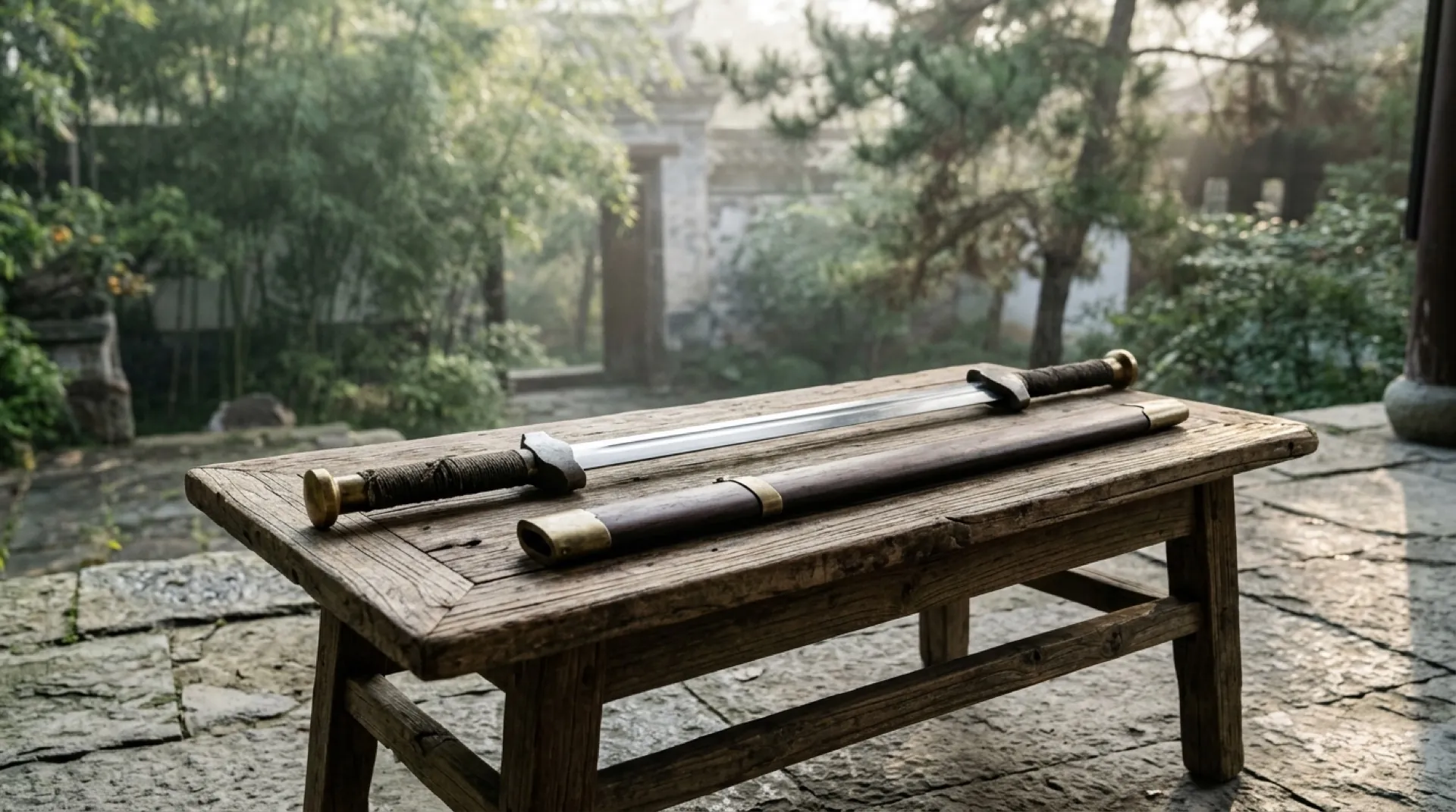
A Chinese straight sword (jian) lying drawn beside its scabbard on a weathered wooden table in a stone-paved courtyard, with pines and a gateway in the mist behind.

1. "The Sword Has No Dead Grip" (Jian Wu Si Ba 剑无死把): Why Clenching the Hilt Breaks Internal Connection

In the classical weapons curriculum of Wudang Mountain, an old proverb distinguishes the single-edged saber (Dao 刀) from the double-edged straight sword (Jian 剑): "Wielding the saber is like a fierce tiger; holding the straight sword is like a swimming dragon" (Na Dao Ru Meng Hu, Wo Jian Si You Long 拿刀如猛虎,握剑似游龙). Because a traditional straight sword is sharpened along both edges and tapers to a responsive tip (Jianfeng 剑锋), it is never meant to smash head-on against heavy weapons. Instead, it glides, adheres, deflects along circular tangents, and enters through subtle openings—embodying the non-contentious responsiveness of the Tao Te Ching and the timely observation of the Yinfu Jing (Guan Tian Zhi Dao, Zhi Tian Zhi Xing).

Why do beginners struggle to make the sword move like a "swimming dragon"? Almost invariably, the root cause lies in a "Dead Grip" (Si Ba 死把)—wrapping all five fingers around the hilt as tightly as if gripping a carpenter's hammer. The moment the hand clenches the hilt into a rigid fist:

  1. The Wrist Joint (Wangu) Freezes: The eight carpal bones lock together, forcing the practitioner to swing the entire forearm and shoulder awkwardly just to turn the blade 45 degrees.
  2. The Center of the Palm (Laogong) Collapses: Clenching crushes the hollow space inside the palm, cutting off tactile sensitivity (Tingjin 听劲) to vibrations along the blade.
  3. The Elbow Floats and the Shoulder Shrugs: As explained in our guide to warming Houxi (SI-3) and Wangu (SI-4) along the ulnar palm edge, excessive thumb-and-index radial tension immediately pulls the elbow upward and tightens the trapezius.

Instead, Wudang Jianfa trains the "Alive Grip" (Huo Ba 活把) or "Spiral Grip" (Luo Ba 螺把):

  • Thumb and Index Finger Form a Supple Fulcrum Ring: Near the sword guard (Hushou 护手), the thumb and index finger wrap lightly around the upper hilt as a rotational pivot—firm enough that the sword never slips, yet soft enough that a small gap remains in the Tiger's Mouth (Hukou 虎口).
  • Middle Finger Acts as the Central Balance Beam: Resting near the middle of the grip, the middle finger supports the weight of the hilt.
  • Ring and Little Fingers Act as the Rudder (Duoshou 舵手): Nestled near the pommel (Jianba Wei 剑把尾) along the ulnar Houxi–Wangu line, the ring and little fingers gently open and close as the wrist turns. When thrusting forward (Ci 刺) or pointing (Dian 点), the little and ring fingers draw gently inward toward the palm heel, aligning the blade cleanly with the forearm bones without locking the wrist.
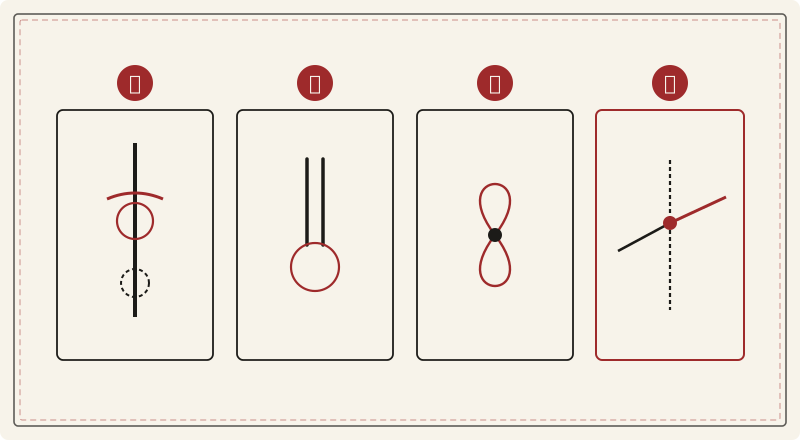
Classical four-panel Wudang straight sword diagram illustrating the Alive Spiral Grip (Huo Ba), the left-hand Sword Finger (Jianzhi) mudra, figure-eight wrist circles (Wan Hua), and whole-body waist-to-tip counterbalance
Figure 1 — Structural Mechanics of Wudang Straight Sword (武当剑法): ① Huo Ba / Luo Ba (活把/螺把 — Alive Spiral Hilt Grip): rounded Hukou fulcrum at the guard with the ring and little fingers steering the pommel along the ulnar edge; ② Jianzhi (剑指 — Left Sword-Finger Formation): index and middle fingers extended together while the thumb gently seals the ring and little fingernails; ③ Taiji Wan Hua (太极腕花 — Figure-Eight Wrist Loops): vertical and horizontal circles led from the waist and ulnar wrist without lifting the elbow; ④ Jian Yu Jianzhi He (剑与剑指合 — Symmetrical Counterbalance): right sword tip and left Sword Finger expanding along opposite vectors from the central Kua and spine.

2. Why Does the Left Hand Form the "Sword Finger" (Jianzhi 剑指)?

Observers watching traditional Wudang swordplay often ask why the unarmed left hand is held with the index and middle fingers extended together while the thumb presses gently over the nails of the folded ring and little fingers—a classical hand seal known as Jianzhi (剑指, "Sword Finger") or Jianjue (剑诀, "Sword Formula"). Far from mere ornament, the left Jianzhi fulfills three indispensable biomechanical and internal functions:

  1. Dynamic Counterweight for Single-Handed Blade Extension: Even a wooden practice sword shifts the upper body's center of mass forward when extended. Just as the rear palm in Separation of Feet (Zuoyou Fenjiao) and Heel Kick (Dengjiao) balances the kicking leg, extending the left Jianzhi to the rear diagonal when the right sword thrusts forward keeps the spine upright and prevents the right shoulder from leaning out over the front knee.
  2. Supporting the Right Wrist and Guiding Intention (Fu Wan Ling Yi 扶腕领意): During close gathering postures, the pads of the left Jianzhi rest lightly beneath or beside the right wrist (Wangu SI-4 / Yangchi TE-4), unifying both arms into a single rounded Peng frame (as in Wudang Taijiquan) before separating like wings.
  3. Six-Meridian Hand-Tip Harmonization: In classical meridian theory, extending the index (Large Intestine Yangming) and middle (Pericardium Jueyin) fingers while sealing the ring (Triple Burner Shaoyang) and little (Heart Shaoyin / Small Intestine Taiyang) fingers under the thumb (Lung Taiyin) gathers the Qi of all six hand channels so the unarmed hand remains energized rather than hanging limp.
Foundational DrillStarting Stance & Hand / Hilt PositionMovement Path & RepetitionsKey Alignment Checkpoint
1. Forming Jianzhi & Huo Ba InspectionStand in shoulder-width Wuji posture; left hand forms Jianzhi at the waist, right hand holds a wooden sword (or wooden ruler / empty Huo Ba grip)Practice opening the ring and little fingers 1 cm as the blade tip dips, then closing them gently into the palm as the tip levels (18 slow repetitions)Keep the right shoulder dropped and the center of the palm (Laogong) hollow, never white-knuckled
2. Left Jianzhi Brushing the Right Wrist (Fu Wan Kai He)Shift into a gentle bow stance; bring the left Jianzhi pads to touch the inside of the right wrist in front of the chestInhale as both hands gather at the chest; exhale as the right hand thrusts forward at chest height while the left Jianzhi arcs backward and upward to temple height (12 repetitions)Feel the expansion originate from the spine between the shoulder blades (Babei), just as in Shuangfeng Guan'er
3. Vertical Figure-Eight Wrist Loops (Li Wan Hua 立腕花)Stand in a relaxed horse or bow stance with left Jianzhi resting lightly near the right elbow or extended to the sideTurn the waist slightly left and right to lead the sword tip through a vertical figure-eight loop on the outer and inner sides of the forearm (12 inward, 12 outward)Let the wrist rotate around Wangu (SI-4) while the elbow stays heavy and quiet
4. Horizontal Slicing & Gathering to Dantian (Ping Mo Shou Jian)Bring the blade horizontal at waist level, palm facing down (Yin Jian) then turning palm-up (Yang Jian)Turn from the Kua to glide the blade horizontally across the centerline, then transfer the sword to the left hand and lower both palms over Qihai and GuanyuanConclude in three breaths of complete stillness (Chang Ying Chang Jing)

3. Three Common Beginner Errors in Wudang Sword Practice and Corrections

  1. Flicking the Wrist With a Stiff Waist (Shua Wan Wang Yao 耍腕忘腰): If you spin the wrist rapidly while your waist and hips stand frozen like a statue, the sword flower (Jianhua 剑花) becomes an empty wrist trick that tires the forearm tendons within a minute. Correction: Every wrist circle must begin with a subtle shift of weight and rotation of the waist and Kua (loosened at Huantiao and Fengshi); the waist moves 30 percent, and the wrist expresses the remaining arc.
  2. Forgetting the Left Jianzhi ("Dead Left Arm"): Beginners stare at the right sword blade while letting their left hand drop lifelessly by the hip. Correction: Keep 50 percent of your intention in the left Jianzhi; whenever the sword moves forward, downward, or left, the Jianzhi provides a living, proportional counterpoint.
  3. Hunching the Neck to Watch the Blade: Craning the neck forward breaks the upright pillar. Correction: Apply the Yinfu Jing principle Ji Zai Mu (the pivot lies in the eye), letting your calm gaze travel through the direction of the sword tip toward the horizon.

4. Heritage Practice on Wudang Mountain and in Singapore

Whether observing traditional weapons practice in the stone courtyards of the UNESCO World Heritage ancient Taoist temples on Wudang Mountain (No. 72 Jianhe 2nd Road, Wudangshan, Hubei, China; UNESCO World Heritage guide) or learning foundational Taijiquan and Jianfa step by step at Lee Wudang International Pte. Ltd. (58A Smith Street (2nd Floor), Singapore 058962; beginner guide), students begin empty-handed or with a light wooden sword only after establishing a calm root in Wudang Qigong and barehand form. Always verify at least two meters of clear space around you before practicing any wooden-sword extensions.

Practice Reflection for Students

Even without a sword in hand, you can train Wudang Jianfa coordination right now: form the Jianzhi with your left hand and a loose Huo Ba grip with your right hand, touch your left index-and-middle fingertips to your right inner wrist in front of your chest, and slowly separate both hands along a diagonal line while exhaling into your heels.

Seeker’s Q&A · Frequently Asked Questions

How should you hold a Wudang straight sword?

With an “alive grip” (活把), never a clenched one: the saying is that “the sword has no dead grip” (剑无死把). The thumb and index finger wrap lightly around the hilt near the guard as a pivot, the middle finger supports the weight, and the ring and little fingers near the pommel open and close like a rudder as the wrist turns. Clenching all five fingers freezes the wrist, deadens the palm’s feel for the blade and lifts the elbow and shoulder. The empty left hand forms the sword-finger (剑指) as a counterbalance. Beginners start empty-handed or with a light wooden sword, with at least two meters of clear space around them.


How can I apply this in practice?

Even without a sword in hand, you can train Wudang Jianfa coordination right now: form the Jianzhi with your left hand and a loose Huo Ba grip with your right hand, touch your left index-and-middle fingertips to your right inner wrist in front of your chest, and slowly separate both hands along a diagonal line while exhaling into your heels.
