TRADITIONAL WEAPONS · 传统器械

Wudang Taiji Jian Drawing, Carrying, Lifting & Parrying Blades (Chou, Dai, Ti, Ge): Redirection and Guard Mechanics Explained 武当太极剑“抽、带、提、格”四法详解:顺势牵引与护身化剑的核心枢机

Master the four classic redirection and guard techniques of Wudang Taiji Jian—Chou (Drawing), Dai (Carrying), Ti (Lifting), and Ge (Parrying)—showing how the waist, wrist, and empty-full footwork neutralize incoming force without blade-on-blade clashing.


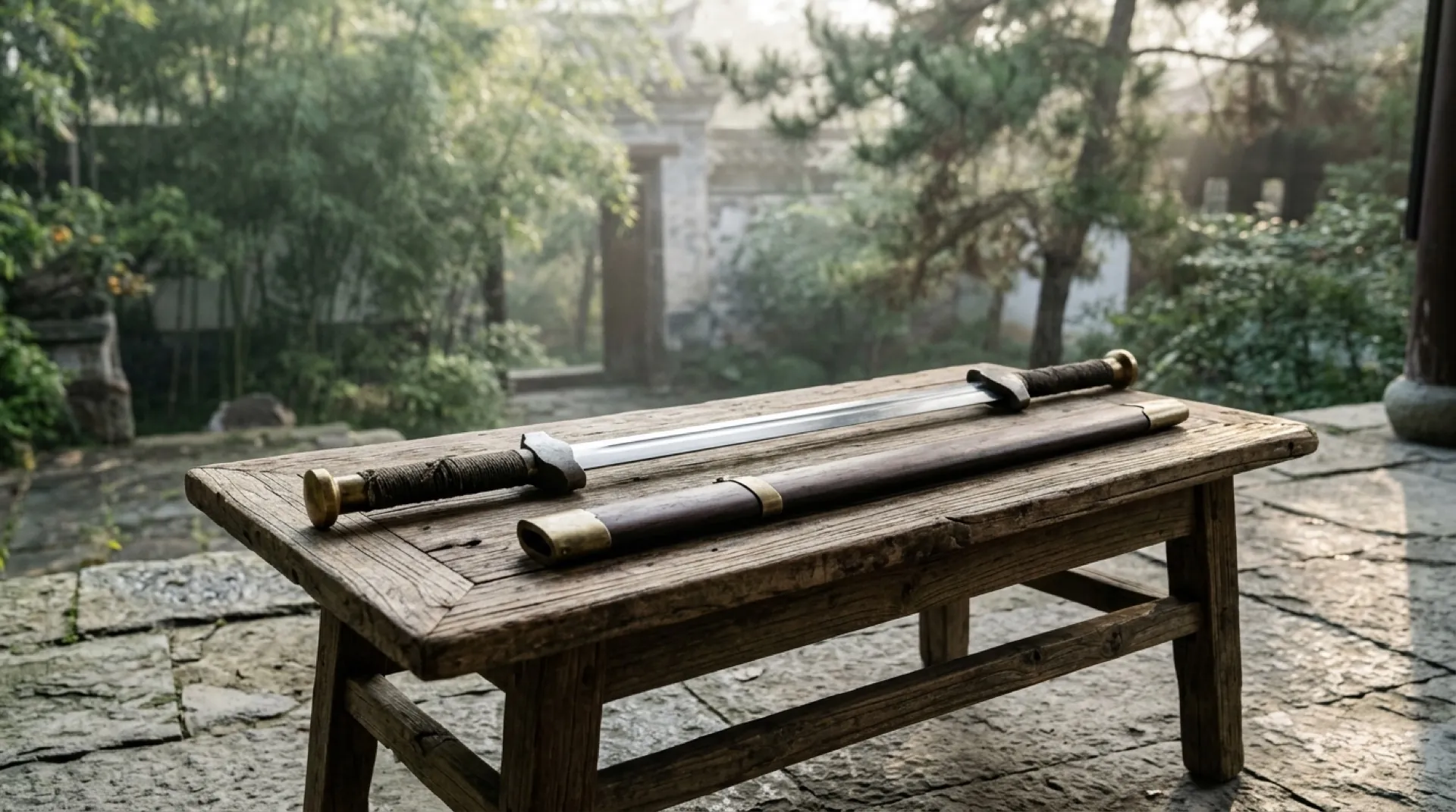
A Chinese straight sword (jian) lying drawn beside its scabbard on a weathered wooden table in a stone-paved courtyard, with pines and a gateway in the mist behind.

1. Completing the Thirteen Sword Methods: Why Redirection Replaces Forceful Blocking

In our earlier studies of Wudang Taiji Jian Fundamentals, Basic Cuts (Ci, Pi, Dian, Liao), Circular Deflections (Gua, Yun, Mo), and Refined Wrist Techniques (Dian, Beng, Xiao, Ya), we emphasized the cardinal rule of the double-edged straight sword (jian 剑): unlike the thick-backed saber (dao 刀), the slender jian never meets heavy force edge-to-edge at ninety degrees.

Instead, the traditional Thirteen Sword Methods (Shisan Jianfa 十三剑法) rely on four indispensable drawing, leading, and guarding techniques—Chou (抽, Drawing), Dai (带, Carrying), Ti (提, Lifting), and Ge (格, Parrying)—to borrow and redirect incoming momentum along a tangent.

2. 'Chou' (Drawing Blade) and 'Dai' (Carrying Blade): Sliding Along the Line vs. Leading to the Flank

Beginners often confuse Chou (抽剑, Drawing Blade) and Dai (带剑, Carrying/Leading Blade) because both move backward or laterally as the practitioner shifts weight into the rear leg. The distinction lies in the blade plane and path:

In Chou (抽, Drawing)—literally 'pulling a silk thread from a cocoon' or 'drawing a bolt back through its slot'—the sword remains aligned with its own longitudinal axis. As you fold the rear hip crease (Kua) and step back (using the Five Steps footwork), the hilt draws straight back toward your hip or shoulder while the front third of the edge slides lightly along the target line.

In Dai (带, Carrying/Leading), the blade is angled flat or slightly oblique in front of the chest. As the waist turns left or right, the flat and edge 'adhere to and carry' the incoming weapon outward in a smooth horizontal arc—the sword equivalent of Lu (Rollback) in Grasp the Sparrow's Tail.

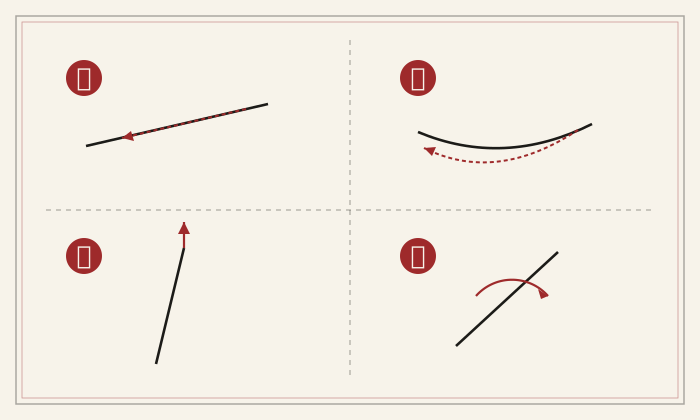
Classical four-quadrant diagram of Wudang Taiji Jian blade techniques showing Chou (Linear Drawing Cut), Dai (Waist-Led Carrying Arc), Ti (Vertical Lifting Guard), and Ge (Circular Parrying Redirection)

Four classic redirection and guard blades of Wudang Taiji Jian: ① Chou (Drawing Blade), ② Dai (Carrying Blade), ③ Ti (Lifting Blade), and ④ Ge (Parrying Blade).

  1. ① Chou (Drawing / Sliding Blade): Retracting the blade along its own line while shifting weight back, slicing or drawing past an opponent's wrist.
  2. ② Dai (Carrying / Leading Blade): Using the flat and upper edge with a horizontal waist turn to lead incoming force off to the side.
  3. ③ Ti (Lifting Blade): Raising the hilt with a suspended wrist while the tip points down-diagonal to guard the flank and lower line.
  4. ④ Ge (Parrying / Bracing Blade): Rotating the forearm and waist in a short arc to deflect an incoming thrust aside without rigid collision.

3. 'Ti' (Lifting Blade) and 'Ge' (Parrying Blade): Protecting the Gates Above and Below

Ti (提, Lifting Blade) is one of the most distinctive visual postures in Wudang Taiji Jian, often paired with an Empty Step (Xubu) or Golden Rooster Stands on One Leg. The wrist relaxes and lifts upward as if holding a lantern, allowing the tip of the sword to hang diagonally downward. This single movement simultaneously clears the lower gate and coils the body to spring forward into a thrust (Ci) or downward chop (Pi).

Ge (格, Parrying Blade) uses the stronger middle-to-rear section of the blade (jianzhong to jiangen) with a compact forearm spiral to deflect an incoming low or middle thrust to the left or right—never hacking into the opponent's weapon, but angling the blade so the incoming point glances harmlessly off.

4. Solo Practice Drill: The 'Draw-Carry-Lift-Thrust' Four-Count Sequence

You can link all four techniques in a smooth solo drill using a wooden practice sword: (1) from a right bow-stance straight thrust (Ci), shift weight back into the left leg while drawing the blade back along its centerline (Chou); (2) turn the waist left to carry an imaginary high press outward across your left flank (Dai); (3) draw the right foot into an empty step while lifting the hilt to shoulder height with the tip angled down (Ti); (4) parry a low line outward with the lower edge (Ge) and step forward into a balanced thrust.

Safety note: practice with a rounded wooden training sword in a clear space with at least three meters of clearance in all directions; this instructional guide is for educational martial arts study.

Seeker’s Q&A · Frequently Asked Questions

What is the core takeaway of Wudang Taiji Jian Drawing, Carrying, Lifting & Parrying Blades (Chou, Dai, Ti, Ge)?

Master the four classic redirection and guard techniques of Wudang Taiji Jian—Chou (Drawing), Dai (Carrying), Ti (Lifting), and Ge (Parrying)—showing how the waist, wrist, and empty-full footwork neutralize incoming force without blade-on-blade clashing.
