TRADITIONAL WEAPONS · 传统器械

Wudang Taiji Jian (Straight Sword) Fundamentals: Flexible Grip, Sword-Fingers and Training Safely as a Beginner 武当太极剑入门:活把握剑、剑指相随、基础剑法与零基础安全习练指南

Why traditional manuals say “the broadsword moves like a fierce tiger, the straight sword glides like a swimming dragon”—and how a wooden practice sword refines your waist, wrist, and attention.

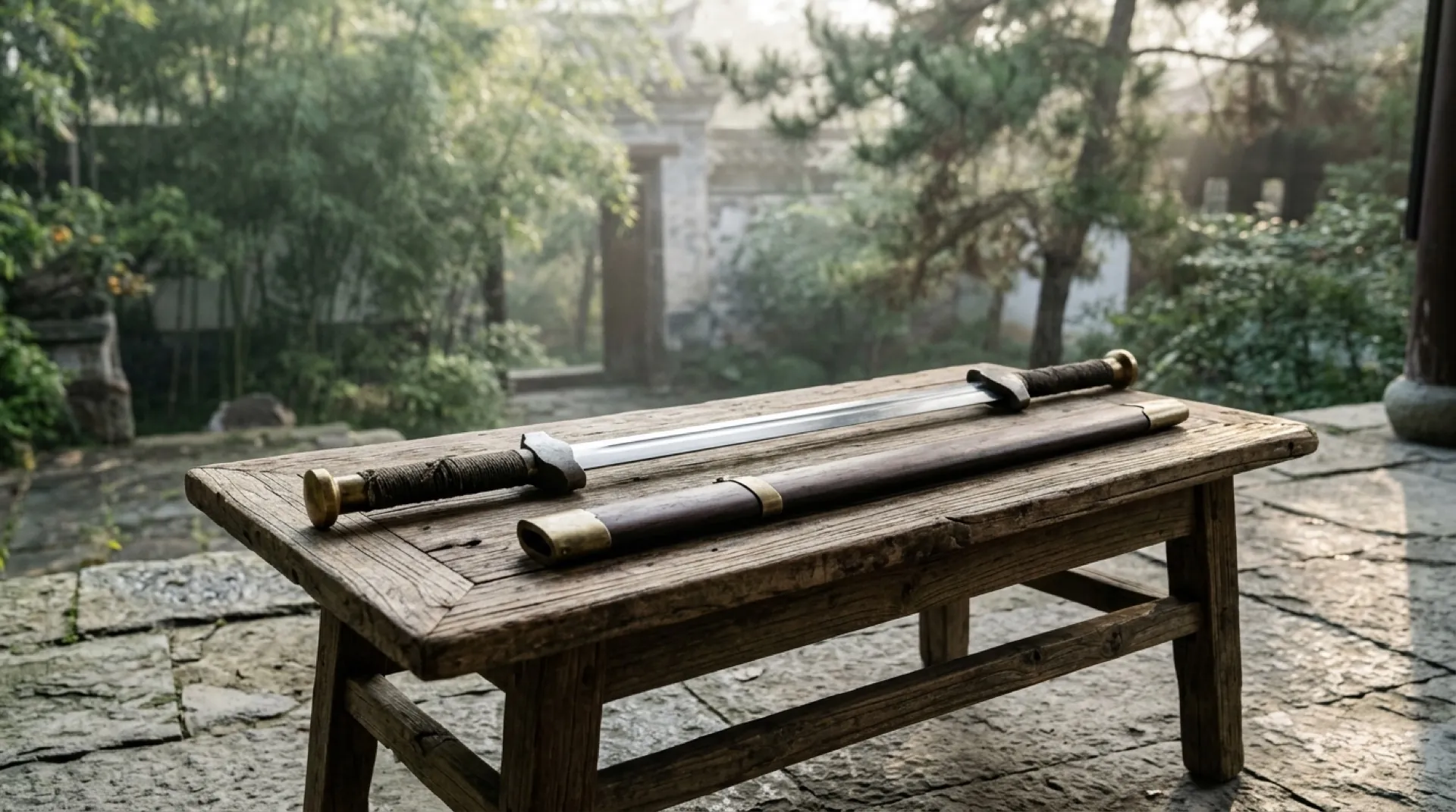
A Chinese straight sword (jian) lying drawn beside its scabbard on a weathered wooden table in a stone-paved courtyard, with pines and a gateway in the mist behind.

Among all the implements of traditional Chinese martial culture, none is more closely associated with Wudang Mountain than the double-edged straight sword—the jian (剑). An old martial proverb captures its character in eight characters: “The single-edged broadsword moves like a fierce tiger; the double-edged straight sword glides like a swimming dragon” (刀如猛虎,剑似游龙). Because a classical Chinese jian is sharpened along both edges and tapers to a responsive tip, you can never brace the back of its blade with your palm the way you do with a single-edged dao. Instead, Wudang swordsmanship (Wudang Jian) relies on footwork agility, waist-led spirals, and the same relaxed sensitivity trained in Wudang Taijiquan.

1. Why Sword Practice Clarifies Your Barehand Tai Chi

New students often wonder why someone interested in calm movement and wellness would pick up a wooden practice sword. The answer lies in instant feedback (The Weapon as an Extension of the Body): when you move empty-handed, a slight wobble in your wrist or a disconnected shoulder is easy to overlook; when you hold a seventy-centimetre wooden blade, even a tiny jerk in the shoulder causes the sword tip to flutter visibly.

Just as Cook Ding’s blade in the Zhuangzi moves through open intervals by following natural structure rather than hacking with brute force, practising Wudang Taiji Jian teaches your shoulders to drop, your waist to lead, and your gaze to extend calmly past the tip of the blade.

2. Three Structural Secrets: Live Grip (活把), Sword-Fingers (剑指), and Waist Axis

Before learning a single fancy tassel circle, check three foundational mechanics:

  1. The “Live Grip” (活把 · Never Clenching the Hilt Like a Hammer): If you squeeze the hilt with all five fingers locked tight (“dead grip,” 死把), your wrist freezes and your shoulder immediately rises. In Wudang swordplay, the thumb, index, and middle fingers form a supple fulcrum near the guard while the ring and little fingers open and close lightly like a bellows, letting the hilt pivot subtly inside the palm.
  2. The Left “Sword-Fingers” (剑指 · Counterbalance and Intention): Why does the non-sword hand extend its index and middle fingers together (jianzhi 剑指) with the thumb resting over the ring and little fingernails? It is never mere decoration: the left hand acts as the counterbalance and spirit-guide of the right hand—opening opposite the blade so the chest and upper back stay rounded, or touching the right wrist to unify whole-body power (Song and Rooting Jin).
  3. Moving the Sword With the Body (以身带剑,身剑合一): Just as beginner Wudang Tai Chi teaches that the hands never move by themselves, the sword never waves from an isolated elbow. The feet step, the waist turns, the shoulder sinks, and the energy arrives cleanly at the last three inches of the tip.

3. Five Foundational Blade Paths Every Beginner Should Know

Traditional Wudang manuals speaks of thirteen sword methods (十三剑势), yet a beginner starts by feeling five clear directions of energy—always guided by the listening sensitivity (Tingjin) of the wrist:

  • Ci (刺 · Level or Upward Thrust): Extending the tip smoothly along a straight line from the waist without locking the elbow joint.
  • Dian (点 · Downward Point-Tap): Raising the wrist lightly and letting the very tip tap downward like a dragonfly touching water or a calligraphy brush dotting paper (Calligraphy).
  • Beng (崩 · Upward Flick): A crisp, elastic upward flick of the tip generated by sinking the wrist and settling the rear hip (kua).
  • Pi (劈 · Axial Split): Guiding the blade downward along the central plane with the whole torso sinking as one unit.
  • Mo (抹 · Horizontal Slicing Draw): Drawing the flat of the blade smoothly across in a horizontal arc as the waist rotates, echoing the yielding curve of Tao Te Ching (Dao De Jing) Chapter 78.

4. How to Practise Safely at Home and Study in Singapore

Beginners should always start with a well-balanced wooden practice sword (木剑, such as pearwood or sandalwood) or an unsharpened balanced practice blade in a clear space with at least two metres of radius around the body and overhead clearance. Wudang.Org connects traditional study among Wudang Mountain’s UNESCO World Heritage ancient Taoist temples with structured instruction in Singapore—where Teacher Jason Lei (雷姿志老师) teaches Eight Brocades, Wudang Tai Chi, and Wudang Straight Sword. You can build your barehand foundation first on Start Here and Zhan Zhuang for Beginners, or check our Singapore course calendar.

Safety note: Always check that the hilt and pommel of any practice implement are secure before swinging, keep a generous safety perimeter away from furniture and other people, and treat traditional weapon forms strictly as cultural movement and coordination training.

Seeker’s Q&A · Frequently Asked Questions

What is the difference between a Chinese straight sword (Jian 剑) and a broadsword (Dao 刀) in Wudang training?

A dao is single-edged with a thick spine that can be braced by the free hand for powerful chopping and wrapping arcs (“broadsword like a fierce tiger”); a jian is double-edged with a responsive tip, requiring a supple “live grip,” balanced footwork, and waist-led finesse rather than brute force (“straight sword like a swimming dragon”).


Why do practitioners form “sword-fingers” (Jianzhi 剑指) with the left hand when holding a sword in the right?

The extended index and middle fingers of the left hand (jianzhi) serve three practical functions: counterbalancing the weight and extension of the right-hand sword, keeping the chest and upper back rounded and open, and touching the right wrist during converging movements to unify whole-body alignment.

Should a beginner buy a metal blade or start with a wooden sword (Mujian 木剑)?

Beginners should start with a well-balanced wooden practice sword (mujian). It is lighter on the wrist tendons while you are still learning the “live grip” (huoba) and waist coordination, and is much safer for home practice.
