TRADITIONAL WEAPONS · 传统器械

Wudang Taiji Jian Intercepting, Circling, Supporting & Coiling Blades (Jie, Jiao, Tuo, Chan): Sticking and Spiral Control Explained 武当太极剑“截、搅、托、格缠”四法精解:粘连随化与缠丝剑意的实战枢机

Explore the four close-adherence and spiral-control techniques of Wudang Taiji Jian—Jie (Intercepting), Jiao (Circling/Stirring), Tuo (Supporting), and Chan (Coiling)—connecting silk-reeling waist power to the sword tip.


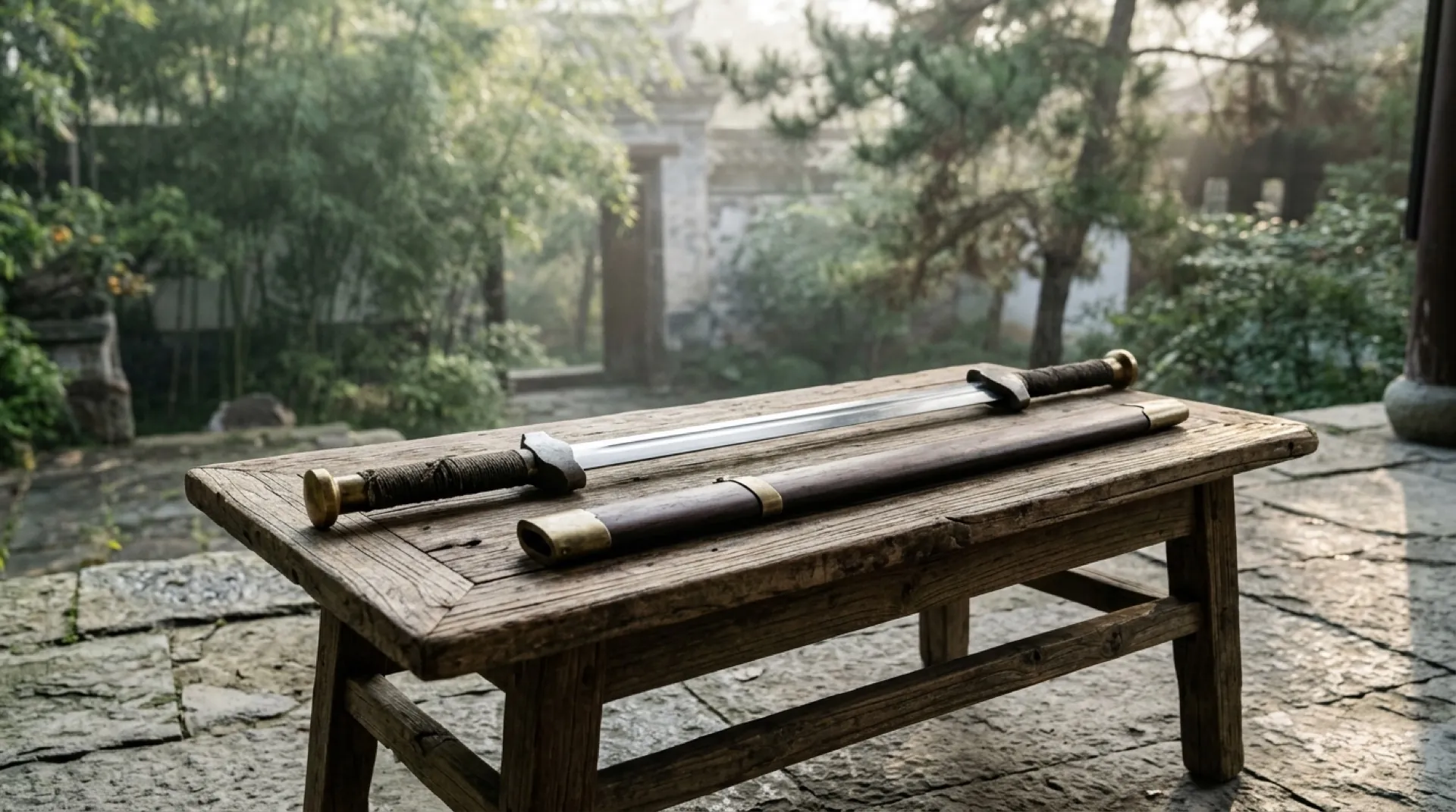
A Chinese straight sword (jian) lying drawn beside its scabbard on a weathered wooden table in a stone-paved courtyard, with pines and a gateway in the mist behind.

1. From Redirection to Sticking Adherence (Zhan Nian Lian Sui) on the Blade

Across our Wudang Taiji Jian series—covering Basic Cuts (Ci, Pi, Dian, Liao), Circular Deflections (Gua, Yun, Mo), Wrist Techniques (Dian, Beng, Xiao, Ya), and Drawing & Lifting Blades (Chou, Dai, Ti, Ge)—we have seen how the straight sword avoids head-on collision.

Yet how does a Wudang swordsman maintain continuous contact (zhan nian lian sui 沾粘连随, sticking, adhering, connecting, following) once two blades cross? Traditional manuals highlight four close-control methods that translate Silk-Reeling Energy (Chansijin) and Listening Energy (Tingjin) directly into steel or wood: Jie (截, Intercepting), Jiao (搅, Circling/Stirring), Tuo (托, Supporting), and Chan (缠, Coiling).

2. 'Jie' (Intercepting Blade) and 'Tuo' (Supporting Blade): Cutting the Path and Propping the Beam

Jie (截, Intercepting Blade) embodies the Neijia principle of 'moving second, arriving first' (hou fa xian zhi 后发先至). Rather than chasing the tip of an opponent's weapon, Jie steps in on a slight diagonal and places the front-middle edge of your sword directly across the opponent's wrist path or forearm line just as their attack begins to unfold—cutting off their bridge before momentum can build.

Tuo (托, Supporting / Propping Blade) meets a heavy downward strike not with a rigid horizontal block, but by sinking into the legs and rising smoothly with the sword held flat or slightly oblique—like a wooden bracket (dougong) propping up a temple beam at an angle so the downward force slides off to the side while opening the opponent's chest line.

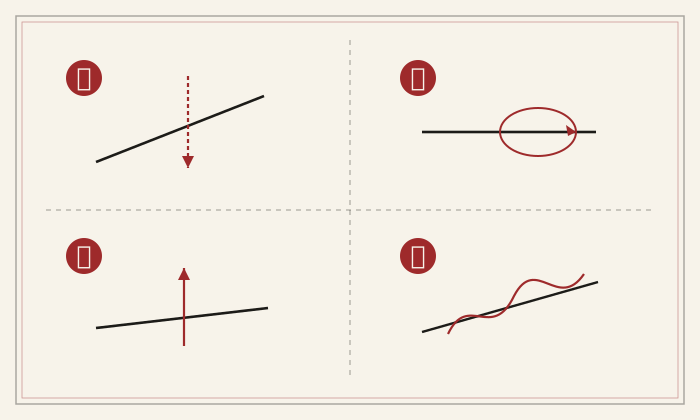
Classical four-quadrant diagram of Wudang Taiji Jian close-control blade techniques showing Jie (Oblique Interception), Jiao (Oval Tip Circling), Tuo (Upward Horizontal Support), and Chan (Spiral Coiling Wrap)

Four close-adherence and spiral-control blades of Wudang Taiji Jian: ① Jie (Intercepting), ② Jiao (Circling/Stirring), ③ Tuo (Supporting), and ④ Chan (Coiling).

  1. ① Jie (Intercepting Blade): Cutting diagonally across an opponent's advancing wrist or weapon line before it reaches full extension.
  2. ② Jiao (Circling / Stirring Blade): Tracing a compact horizontal or vertical oval with the front third of the blade to unbalance the opponent's point.
  3. ③ Tuo (Supporting / Propping Blade): Raising the flat or upper edge horizontally upward from beneath to lift and neutralize a downward chop.
  4. ④ Chan (Coiling / Wrapping Blade): Spiraling the wrist and forearm closely around the opponent's weapon shaft like silk reeling.

3. 'Jiao' (Circling Blade) and 'Chan' (Coiling Blade): Silk-Reeling Spirals at the Sword Tip

As we noted in our Sword Tassel (Jiansui) and Body-Footwork guide, Jiao (搅, Circling/Stirring) and Chan (缠, Coiling/Wrapping) are the ultimate tests of waist-to-wrist integration:

In Jiao (搅剑), the hilt moves in a small, controlled circle driven by the waist and kua while the front third of the blade traces a larger horizontal or vertical cone, enveloping the opponent's point so they cannot find a straight line to thrust.

In Chan (缠剑), the blade adheres lightly to the opponent's weapon shaft and coils around it in a tight inward or outward spiral—transferring control from the weak tip (jianfeng) to the strong base (jiangen) while stepping in to issue a crisp thrust or slice.

4. Solo Coordination Drill: The Four-Count 'Intercept-Coil-Support-Thrust' Flow

With a wooden training sword in an open space, practice this slow four-count loop: (1) step diagonally forward into a bow stance and extend the edge obliquely across the centerline (Jie); (2) shift weight slightly back while tracing one smooth inward oval with the blade tip (Jiao); (3) spiral the wrist half a turn to wrap around an imaginary shaft (Chan); (4) sink and rise with the blade angled upward at chest height (Tuo), then settle the wrist into a centered thrust (Ci).

Safety note: always train with a rounded wooden practice sword in an unobstructed area; this guide is for educational martial arts study.

Seeker’s Q&A · Frequently Asked Questions

What is the core takeaway of Wudang Taiji Jian Intercepting, Circling, Supporting & Coiling Blades (Jie, Jiao, Tuo, Chan)?

Explore the four close-adherence and spiral-control techniques of Wudang Taiji Jian—Jie (Intercepting), Jiao (Circling/Stirring), Tuo (Supporting), and Chan (Coiling)—connecting silk-reeling waist power to the sword tip.
