TRADITIONAL WEAPONS · 传统器械

Wudang Eight Immortals Sword Fundamentals (Ba Xian Jian): Eight Immortal Posture Archetypes, Deceptive Stepping, and Supple Wrist Issuance 武当八仙剑基础指南:八仙身法意象、醉步走化与柔中寓刚剑诀

A comprehensive practitioner's guide to the Wudang Eight Immortals Sword (Ba Xian Jian), examining how the eight folk-Taoist Immortal archetypes encode distinct martial body mechanics, 'drunken in appearance yet sober in spirit' (Xing Zui Yi Bu Zui) footwork, and sudden wrist-snapping issuance.


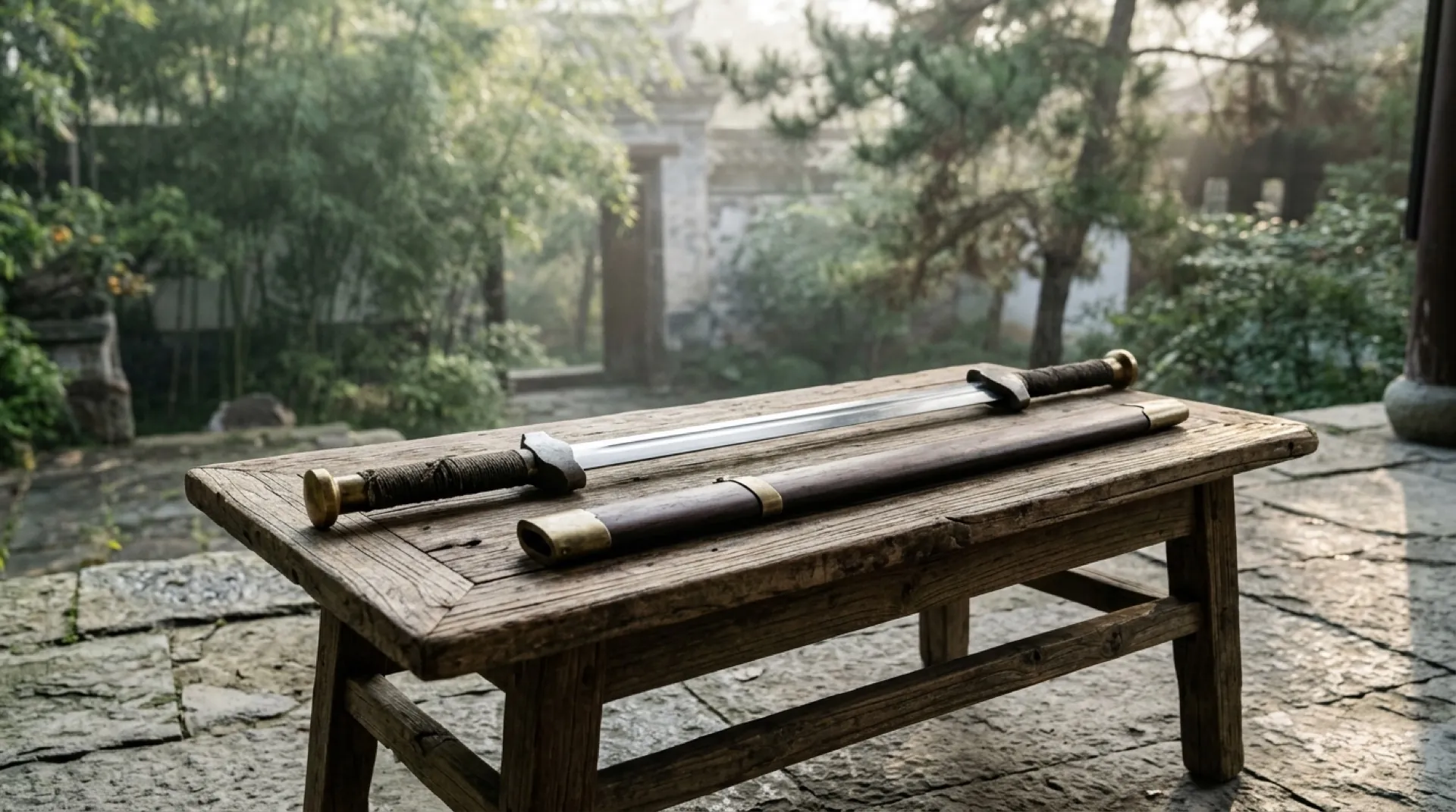
A Chinese straight sword (jian) lying drawn beside its scabbard on a weathered wooden table in a stone-paved courtyard, with pines and a gateway in the mist behind.

1. Cultural & Martial Heritage: Encoding Eight Body Qualities into the Wudang Straight Sword

Within the traditional weapon curriculum of Wudang Mountain, the Eight Immortals Sword (八仙剑, Ba Xian Jian) stands alongside Taiji Jian and Xuanmen Jian as a celebrated intermediate-to-advanced straight sword routine. Rather than treating the Eight Immortals (八仙) merely as theatrical folklore, Wudang sword masters used the distinct temperament and emblem of each figure as a somatic mnemonic for eight complementary martial qualities—ranging from regal upright extension to low, asymmetrical evasive coiling. Taught across the courtyard training halls associated with Wudang Mountain's UNESCO World Heritage ancient Taoist architectural complex and in structured weapon classes at Lee Wudang International Pte. Ltd., Ba Xian Jian trains the practitioner to transition seamlessly between steady centrality and sudden, unpredictable changes of angle.

2. 'Drunken in Form, Sober in Spirit' (Xing Zui Yi Bu Zui): Tilting Axes and Rooted Footwork

A signature feature of Wudang Ba Xian Jian—especially in postures inspired by Iron-Crutch Li (铁拐李) and Lü Dongbin's wine-cup sequences—is the principle of 'drunken in outer form, yet crystal-clear in inner intent' (形醉意不醉,步醉心不醉). In standard basic sword drills, the spine remains strictly vertical; in Ba Xian Jian, the torso purposefully leans, folds, sways, and weaves off the vertical line to draw an opponent into over-committing (echoing Laozi's Chapter 30 dictum to resolve force without head-on collision). Crucially, the inclination of the upper body never severs connection to the feet: whether stepping into a cross-legged Twist Step (歇步, Xiebu), a single-leg Independent Stance (独立步, Dulibu), or a low Hook Step (勾步, Goubu), the center of gravity remains anchored through the kua and Yongquan (KI-1) wellspring so the practitioner can recover upright equilibrium in an instant.

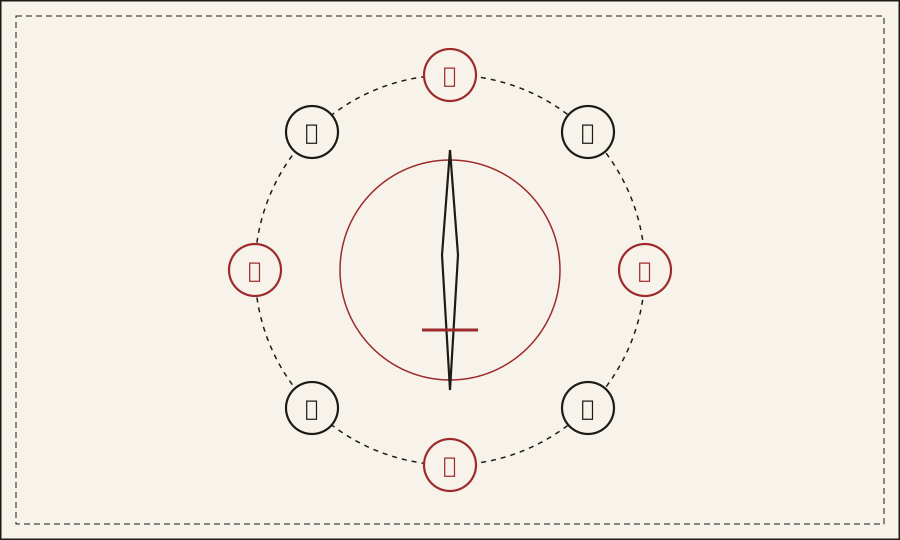
Numbers-only classical Wudang ink-and-cinnabar octagon diagram of the Eight Immortals Sword (Ba Xian Jian) posture archetypes around the central double-edged straight sword (①–⑧).

Classical Wudang diagram of the Eight Immortals Sword (Ba Xian Jian, numbers-only SVG key)

  1. ① Lü Dongbin (Upright Cloud-Sweep & Central Ci Thrust)
  2. ② Iron-Crutch Li (Asymmetrical Pivot & Low Reverse Beng Snap)
  3. ③ Han Zhongli (Fanning Horizontal Mo Draw-Slice)
  4. ④ Zhang Guolao (Retreating Step & Look-Back Thrust)
  5. ⑤ He Xiangu (Buoyant Empty Step & High Hanging Gua Parry)
  6. ⑥ Lan Caihe (Oblique Weaving & Low Basket-Scoop Liao Cut); ⑦ Han Xiangzi (Flute-Grip Alignment & Compact Wrist Dian Dot); ⑧ Cao Guojiu (Sunken Bow Stance & Level Tablet-Presenting Guard).

3. The Eight Immortal Posture Archetypes (Ba Xian Tai) and Their Sword Mechanics

Each of the Eight Immortal archetypes trains a specific coordination of waist, Sword-Fingers (剑指, Jianzhi), and blade edge: (1) Lü Dongbin (吕洞宾, Pure-Yang Sword) emphasizes expansive, upright figure-eight cloud sweeps and decisive central thrusts (刺剑); (2) Iron-Crutch Li (铁拐李, Gourd & Crutch) trains low, asymmetrical single-leg pivots and reverse-underhand upward snaps (崩剑) as if propping on a staff; (3) Han Zhongli (汉钟离, Fanning the Elixir Fire) uses broad horizontal drawing slices (抹剑) and fanning wrist arcs across the chest; (4) Zhang Guolao (张果老, Riding the Donkey Backward) specializes in retreating deceptive steps paired with sudden rearward look-back thrusts (回身刺); (5) He Xiangu (何仙姑, Holding the Lotus) refines high, buoyant empty steps and overhead hanging parries (挂剑 / 架剑); (6) Lan Caihe (蓝采和, Carrying the Flower Basket) practices low scooping cuts (撩剑) and nimble lateral weaving; (7) Han Xiangzi (韩湘子, Playing the Flute) trains close-body double-hand wrist alignment and compact dotting (点剑); and (8) Cao Guojiu (曹国舅, Presenting the Jade Tablet) cultivates dignified, sunken bow stances with level two-finger-and-hilt alignment.

4. Prerequisite Foundations, Safety Guidelines, and Wudang Curriculum Bridges

Safety note: Because Ba Xian Jian incorporates off-axis leaning, low twisted stances (Xiebu), and rapid backward-stepping thrusts, students should first master upright basic sword alignments and ankle-knee stability before attempting full-speed 'drunken' transitions. Begin by reviewing Wudang Straight Sword Eight Mother Techniques (Ba Mu Jian), Wudang Horsetail Whisk Fundamentals (Taiji Fuchen & Xuanwu Fuchen), and our Wudang Martial Arts Overview. For philosophical and post-training Daoyin integration, pair this guide with Achieve the Result Without Boasting or Forcing (Tao Te Ching Chapter 30) and Dry-Bathing the Face (Mo Mian / Gan Yumian) Daoyin Guide.

Seeker’s Q&A · Frequently Asked Questions

What is the core takeaway of Wudang Eight Immortals Sword Fundamentals (Ba Xian Jian)?

A comprehensive practitioner's guide to the Wudang Eight Immortals Sword (Ba Xian Jian), examining how the eight folk-Taoist Immortal archetypes encode distinct martial body mechanics, 'drunken in appearance yet sober in spirit' (Xing Zui Yi Bu Zui) footwork, and sudden wrist-snapping issuance.
