TRADITIONAL WEAPONS · 传统器械

Wudang Straight Sword Eight Mother Techniques (Ba Mu Jian): Structural Mechanics of Dian, Beng, Liao, Pi, Ci, Gua, Mo, and Tiao 武当剑法八母剑指南:点、崩、撩、劈、刺、挂、抹、挑的结构与劲路

A rigorous practitioner's guide to the Eight Mother Sword Techniques (Ba Mu Jian) of the Wudang straight sword (Jian)—Dian, Beng, Liao, Pi, Ci, Gua, Mo, and Tiao—detailing three-section blade anatomy, Sword-Fingers (Jianzhi) counter-balance, and flexible wrist-waist alignment.


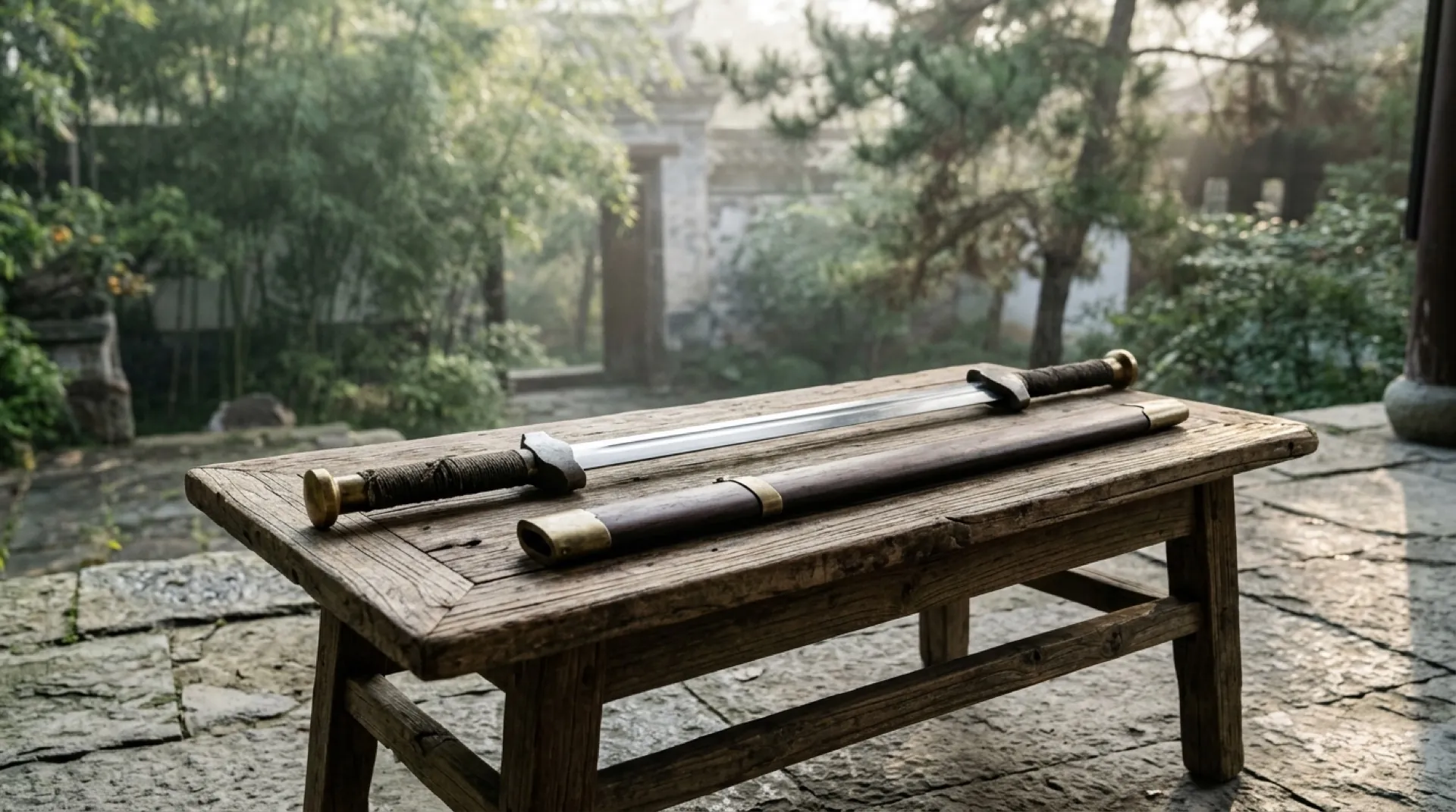
A Chinese straight sword (jian) lying drawn beside its scabbard on a weathered wooden table in a stone-paved courtyard, with pines and a gateway in the mist behind.

1. The Gentleman of Weapons: Three-Section Blade Anatomy and Sword-Fingers (Jianzhi) Alignment

While the long staff is known in Chinese martial culture as the ancestor of weapons, the double-edged straight sword (剑, Jian) is revered as the 'Gentleman of All Weapons' (百兵之君, Bai Bing Zhi Jun). Never relying on heavy, brute-force colliding against heavier battlefield blades, the Wudang straight sword prevails through evasive footwork (走化, zou hua), tactile sensitivity at the blade tip, and seamless coordination between the sword hand and the empty lead hand formed into 'Sword-Fingers' (剑指, Jianzhi—index and middle fingers extended together, with the thumb lightly sealing the ring and little fingers). Structurally, the blade is divided into three functional zones: the Sword Tip (剑锋 / 剑尖, Jianfeng, the front third used for precise thrusting, dotting, and flicking), the Middle Edge (中刃, Zhongren, used for slicing, drawing, and deflecting), and the Sword Root near the crossguard (剑根 / 护手, Jiangen, used for guarding the wrist and guiding close-gate parries). Whether practicing on the stone terraces of Wudang Mountain's UNESCO World Heritage ancient Taoist temples or in structured classes at Lee Wudang International Pte. Ltd., students begin by mastering the Eight Mother Sword Techniques (八母剑, Ba Mu Jian) before entering complex routines.

2. The First Four Mother Techniques: Dian (Point/Dot), Beng (Snap-Up), Liao (Scoop-Slice), and Pi (Split)

The first quartet of the Eight Mother Techniques trains vertical and arcuate expressions of wrist-and-waist elasticity: (1) Dian (点剑, Dotting/Pointing) raises the wrist slightly while sinking the shoulder and elbow, delivering a crisp downward tap of the very tip of the blade—like a dragonfly touching water or a calligrapher's brush forming a dot—aimed at an opponent's attacking wrist; (2) Beng (崩剑, Upward Flick/Snap) is the exact inverse of Dian, compressing ulnar wrist flexion into an abrupt radial upward snap of the blade tip from below, propelled by a sudden grounding of the rear root; (3) Liao (撩剑, Upward Scooping Slice) rotates the forearm in a full supine or pronated circle from below upward along the sagittal plane, grazing forward with the front third of the edge while the torso steps obliquely off the centerline; and (4) Pi (劈剑, Downward Splitting) extends the spine and waist to guide the blade from overhead downward along the central plane without locking the elbow or stiffly chopping from the shoulder.

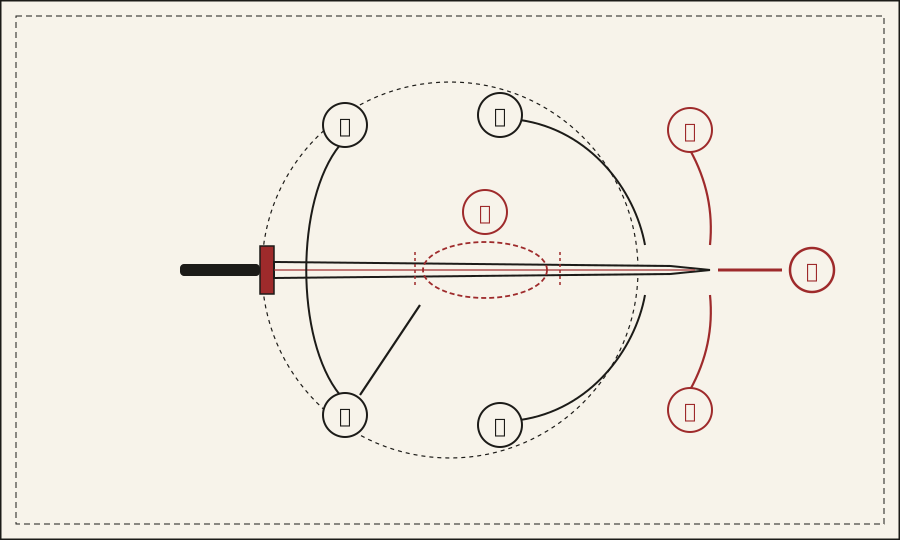
Numbers-only classical Wudang ink-and-cinnabar diagram of the Eight Mother Sword Techniques (Ba Mu Jian) and three-section blade anatomy (①–⑧).

Classical Wudang diagram of the Eight Mother Sword Techniques (numbers-only SVG key)

  1. ① Dian (Downward Tip-Pointing)
  2. ② Beng (Upward Tip-Snap)
  3. ③ Liao (Upward Arcuate Scoop-Slice)
  4. ④ Pi (Central Downward Split)
  5. ⑤ Ci (Central Linear Thrust along the Three Sections: Root, Middle Edge, and Tip)
  6. ⑥ Gua (Vertical Hanging Parry); ⑦ Mo (Horizontal Waist-Led Draw-Slice); ⑧ Tiao (Upward Diagonal/Vertical Blade Lift).

3. The Second Four Mother Techniques: Ci (Thrust), Gua (Hang/Hook-Parry), Mo (Horizontal Draw-Slice), and Tiao (Upward Lift)

The second quartet integrates linear penetration, protective parrying, and horizontal drawing: (5) Ci (刺剑, Linear Thrust) aligns the foot, kua, spine, shoulder, elbow, wrist, and sword tip into a single level or oblique line, while the opposite Sword-Fingers extend rearward or stabilize the forward wrist so the tip issues without tremor; (6) Gua (挂剑, Hanging Parry) drops the blade tip vertically downward and sweeps across the left or right flank of the body like a hanging curtain, deflecting incoming mid-to-low attacks away from the ribs and knees; (7) Mo (抹剑, Horizontal Drawing Slice) holds the blade flat (平剑) at chest or throat height and draws it horizontally in an arc from left to right or right to left driven purely by waist rotation; and (8) Tiao (挑剑, Upward Lifting) keeps the hilt low while tilting the wrist to lift the blade edge diagonally or vertically upward from underneath an incoming weapon.

4. Daily Solo Drills, Safety Principles, and Wudang Curriculum Bridges

Practice the Eight Mother Techniques as a continuous stepping line drill—pairing Dian with Beng, Gua with Ci, and Liao with Mo—always keeping the grip relaxed so the pommel can pivot inside the palm without clenching. To ground your sword practice in internal martial theory and Taoist philosophy, review our overview of Wudang Martial Arts, compare long-weapon leverage in Wudang Staff Fundamentals: Xuanwu Gun and Taiji Gun Guide, study the polarity of softness and strength in Know the Male, Keep to the Female (Tao Te Ching Chapter 28), and balance training with Tapping the Teeth and Swallowing the Jade Fluid (Kou Chi Yan Jin).

Seeker’s Q&A · Frequently Asked Questions

What is the core takeaway of Wudang Straight Sword Eight Mother Techniques (Ba Mu Jian)?

A rigorous practitioner's guide to the Eight Mother Sword Techniques (Ba Mu Jian) of the Wudang straight sword (Jian)—Dian, Beng, Liao, Pi, Ci, Gua, Mo, and Tiao—detailing three-section blade anatomy, Sword-Fingers (Jianzhi) counter-balance, and flexible wrist-waist alignment.
