TRADITIONAL WEAPONS · 传统器械

Wudang Taoist Horsetail Whisk (武当太极拂尘 Fuchen) Foundations: Sweeping Away Mental Dust, Soft-and-Firm Coiling Silk (Chanrao), and Waist-Led Figure-Eight Mechanics 武当太极拂尘(尘尾)精解:由“拂去心尘、刚柄柔丝”通向腰带腕花、缠绕圈拦与把底点打的内家奇门功法

How a daily Taoist monastic implement becomes a signature Wudang internal weapon uniting staff-handle precision, whip-like centrifugal flow, and straight-sword footwork.

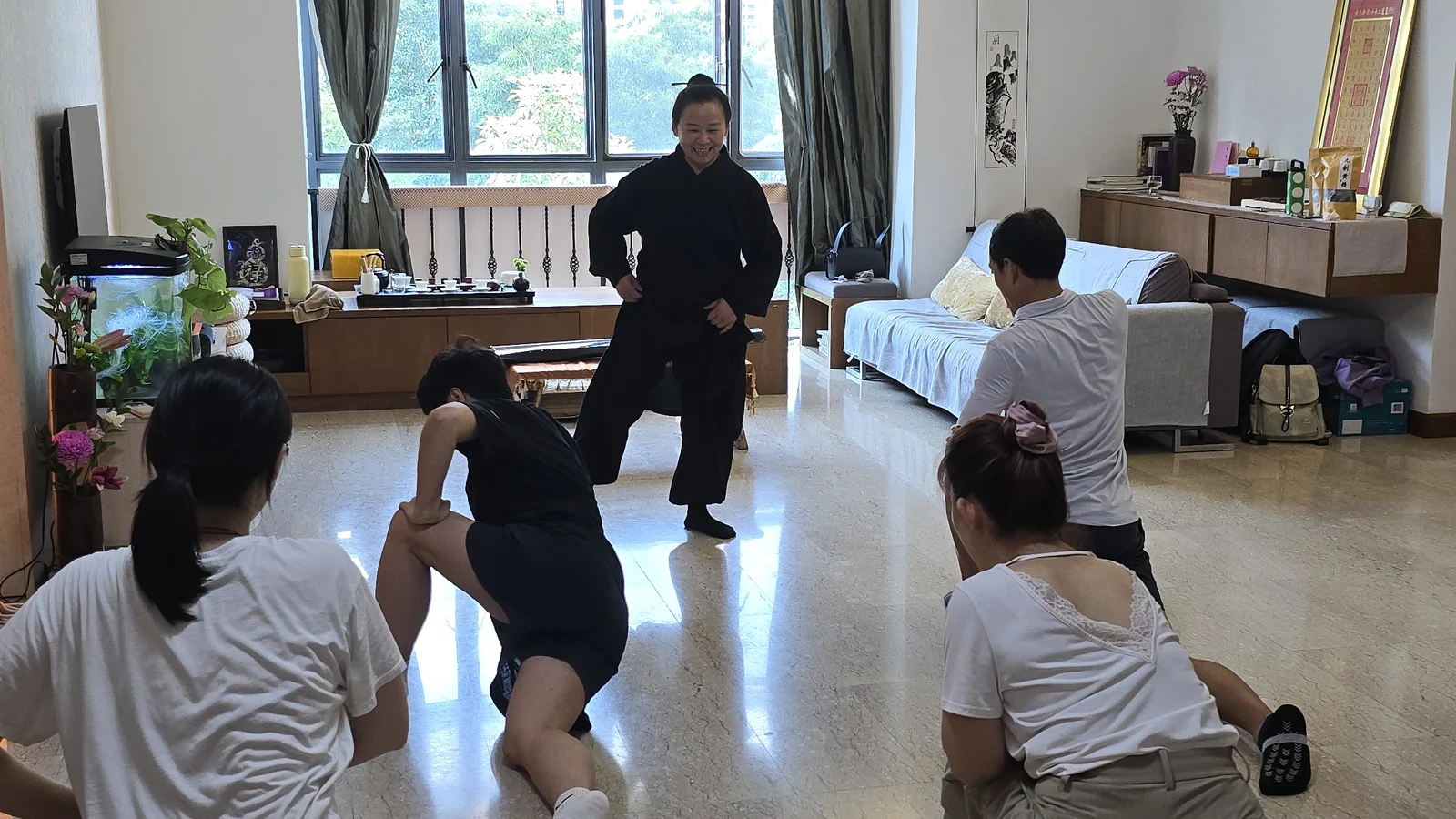
A Wudang taijiquan lesson in a sunlit room: students seen from behind kneel into deep lunges to open the hips while a teacher in black Taoist-style clothing stands in a wide stance, smiling, with an ink-painting scroll on the wall behind.

1. Cultural Origins and the Yin-Yang Anatomy of the Wudang Fuchen (拂尘)

To anyone who has visited the stone courtyards of Wudang Mountain or studied classical Chinese art, the Fuchen (拂尘, literally "Dust-Whisk") is immediately recognizable as the quintessential emblem of Taoist cultivation. Historically connected both to the Zhuwei (麈尾, the scholar's conversation whisk held during Wei-Jin philosophical dialogues on the Tao Te Ching and Zhuangzi) and to the practical monastic whisk carried by wandering Taoist adepts (Yunshui Daoren 云水道人), the Fuchen originally served two non-violent daily purposes:

  1. Outward Compassion (Li Er Buhai 利而不害): In mountain forests during summer, a practitioner uses the soft strands to gently wave away mosquitoes and flies rather than slapping and killing living creatures—directly embodying Chapter 81 of the Tao Te Ching ("The Way of Heaven benefits and does not harm").
  2. Inward Contemplative Reminder (Fu Qu Chen Lao 拂去尘劳): The two characters Fu Chen mean "to whisk away dust"—specifically the six sensory "dusts" (sights, sounds, odors, tastes, touches, and discursive attachments) that cloud the mirror of the heart-mind, echoing the Qingjing Jing (Cheng Qi Xin Er Shen Zi Qing) and the Huangting Jing.

When travelling adepts needed to defend themselves along mountain roads without carrying heavy iron blades, the Fuchen became a uniquely Taoist "soft-and-hard combined" (Ruan Ying Jian Shi 软硬兼施) martial instrument:

  • The Wooden Handle (Chenbing 尘柄 — Yang / Firmness): Turned from dense hardwood (such as jujube, pearwood, or ebony, typically 30 to 50 cm long), the handle functions at close range like a short staff, flute, or closed fan—capable of parrying a wrist, pressing an acupoint gate, or striking with its rounded pommel (Badou / Badi 把底).
  • The Flowing Strands (Chensi 尘丝 — Yin / Softness): Bound securely to the neck of the handle and extending 60 to 85 cm, the flexible strands (traditionally white horsetail hair or prepared plant hemp/agave fiber) hang completely weightless at rest. Yet when accelerated along a continuous spiral arc from the waist and wrist, the soft bundle gathers centrifugal momentum to coil around an incoming weapon (Chanrao 缠绕), sweep across the eyes (Sao 扫), or flick straight out like a darting spear tip (Dou Ci 抖刺)—proving Chapter 43 and Chapter 78 of the Tao Te Ching: "The softest thing in the world overrides the hardest."
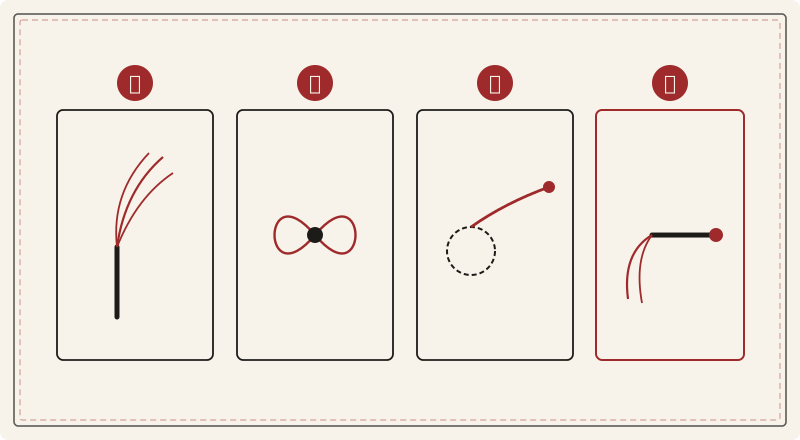
Classical four-panel Wudang Fuchen diagram illustrating the Yin-Yang structure of wooden handle and soft strands, waist-led figure-eight centrifugal arcs that prevent tangling, coiling-and-flicking extension, and handle-pommel reversal
Figure 1 — Biomechanical Architecture of the Wudang Fuchen (武当太极拂尘): ① Gang Bing Rou Si (刚柄柔丝 — Firm Handle & Soft Strands): the Yang hardwood handle paired with the Yin flexible strand bundle and left-hand Jianzhi; ② Yao Dai Wan Hua (腰带腕花 — Waist-Led Continuous Figure-Eight): tangent centrifugal arcs keeping the soft strands streaming smoothly without wrapping the arm; ③ Chanrao Yu Doufa (缠绕与抖发): circular coiling redirection followed by axial wave-like extension; ④ Badi Dianchui (把底点锤): reversing the handle so the strands drape softly back while the wooden pommel points forward.

2. Why Does the Whisk Tangle on Beginners? The Law of Continuous Tangent Momentum

Unlike a wooden Wudang straight sword (Jian), whose rigid blade stays straight even when you stop moving, the strands of a Fuchen have zero intrinsic stiffness. If a beginner swings the whisk forward, stops dead at an sharp corner, and pulls the hand straight back along the same line, the trailing strands collapse onto their own wrist, wrap around their elbow, or tangle in their collar!

To make the Fuchen flow "without scattering when slow, and without tangling when fast" (Man Bu San Si, Kuai Bu Chan Shen 慢不散丝,快不缠身), three classical Wudang principles are essential:

  1. Never Reverse Along a Dead Corner—Always Turn via a Rounded Loop (Yuan Zhuan Bu Zhe Jiao 圆转不折角): Whenever changing direction from left to right or from low to high, the handle must trace a small, smooth tangent curve (a "figure-eight" or teardrop loop) so centrifugal force keeps the tips of the strands gently tensioned in space.
  2. Use the Same "Alive Grip" (Huo Ba 活把) and Forearm Pivot as Jianfa: Hold the wooden handle 3–5 cm below the strand collar using a supple thumb-and-index ring while the ring and little fingers steer the pommel along the Houxi (SI-3) and Wangu (SI-4) ulnar line, allowing the radius and ulna to rotate freely through Neiguan (PC-6) and Waiguan (TE-5).
  3. Unify With the Left Sword Finger (Jianzhi 剑指): Just as in Wudang swordplay, the unarmed left hand forms the Jianzhi—either resting near the right wrist to cradle the handle during coiling turns, or extending in the opposite direction as a dynamic counterweight.
Core Fuchen TechniqueHandle & Strand TrajectoryWaist, Kua & Left Jianzhi CoordinationMartial & Contemplative Meaning
1. Vertical Figure-Eight Whisk Flowers (Li Wan Hua 立腕花)Shift weight left and right while guiding the handle in continuous vertical figure-eight loops beside the left and right ribs (18 loops each direction)Turn from the hips (Huantiao and Fengshi); left Jianzhi rests lightly near the solar plexus or opens to the sideTrains continuous centrifugal flow so the strands never slacken or tangle
2. Horizontal Sweeping & Wrapping (Ping Sao Chanrao 平扫缠绕)Step into a bow stance; sweep the strands horizontally across waist-to-chest height, then spiral the wrist inward in a 360-degree coiling circle (Chan 缠)Sink into the rear heel first; left Jianzhi touches the right inner wrist (Neiguan) during the coilEmbodies Huang Zongxi's 1669 Neijia principle Yi Jing Zhi Dong, wrapping and deflecting incoming force
3. Wave-Flick Extension (Dou Biao / Pi Chen 抖镖/劈尘)From a coiled chamber near the shoulder or waist, extend the arm along a smooth wave while closing the ring and little fingers on the handle pommelExhale into the lower abdomen as the left Jianzhi shoots backward along the opposite diagonalTransmits a whip-wave from the spine (Babei) to the very tips of the strands without snapping the elbow
4. Handle-Pommel Reversal (Dao Ba Dian Chui 倒把点锤)Fold the wrist so the strands drape softly backward along the outer forearm while the blunt wooden pommel (Badi) points forward at chest heightStep forward or settle into an empty stance while pressing the left Jianzhi palm-side against the forearmDemonstrates Yin-Yang reversal: when an opponent closes past the soft strands, the firm wooden handle is already in place

3. Three Common Beginner Mistakes and Wudang Corrections

  1. Snapping the Elbow Like a Bullwhip: Beginners often try to make a loud "crack" by jerking the elbow joint violently backward and forward. Correction: A harsh elbow jerk strains the joint ligaments and scatters the breath. In Wudang Fuchen, power travels as a smooth sine wave from the feet, through the waist and dorsal spine (just as in Shuangfeng Guan'er), and out through a relaxed wrist.
  2. Holding the Handle Too Far Down at the Bottom Tip: Gripping the very bottom end of the wooden handle makes the whisk top-heavy and prevents pommel reversals (Badi Dianchui). Correction: Grip the upper third of the handle near the strand collar so two-thirds of the wooden shaft rests smoothly along the palm and inner forearm when folded.
  3. Rushing Transitions When Draping Over the Shoulder (Bei Chen 背尘): When resting the strands over the shoulder or back in a stationary posture, wait an extra half-beat for the light strands to travel through the air and settle peacefully.

4. Living Heritage on Wudang Mountain and in Singapore

Across the morning courtyards of the UNESCO World Heritage ancient Taoist temples on Wudang Mountain (No. 72 Jianhe 2nd Road, Wudangshan, Hubei, China; UNESCO World Heritage guide) and traditional classes at Lee Wudang International Pte. Ltd. (58A Smith Street (2nd Floor), Singapore 058962; beginner guide), students who have built a solid foundation in Wudang Qigong, Taijiquan, and straight sword find the Fuchen an extraordinary teacher of timing: because the soft strands never lie, they show you instantly whether your waist and wrist are moving in unbroken harmony.

Practice Reflection for Students

If you do not have a Fuchen at home, hold a folded hand towel by one corner in your right hand and form the Jianzhi with your left: practice tracing slow, continuous vertical figure-eight loops on both sides of your body by turning your waist left and right—finding the exact, unhurried speed at which the cloth stays smoothly extended without ever dropping limp.

Seeker’s Q&A · Frequently Asked Questions

What is the Taoist horsetail whisk (拂尘 Fuchen), and how is it used in Wudang practice?

The Fuchen is the “dust-whisk” carried by Taoist adepts: a hardwood handle of 30 to 50 cm with a bundle of soft strands 60 to 85 cm long, traditionally white horsetail hair or plant fiber. Its first uses are peaceful: waving insects away instead of killing them, and reminding the holder to “whisk away the dust” that clouds the heart-mind. As a Wudang internal-arts instrument it joins the firm handle (Yang) to the soft strands (Yin): moved in continuous figure-eight loops led by the waist, the strands coil, sweep or flick, while the handle parries or strikes with its pommel. Because the strands show at once whether waist and wrist move together, it suits students who already have a foundation in Qigong, Taijiquan and straight sword.


How can I apply this in practice?

If you do not have a Fuchen at home, hold a folded hand towel by one corner in your right hand and form the Jianzhi with your left: practice tracing slow, continuous vertical figure-eight loops on both sides of your body by turning your waist left and right—finding the exact, unhurried speed at which the cloth stays smoothly extended without ever dropping limp.
