TRADITIONAL WEAPONS · 传统器械

Wudang Taiji Jian Sword-Fingers Mudra (Jianjue / Jianzhi) & Two-Hand Coordination: Why the Left Hand Is Half the Sword 武当太极剑“左手剑诀(剑指)”与双手开合要领:为何“单剑全凭双手练”?

Learn how to form the traditional Wudang Sword-Fingers hand seal (Jianjue / Jianzhi) and coordinate the left hand with the right sword hand through opening-closing counterbalance, wrist support, and gaze alignment.


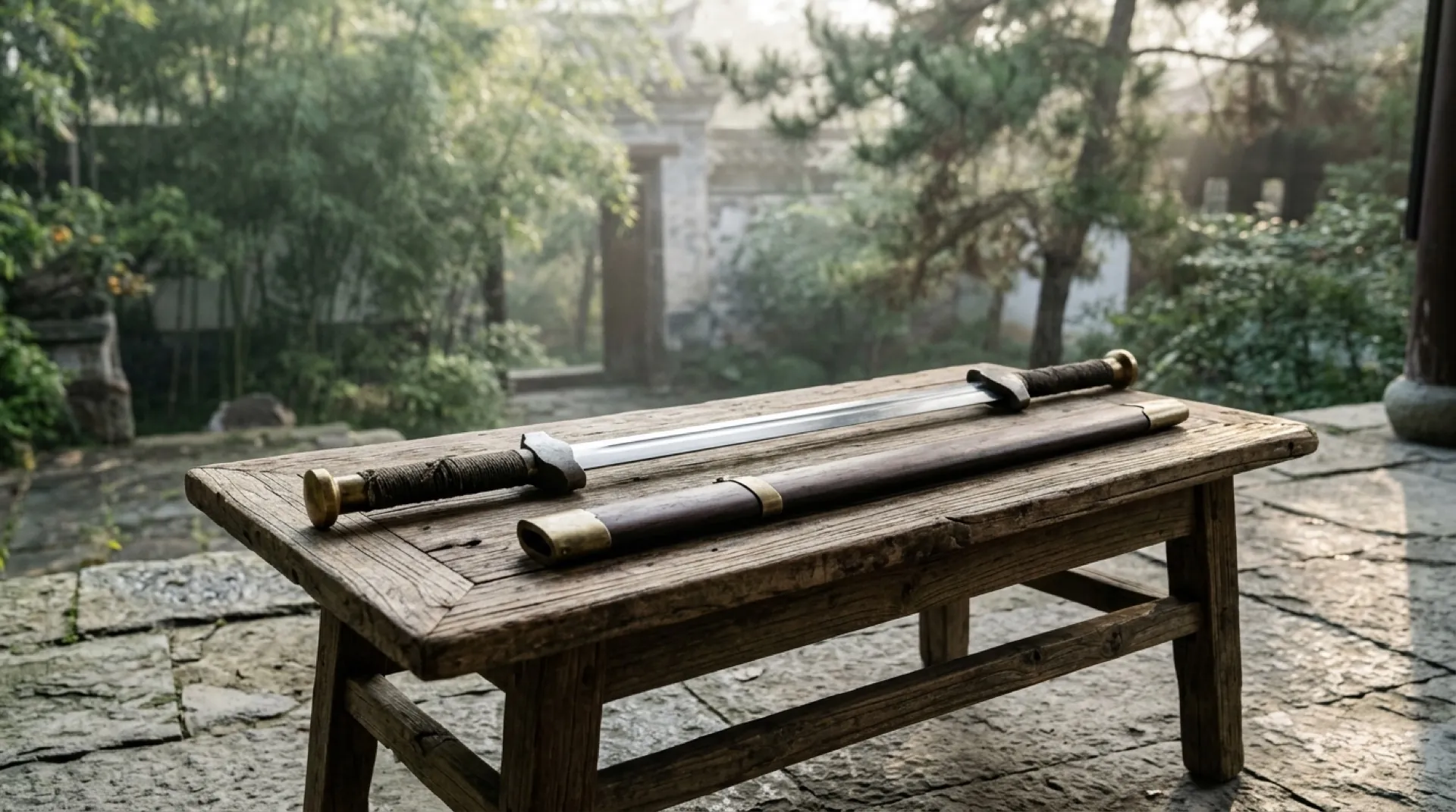
A Chinese straight sword (jian) lying drawn beside its scabbard on a weathered wooden table in a stone-paved courtyard, with pines and a gateway in the mist behind.

1. 'A Single Sword Needs Two Hands': Why the Left Hand Never Hangs Idle

When beginners pick up a straight sword (jian 剑) to study Wudang Taiji Jian Fundamentals, ninety percent of their attention rushes into the right hand holding the hilt, leaving the left arm dangling lifelessly at their side. In traditional Wudang sword transmission, teachers correct this immediately with an old saying: 'Though the straight sword is a single-handed weapon, half the skill lives in the left hand' (dan jian shuang shou lian, zuo shou ban ba jian 单剑双手练,左手半把剑).

That left hand is shaped into the classic Taoist and martial hand seal known as Sword-Fingers (Jianjue 剑诀 or Jianzhi 剑指)—serving simultaneously as a meridian circuit, a dynamic counterweight across the spine, a secondary striking and guarding tool, and a brace for the sword wrist.

2. How to Form the Sword-Fingers Mudra (Jianjue) Without Stiffness

To form Jianjue correctly, extend your index finger (shizhi) and middle finger (zhongzhi) side by side so they are straight, unified, and softly energized—never hyperextended or rigid. Curve your ring finger (wumingzhi) and little finger (xiaozhi) inward toward the palm, and rest the pad of your thumb (muzhi) gently across the fingernails or middle knuckles of the ring and little fingers, leaving a small hollow space inside the center of the palm (Laogong, as in our Wrist and Finger Spiral Meridian Daoyin).

In meridian terms, extending the index and middle fingers lengthens the Large Intestine and Pericardium channels (connecting to Shanzhong and Neiguan in the chest and forearm), while sealing the ring and little fingers with the thumb unifies the Lung, Triple Burner, Heart, and Small Intestine lines—preventing qi from leaking out of the unengaged hand.

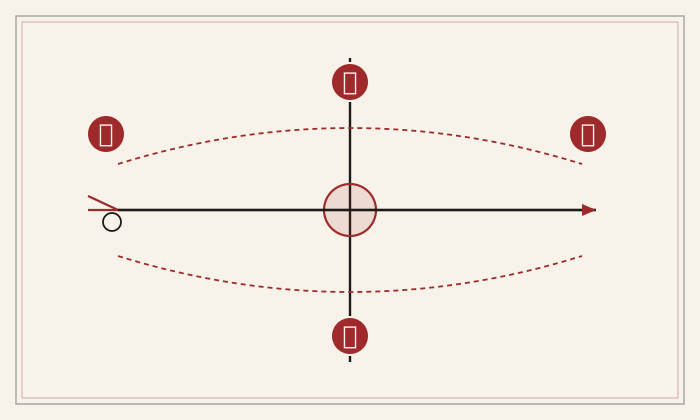
Classical diagram of Wudang Taiji Jian two-hand coordination showing the left-hand Sword-Fingers mudra (Jianjue), the central spinal axis, the right-hand straight sword, and the opening-closing counterbalance arc

Why the left hand is half the sword in Wudang Taiji Jian: ① Left-Hand Sword-Fingers Mudra (Jianjue), ② Central Spinal Axis, ③ Right-Hand Sword Tip, and ④ Two-Wing Opening-Closing Arc.

  1. ① Left-Hand Sword-Fingers (Jianjue / Jianzhi): Index and middle fingers extended together while the thumb gently seals the ring and little fingers.
  2. ② Central Spinal Axis (Zhongding): The upright pivot through which left-hand and right-hand forces balance each other.
  3. ③ Right-Hand Sword Extension (Jianfeng): The live grip transmitting waist power to the tip.
  4. ④ Two-Wing Counterbalance Arc (Kaihe Xiangsui): Opening symmetrically like a phoenix spreading wings and closing to support the right wrist.

3. The Three Coordinations of Sword-Fingers and Blade: Counterbalance, Bracing, and Leading

Across the postures of Basic Cuts (Ci, Pi, Dian, Liao), Circular Deflections (Gua, Yun, Mo), Drawing & Lifting Blades (Chou, Dai, Ti, Ge), and Intercepting & Coiling Blades (Jie, Jiao, Tuo, Chan), the left Jianjue interacts with the right sword hand in three primary ways:

1. Opposite-Direction Counterbalance (Qianhou Duila): When the right sword thrusts forward (Ci) or chops forward (Pi), the left Jianjue extends backward and slightly upward along the opposite diagonal. Like a bird spreading both wings from the shoulder blades (Babei), this two-way pull keeps your Central Equilibrium (Zhongding) from leaning forward after the heavy steel blade.

2. Supporting the Wrist (Fuwan Zhuli 附腕助力): During compact parries (Ge), upward supports (Tuo), or preparation coils, the fingertips of the left Jianjue lightly touch the inside of the right forearm or wrist (Neiguan area), unifying both arms into a single structural arch.

3. Leading the Gaze and Dividing over the Crown (Lingmu Fenjian): Often the eyes first follow the left Jianjue as it circles overhead to clear the upper line before the right sword issues forward—fulfilling the Six Harmonies (Liuhe) between eyes, hands, and waist.

4. Solo Practice: The 'Two-Wing Phoenix' Mirror Drill

Even without a sword in hand, you can train Jianjue coordination in three minutes: form Sword-Fingers with both hands, stand in a left bow stance, and practice touching both wrists together in front of your lower dantian on the inhale, then spiraling both arms open in opposite directions from the center of your upper back on the exhale. When you pick up your wooden practice sword, keep that exact symmetrical feeling alive between your left fingertips and the right sword tip.

Safety note: keep the shoulders relaxed downward and avoid locking the elbows; this instructional guide is for educational martial arts study.

Seeker’s Q&A · Frequently Asked Questions

What is the core takeaway of Wudang Taiji Jian Sword-Fingers Mudra (Jianjue / Jianzhi) & Two-Hand Coordination?

Learn how to form the traditional Wudang Sword-Fingers hand seal (Jianjue / Jianzhi) and coordinate the left hand with the right sword hand through opening-closing counterbalance, wrist support, and gaze alignment.
