
TRADITIONAL WEAPONS · 传统器械

Wudang Staff Fundamentals (Xuanwu Gun & Taiji Gun): Eyebrow-Height Staff, Yin-Yang Grip, and Coiling-Sweeping Mechanics (Lan, Na, Zha, Sao) 武当玄武棍与太极棍基础指南:齐眉度法、阴阳把与“拦拿扎扫”核心劲路

A comprehensive technical guide to Wudang staff training (Xuanwu Gun and Taiji Gun), covering traditional eyebrow-height sizing (Qimei Gun), the Three Sections (Ba, Zhong, Shao), Yin-Yang grip transitions, and the core four techniques of Lan, Na, Zha, and Sao.


An empty timber hall with dark wooden pillars and a plank floor, its lattice doors standing open onto a green courtyard.

1. The Ancestor of All Weapons: Eyebrow-Height Sizing and Three-Section Anatomy

In Chinese martial history, the long staff (棍, Gun) is revered as the 'Ancestor of All Weapons' (百兵之祖, Bai Bing Zhi Zu), because its linear thrusts, spiraling coils, and levered sweeps form the structural foundation for the spear (枪, Qiang), halberd, and sword. In Wudang courtyard practice—spanning both the dynamic Xuanwu Staff (玄武棍) and the continuous, circular Taiji Staff (太极棍)—the standard training weapon is the Eyebrow-Height Staff (齐眉棍, Qimei Gun), cut from resilient white wax wood (白蜡杆, Bailagan) so that when stood vertically beside the practitioner's foot, its tip reaches cleanly between the eyebrows. Structurally, the staff is divided into Three Sections (三节): the Butt Section (把段, Ba Duan) held near the rear hip and Dantian, the Middle Section (中段, Zhong Duan) which acts as the fulcrum and defensive shield, and the Tip Section (梢段, Shao Duan) which expresses listening energy (听劲, Tingjin) and penetrating issuance. Unlike heavy battlefield poles that rely on brute upper-body swinging, a properly seasoned white wax wood staff possesses slight elastic flex, requiring the practitioner to transmit whole-body waist-and-kua torque smoothly from root to tip.

2. Yin-Yang Grip Architecture (Yin-Yang Ba) and Sliding-Hand Leverage (Hua Ba)

The secret of Wudang staff agility lies in how the two hands relate along the shaft through the Yin-Yang Grip (阴阳把, Yin-Yang Ba): one hand holds with the palm facing downward (Yang grip, 阳把) while the other holds with the palm facing upward (Yin grip, 阴把), typically spaced one forearm's length apart during basic guarding postures. Rather than clamping all five fingers tightly around the wood—which locks the shoulders and kills the spiral rotation of the shaft—power is guided primarily through the 'tiger's mouth' (虎口, Hukou, between thumb and index finger) and the ring-and-little-finger coil, allowing the wrist to roll freely. During transitions between long-range thrusting and close-quarter double-ended striking (两头蛇, 'Two-Headed Snake'), the hands execute Sliding-Grip Exchanges (滑把, Hua Ba / 换把, Huan Ba), gliding seamlessly along the wax wood surface without losing tactile contact or structural connection to the Mingmen (命门) lumbar axis.

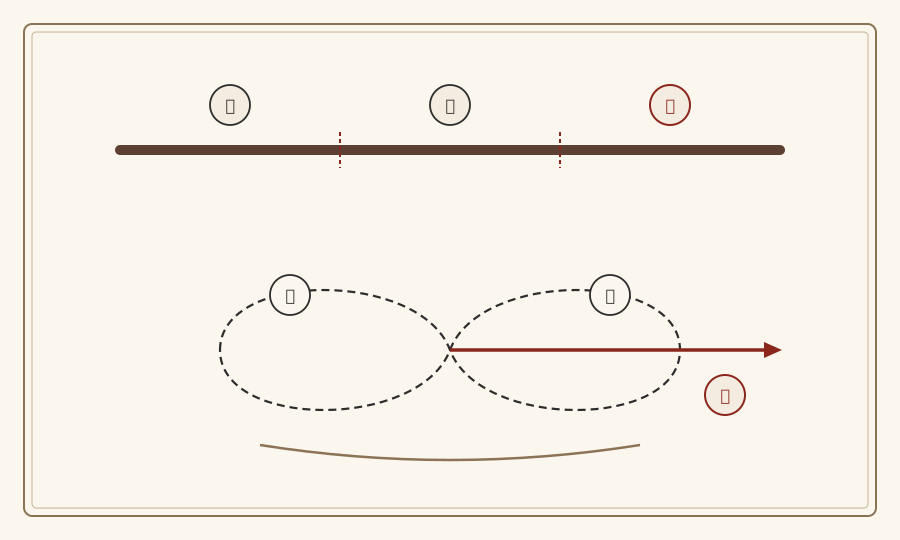
Technical diagram of Wudang Staff (Xuanwu Gun & Taiji Gun): Eyebrow-Height Three Sections (Ba, Zhong, Shao), Yin-Yang Grip, and the Figure-Eight Coiling Path of Lan (Intercept), Na (Press-Capture), Zha (Central Thrust), and Sao (Low Sweep).

Technical diagram of Wudang Staff (Xuanwu Gun & Taiji Gun): Eyebrow-Height Three Sections (Ba, Zhong, Shao), Yin-Yang Grip, and the Figure-Eight Coiling Path of Lan (Intercept), Na (Press-Capture), Zha (Central Thrust), and Sao (Low Sweep).

  1. ① Butt Section (把段, Ba Duan): held near the rear hip and Dantian
  2. ② Middle Section (中段, Zhong Duan): the fulcrum and defensive shield
  3. ③ Tip Section (梢段, Shao Duan): listening energy and penetrating issuance
  4. ④ Lan (拦): the outward coiling interception, one loop of the figure-eight
  5. ⑤ Na (拿): the inward pressing capture, the returning loop
  6. ⑥ Zha (扎) and Sao (扫): the straight thrust along the centerline, with the arc of the low sweep beneath it

3. Core Coiling & Sweeping Mechanics: Lan (Intercept), Na (Press-Capture), Zha (Thrust), and Sao (Sweep)

At the heart of both Wudang Taiji Gun and Xuanwu Gun lies the classical four-part sequence of Lan (拦, outward coiling interception), Na (拿, inward pressing capture), Zha (扎, central linear thrust), and Sao (扫, low horizontal sweep). Lan draws an inward-to-outward protective arc across the centerline driven by an opening rotation of the waist and rear kua, deflecting an incoming strike toward the outside gate; Na immediately reverses the spiral inward and downward, adhering to and pressing the opponent's weapon shaft to neutralize their leverage; Zha releases stored elastic energy straight down the centerline from the rear foot through the spine and rear hand (把, Ba) while the lead hand guides the tip like a sighting ring; and Sao drops the pelvis into a low bow or pu-bu stance to sweep the staff horizontally at ankle height, balancing upper-body verticality with grounded rotational momentum. When practiced as a single continuous drill (拦拿扎练习), Lan, Na, and Zha form a compact figure-eight coil at the tip no wider than the practitioner's shoulders, ensuring every defense is simultaneously a coiled preparation to issue.

4. Training Progression, Safety Checkpoints, and Wudang Weapon Cross-References

Begin each session with ten minutes of single-posture Lan-Na-Zha coiling on both left and right leads, verifying that the staff tip neither wobbles vertically during the Zha thrust nor pulls the torso forward past the front knee. To connect staff footwork with philosophical and internal foundations, pair this guide with A Good Traveler Leaves No Tracks: Knotless Skill in Tao Te Ching Ch. 27 and Wudang Taijiquan Thirteen Postures (Shisan Shi): Eight Gates and Five Steps. After vigorous weapon rounds, cool down the shoulders and Triple Burner meridian channels with Soothing the Triple Burner (Sanjiao) and Twilight Xi-Breath Daoyin Guide.

Seeker’s Q&A · Frequently Asked Questions

What is the core takeaway of Wudang Staff Fundamentals (Xuanwu Gun & Taiji Gun)?

A comprehensive technical guide to Wudang staff training (Xuanwu Gun and Taiji Gun), covering traditional eyebrow-height sizing (Qimei Gun), the Three Sections (Ba, Zhong, Shao), Yin-Yang grip transitions, and the core four techniques of Lan, Na, Zha, and Sao.
