QIGONG & YANGSHENG · 气功与导引

Wudang Wrist & Finger Spiral Daoyin (Huowan Shuzhi): Releasing Forearm and Hand Stiffness While Awakening the Arm Meridians 武当“活腕舒指”缠丝导引术:疏通手三阴三阳经与缓解腕指僵劳的练习

Grounded in the Taijiquan Lun's 'expressed in the fingers' and Wudang silk-reeling (Chansijin) mechanics, learn a gentle wrist-rotating and finger-coiling Daoyin routine for desk workers and internal martial artists.


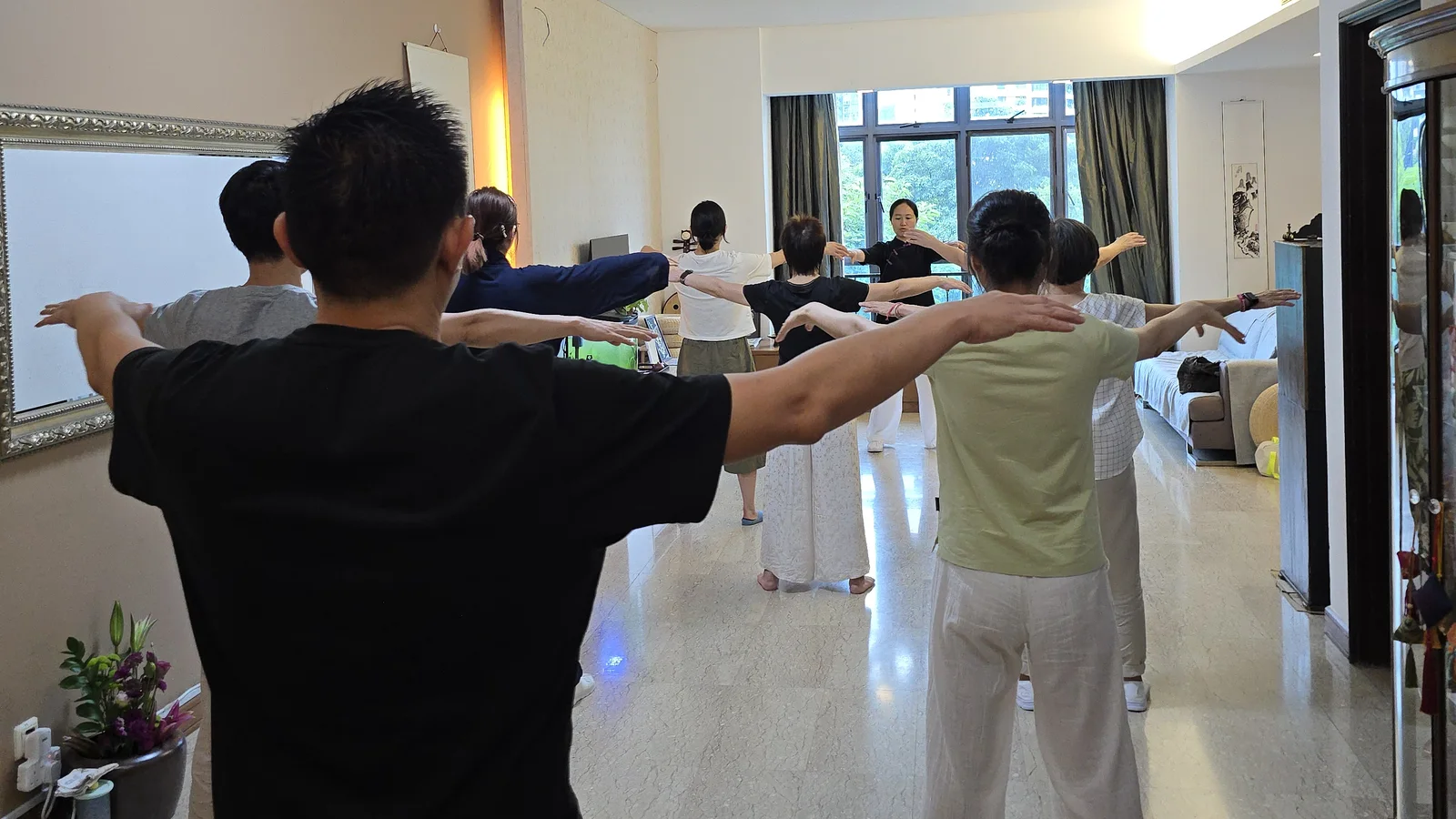
A standing qigong class in a sunlit room: students seen from behind hold both arms open at shoulder height in the same alignment, facing a teacher in dark clothing before a tall window with green trees outside.

1. Classical Principles: Why Internal Force Is 'Expressed in the Fingers' (Xing Yu Shouzhi)

In Wang Zongyue's Taijiquan Lun, the classic chain of whole-body power concludes at the hands: 'Its root is in the feet, issued through the legs, governed by the waist, and expressed in the fingers' (xing yu shouzhi 形于手指). In traditional meridian theory, the fingertips and wrist creases are the meeting gates where the Three Yin meridians of the hand (Lung, Pericardium, and Heart—flowing from the chest to the fingers) connect with the Three Yang meridians of the hand (Large Intestine, Triple Burner, and Small Intestine—returning from the fingers to the head).

When hours of keyboard typing, mouse clicking, or phone gripping lock the wrist flexors and stiffen the finger joints, both local tendon glide and upper-limb circulation become congested. In Wudang Qigong and sword training, practitioners cultivate Huowan Shuzhi (活腕舒指, 'enlivening the wrists and unfolding the fingers') alongside Silk-Reeling Energy (Chansijin) and desk neck and shoulder Daoyin relief so that warmth and suppleness reach all the way to the fingertips.

2. 'Sitting the Wrist' (Zuowan) vs. Floppy or Rigid Hands

Before practicing dynamic wrist circles, it helps to understand the Wudang structural alignment known as Zuowan (坐腕, 'sitting the wrist') and Shuzhi (舒指, 'extending the fingers comfortably'). A common misconception in beginners' Taijiquan and Qigong is that relaxation (Song 松) means letting the hands hang limp like wilted leaves, or conversely, hyperextending the fingers backward like rigid boards.

In authentic Wudang practice—whether forming the open Taiji palm, the hook hand of Single Whip (Danbian), or the flexible grip of Wudang Taiji Jian—the wrist settles gently with a subtle dorsal curve while the center of the palm (Laogong 劳宫) remains slightly hollow and the fingers lengthen softly with space between them.

3. Three-Part Wudang Wrist & Finger Spiral Daoyin Routine

You can practice this four-minute sequence seated at your desk or standing in a relaxed shoulder-width stance:

1. Lotus-Wrist Silk-Reeling Circles (Xuanwan Chansi 旋腕缠丝): Hold both forearms lightly in front of your lower ribs with elbows sunk (Zhuizhou). Touch the tips of the middle fingers and thumbs lightly together or keep the palms soft, and roll the wrists in slow, continuous figure-eight circles—nine times spiraling inward toward the chest (Shunchan) and nine times spiraling outward (Nichan)—letting the motion flow smoothly through the forearm bones (radius and ulna) without hiking the shoulders.

2. Sequential Finger Unfurling (Wuzhi Bomo 五指拨浪): Beginning with the little finger (Heart and Small Intestine meridian tips), curl each finger sequentially into the hollow of the palm—little finger, ring finger, middle finger, index finger, thumb—and then unfurl them one by one like fern fronds opening in spring, finishing with a gentle sitting of the wrist (Zuowan). Repeat nine cycles in each direction.

3. Pressing and Releasing the Laogong & Hegu Gates: Finish by gently massaging the center of each palm (Laogong) and the fleshy web between thumb and index finger (Hegu 合谷) with the opposite thumb for six slow breaths.

4. Breath Coordination & Carpal Safety Guidelines

Coordinate your breath naturally with the opening and gathering of the hands: inhale softly as the fingers curl inward and the wrists gather toward the centerline, and exhale slowly as the wrists settle and the fingers lengthen outward, feeling a gentle warmth or tingling (Qi sensation) fill the palms.

Safety note: never force the wrists into extreme flexion or bear heavy body weight on bent wrists; if you have acute carpal tunnel syndrome, tendonitis, or wrist arthritis, keep the rotations small, slow, and strictly within a pain-free range. This traditional Daoyin guide is for educational movement wellness and does not replace medical care or occupational therapy.

Seeker’s Q&A · Frequently Asked Questions

What is the core takeaway of Wudang Wrist & Finger Spiral Daoyin (Huowan Shuzhi)?

Grounded in the Taijiquan Lun's 'expressed in the fingers' and Wudang silk-reeling (Chansijin) mechanics, learn a gentle wrist-rotating and finger-coiling Daoyin routine for desk workers and internal martial artists.
