QIGONG & YANGSHENG · 气功与导引

Dry-Bathing the Face (Mo Mian / Gan Yumian): Warming the Laogong Palms and Harmonizing the Yang Meridians in the Yangxing Yanming Lu 摩面(干浴面):《养性延命录》劳宫温煦头面与晨起开窍导引指南

A primary-source practical guide to the classical Taoist morning self-massage of Dry-Bathing the Face (Gan Yumian / Mo Mian), grounded in Tao Hongjing's Yangxing Yanming Lu, detailing Laogong (PC-8) palm friction, gentle circular facial sweeping, and integration with Ming Tiangu and Kou Chi Yan Jin.


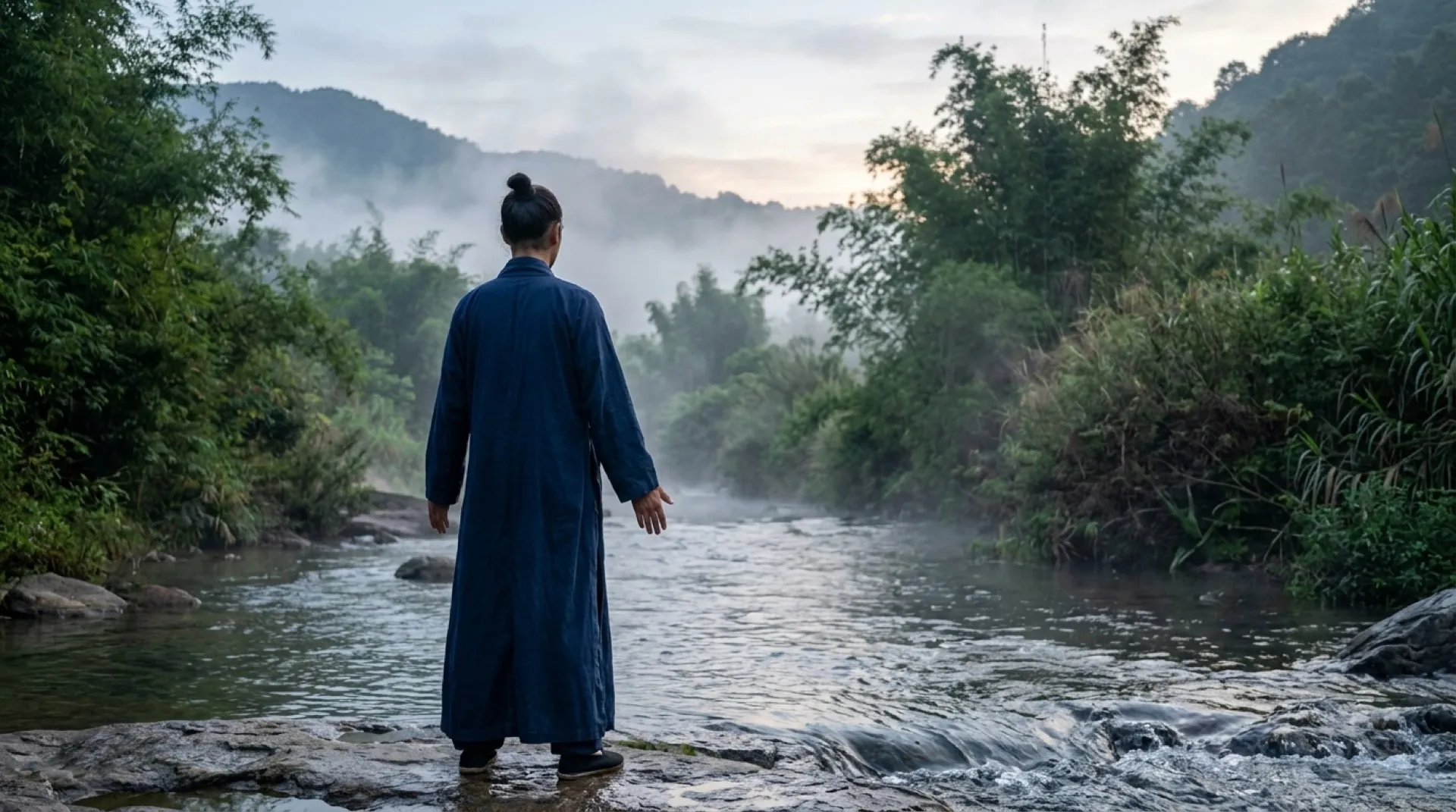
A figure in a long indigo robe with hair tied in a topknot, seen from behind, standing at the edge of a shallow misty mountain stream among bamboo.

1. Primary Textual Foundations: 'Dry-Bathing the Face' (Gan Yumian) in Tao Hongjing's Yangxing Yanming Lu

In classical Taoist longevity manuals and the daily morning liturgy of Wudang Mountain, 'Rubbing the Face' (摩面, Mo Mian) or 'Dry-Bathing the Face' (乾浴面, Gan Yumian) forms the closing movement of the awakening triad alongside Tapping the Teeth (叩齿, Kou Chi) and Beating the Heavenly Drum (鸣天鼓, Ming Tiangu). In the Daoyin and Self-Massage treatise of the Yangxing Yanming Lu (《养性延命录·导引按摩篇》), Tao Hongjing (陶弘景, 456–536 CE) records the foundational method: 'Rub the hands together until hot, then use them to rub the face from top to bottom repeatedly; this brings a warm luster to the countenance and is called Dry-Bathing the Face (摩手令热,以摩面,从上至下,无数,令人面上有光泽,名为乾浴面).' Similarly, the Huangting Neijing Jing (《黄庭内景经》) emphasizes that all sensory gates of the countenance—eyes, ears, nose, and mouth—are governed by the upper spirit chamber and thrive when kept warm, calm, and unhurried.

2. Traditional Meridian Context: The Convergence of All Yang Channels on the Countenance

According to the Huangdi Neijing Lingshu (《黄帝内经·灵枢·邪气藏腑病形》), 'All Yang channels of the twelve regular meridians ascend to meet at the head and face' (诸阳之会皆在于面)—including the Stomach meridian framing the nose, cheeks, and jaw; the Bladder meridian rising from the inner canthus of the eyes (Jingming, 睛明, BL-1) over the forehead to the crown; the Gallbladder meridian at the temples (Taiyang and Tongziliao); and the Large and Small Intestine meridians beside the nostrils (Yingxiang, 迎香, LI-20) and cheekbones. Simultaneously, the center of each palm houses Laogong (劳宫, PC-8) on the Pericardium channel. Briskly rubbing the palms together until warm and sweeping them gently across the forehead, orbits, nose bridge, and cheeks transfers soothing manual warmth across the superficial facial fascia, easing morning stiffness in the jaw and brow. Safety note: Gan Yumian is a gentle traditional Taoist self-care and relaxation practice, not a dermatological or medical treatment.

3. Step-by-Step Wudang Execution: Warming Laogong, Ascending the Nose Bridge, and Descending the Cheeks

As practiced in morning Daoyin routines associated with Wudang Mountain's UNESCO World Heritage ancient Taoist temples and taught in Singapore at Lee Wudang International Pte. Ltd., perform Gan Yumian with clean, dry hands seated or standing in Wuji posture: (1) Relax the shoulders and rub both palms briskly together for ten to fifteen seconds until the Laogong (PC-8) centers feel distinctly warm; (2) Cup both warm palms softly over the closed eyes for one quiet breath without pressing on the eyeballs; (3) Inhale gently as the middle and ring fingers glide upward along both sides of the bridge of the nose (passing Yingxiang LI-20 and Jingming BL-1) up to the hairline and forehead; (4) Exhale smoothly as the full palms sweep outward across the temples and descend softly down the cheeks and jawline back to the chin, as if washing the face with warm spring water; (5) Repeat eighteen or thirty-six times at a calm, unhurried pace, then rest both palms over the Lower Dantian.

4. Completing the Morning Triad & Cross-References Across the Wudang Curriculum

When combined in sequence—first Tapping the Teeth and Swallowing the Jade Fluid (Kou Chi Yan Jin), second Beating the Heavenly Drum (Ming Tiangu), and third Dry-Bathing the Face (Gan Yumian)—practitioners complete the classic five-minute Wudang seated awakening or post-standing closing seal. Explore further guides at our Wudang Wellness & Qigong Overview, reflect on non-coercive sufficiency in Achieve the Result Without Boasting or Forcing (Tao Te Ching Chapter 30), and study Wudang Eight Immortals Sword Fundamentals (Ba Xian Jian).

Seeker’s Q&A · Frequently Asked Questions

What is the core takeaway of Dry-Bathing the Face (Mo Mian / Gan Yumian)?

A primary-source practical guide to the classical Taoist morning self-massage of Dry-Bathing the Face (Gan Yumian / Mo Mian), grounded in Tao Hongjing's Yangxing Yanming Lu, detailing Laogong (PC-8) palm friction, gentle circular facial sweeping, and integration with Ming Tiangu and Kou Chi Yan Jin.
